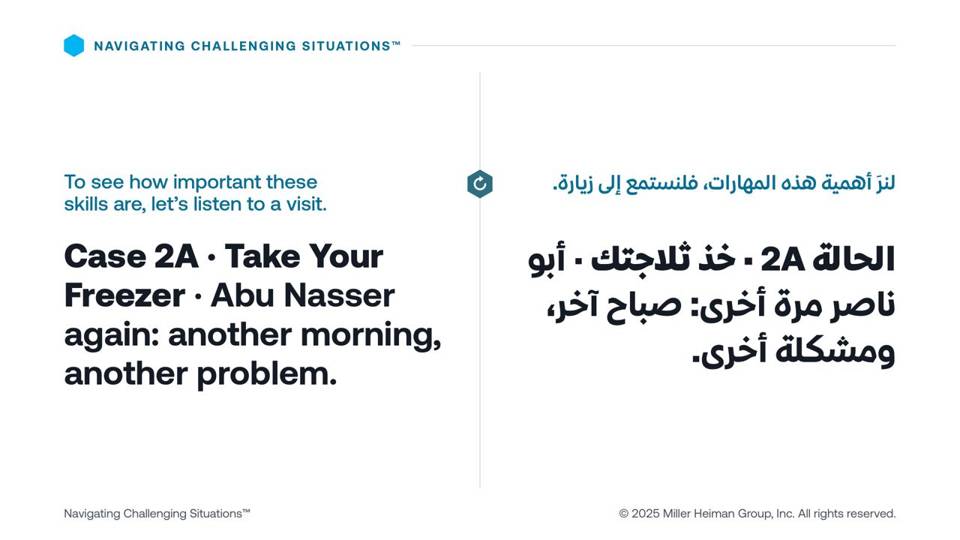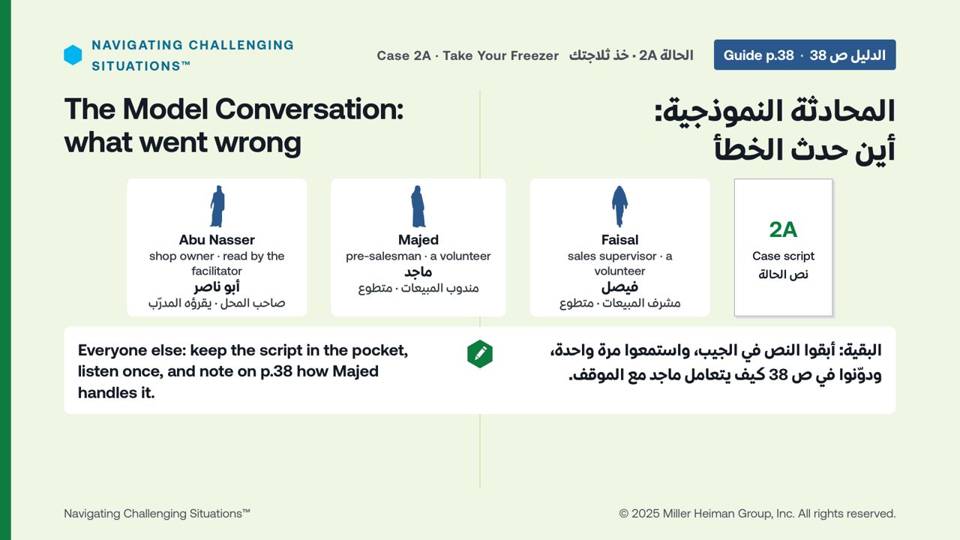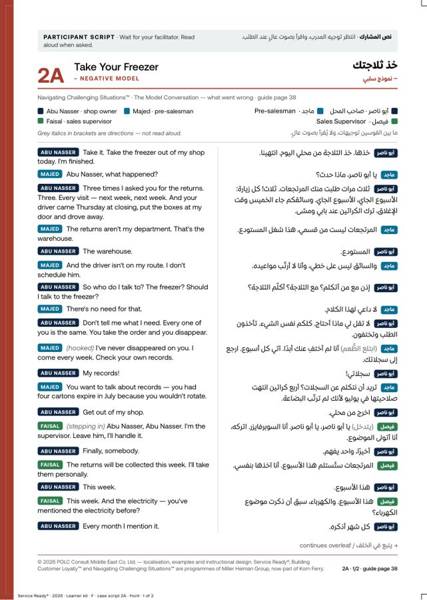
Service Ready® · Facilitator Guide

Virtual day on Teams · Building Customer Loyalty™ and Navigating Challenging Situations™ · 179 slides (415 pages with every build step). Each card shows the real slide, the page or card the learners use, and what you do. The slide tells you what to ask; you run it your own way.

The day

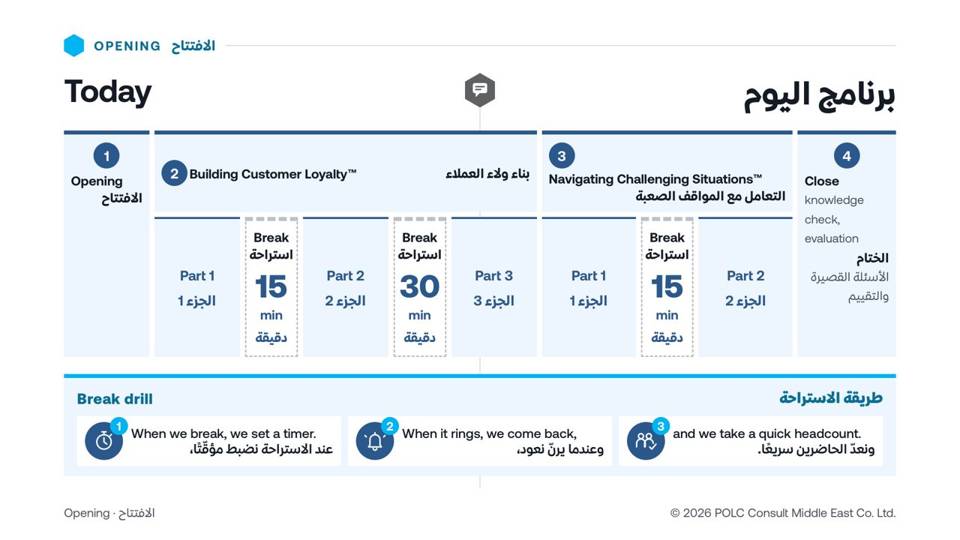
Opening→Building Customer Loyalty™ · Part 1→Break 15→Part 2→Break 30→Part 3→Bridge→Navigating Challenging Situations™ · Part 1→Break 15→Part 2→Close

Planned (Riyadh time): start 8:30 · breaks 10:00 (15 min), 11:30 (30 min), 14:00 (15 min) · finish 16:00. The slides show only the break lengths; say the times aloud. The producer confirms them for each run.

Who is in the room

  • Learners join in groups from depot conference rooms (screen, camera, mic), each with the printed kit.
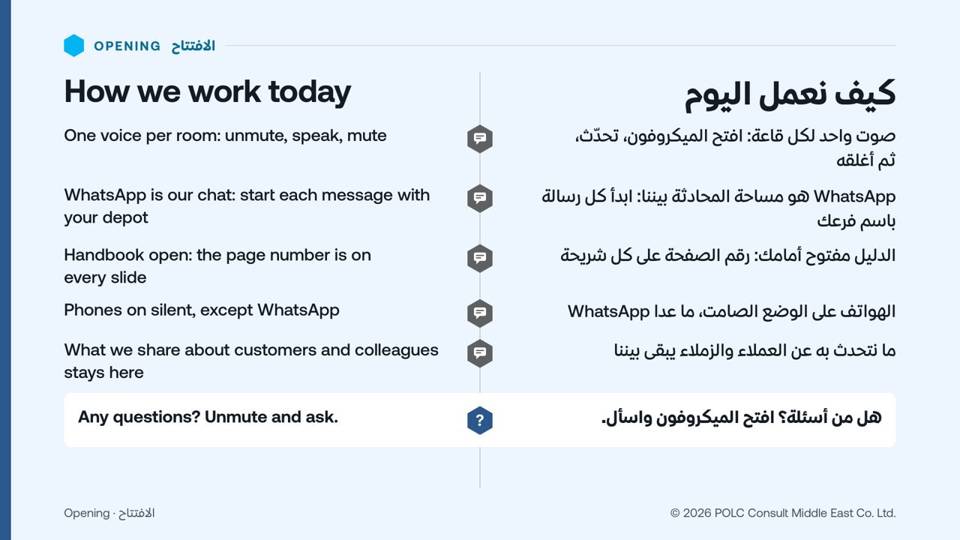
  • One voice per room: whoever speaks unmutes, speaks, mutes.
  • People alone in a room join on their own; they work alone, or the producer puts them in a breakout together.
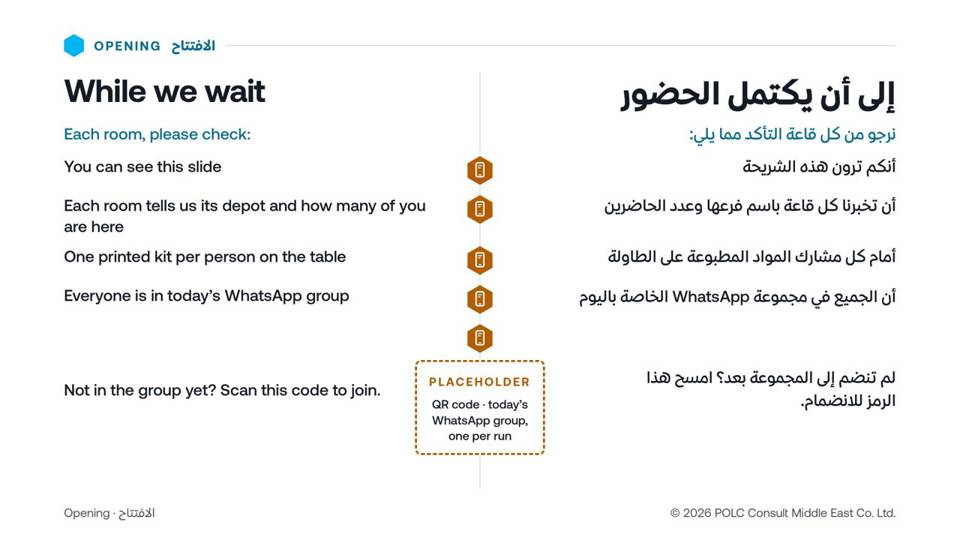
  • WhatsApp is the chat: one group per run. Its QR code on the room-check slide is the only QR code in the deck.

The producer

  • Room check: calls each depot, checks kits and WhatsApp.
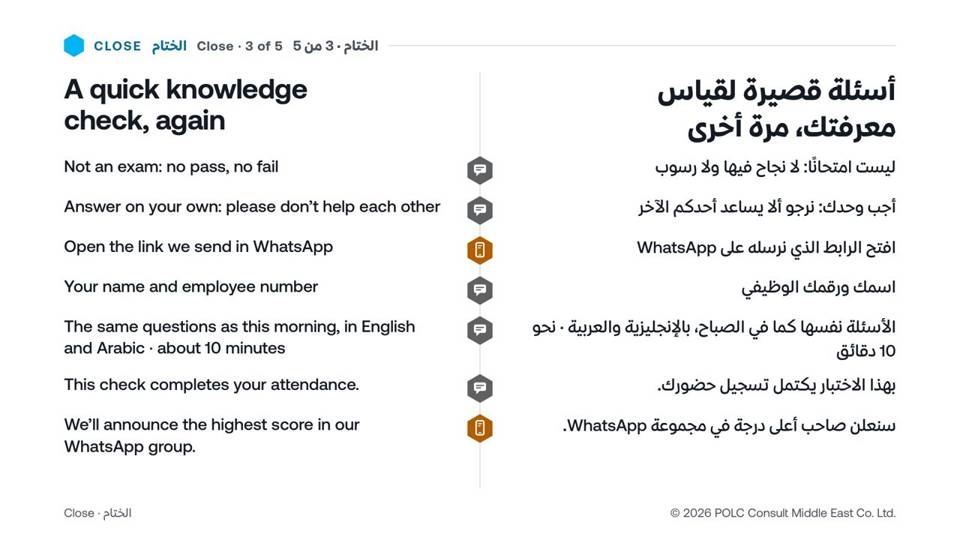
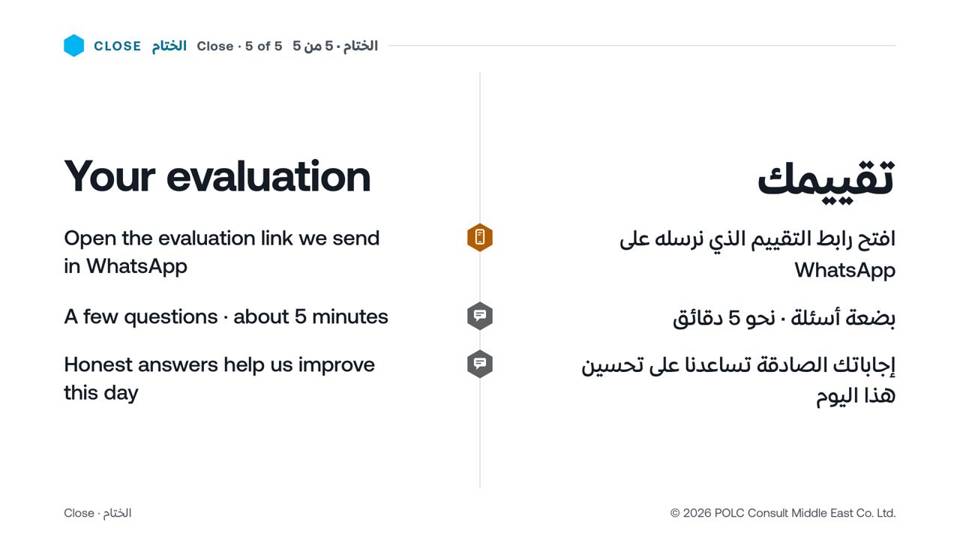
  • Posts the links in WhatsApp: knowledge check (start and end) and evaluation. The slides show text only, no QR.
  • Runs the timers for activities and breaks; quick headcount after each break.
  • Checks that every name appears in both knowledge checks; after the day, posts the highest score in the group.

Materials per learner

  • Participant Guide (printed, 72 pages): slides show the page.
  • Angry Customer cards (one card cut out per person in the pairs practice) · case scripts.
  • Arabic learning support cards (Arabic runs).

Attendance and the knowledge check

Attendance counts only when all three are done: the knowledge check at the start, the same check at the end, and the evaluation. Not an exam: no pass or fail; each person answers alone. 15 questions, about 10 minutes.

Two self-assessments

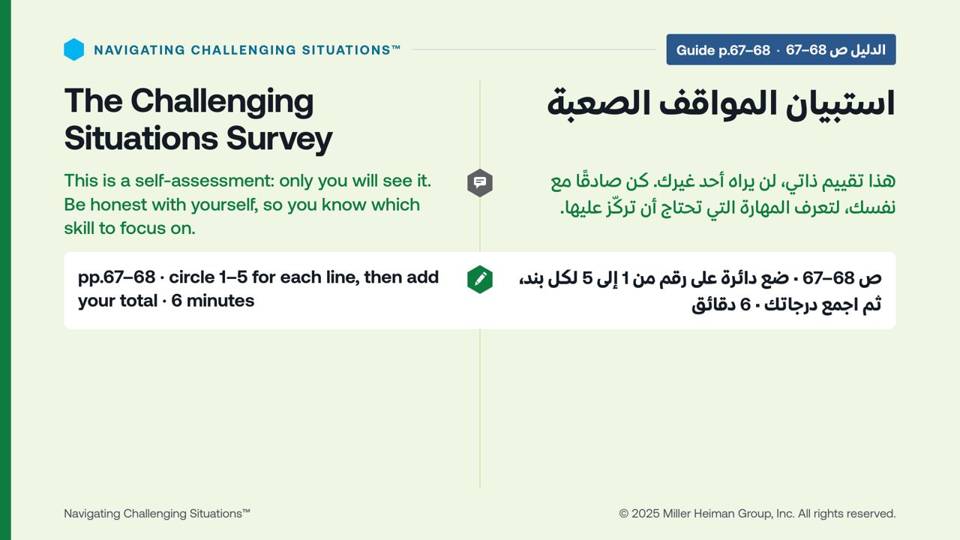
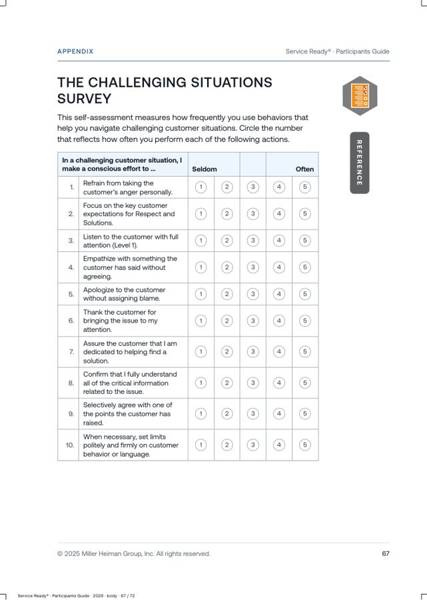
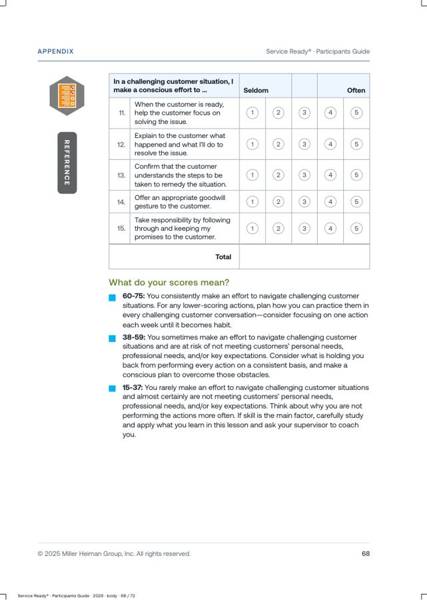
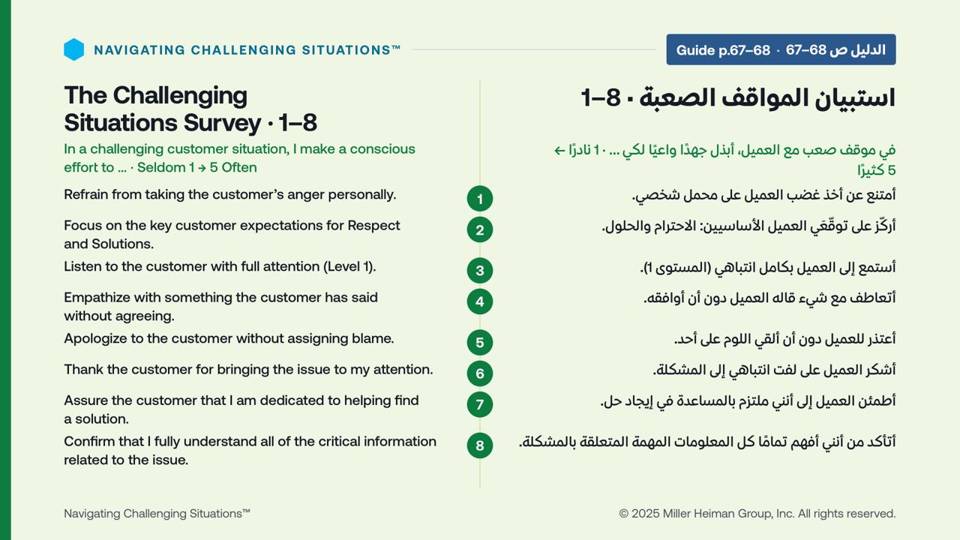
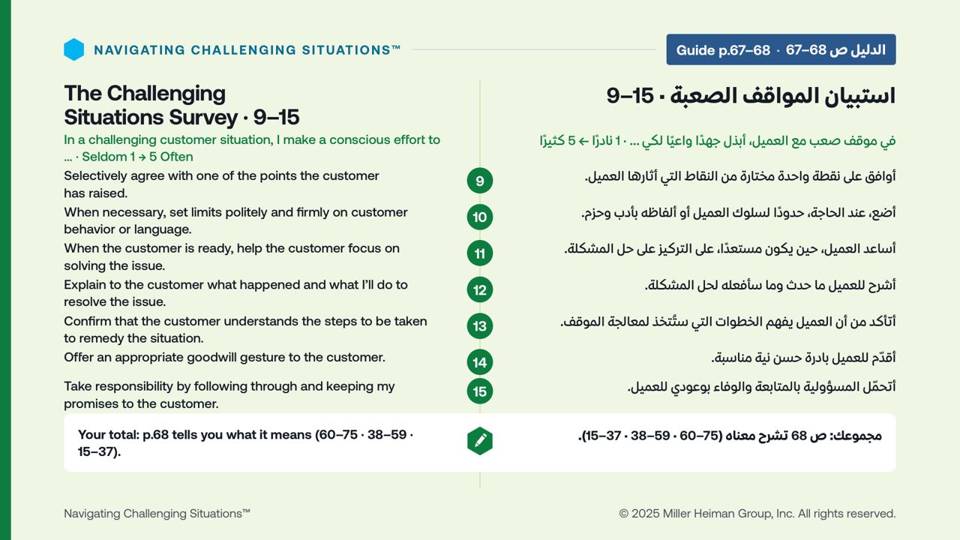
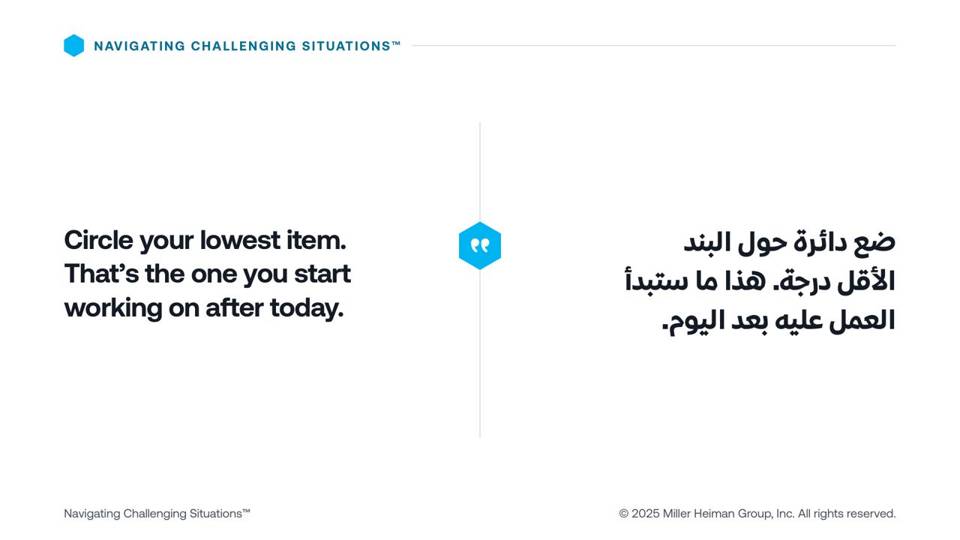
The Customer Expectations Survey (end of Building Customer Loyalty™) and the Challenging Situations Survey (after RESOLVE). Before each, the disclaimer: only you will see it; be honest with yourself, so you know which skill to focus on.

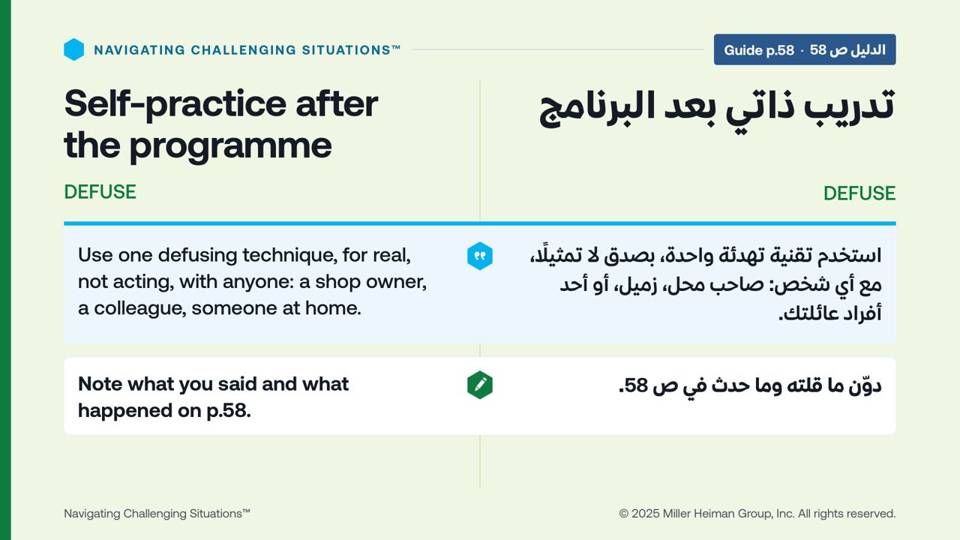
Self-practice after the programme

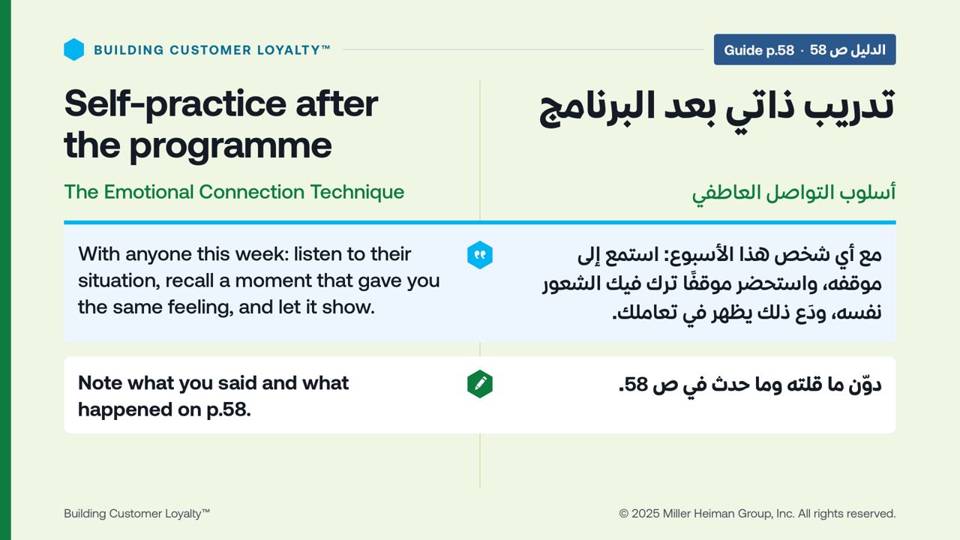
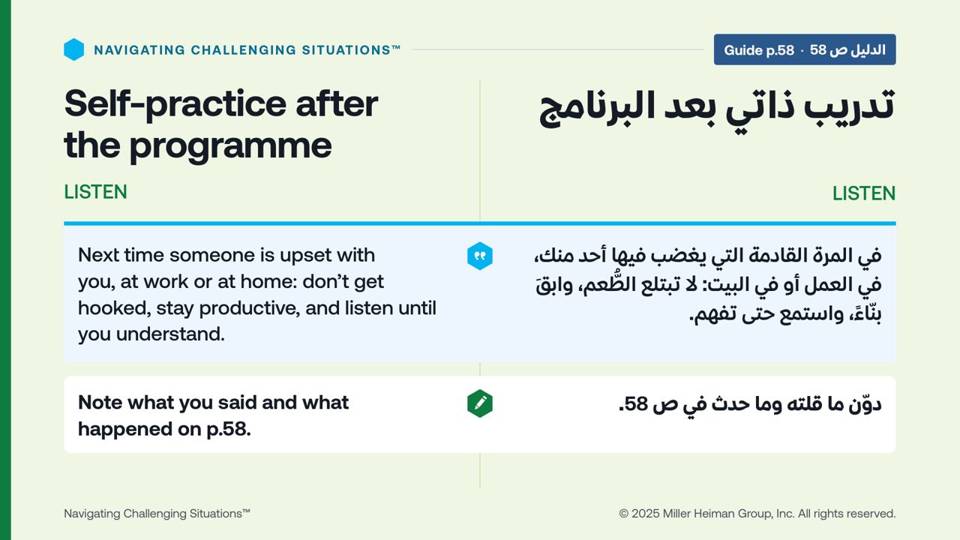
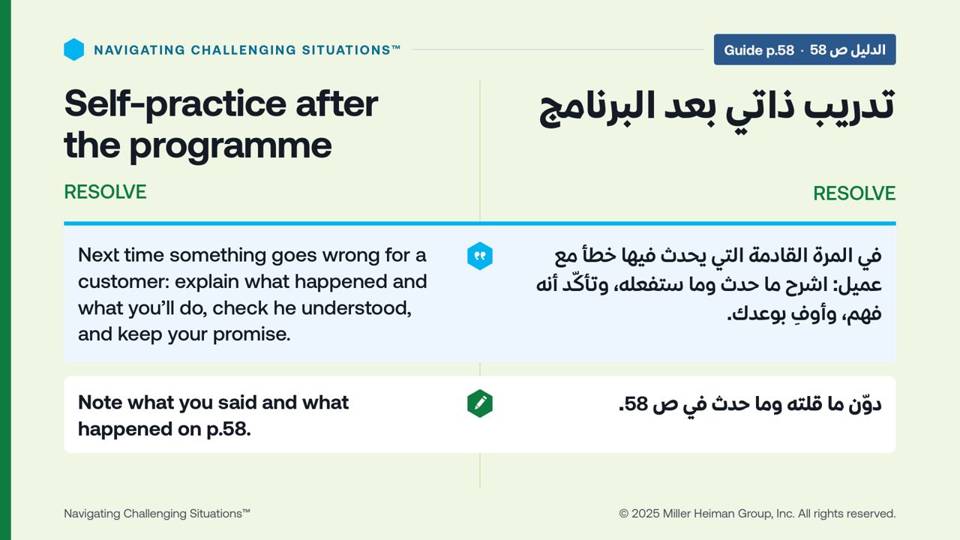
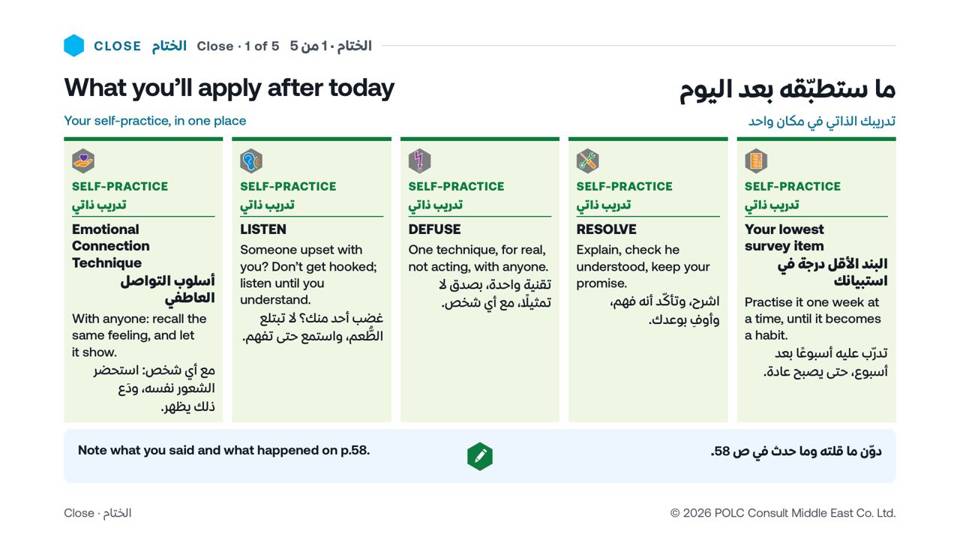
Four short slides, one per tool: Emotional Connection Technique, LISTEN, DEFUSE, RESOLVE. Read each aloud (about 30 seconds); no writing now. Learners note what they said and what happened on p.58 after the day. "What you'll apply after today" in the recap gathers them, then My Commitment.

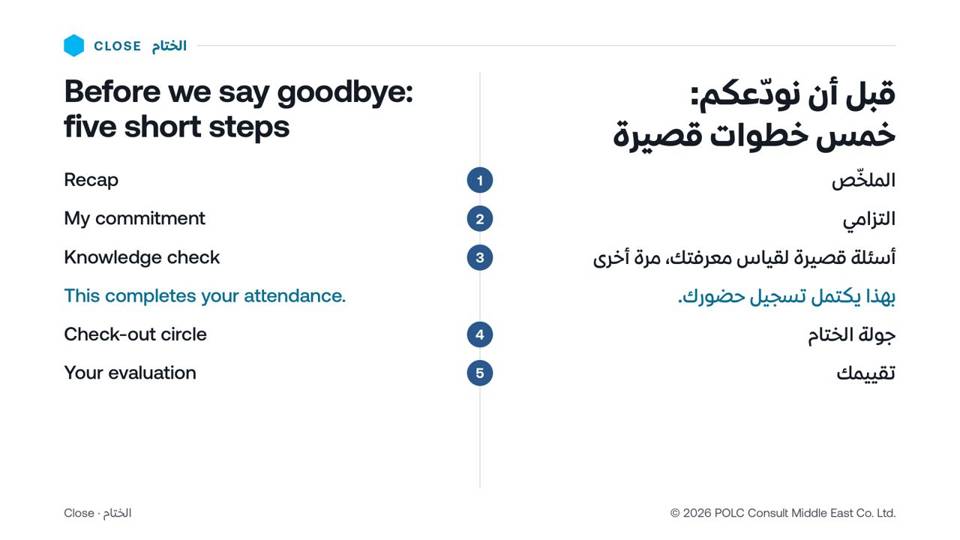
The Close: five steps

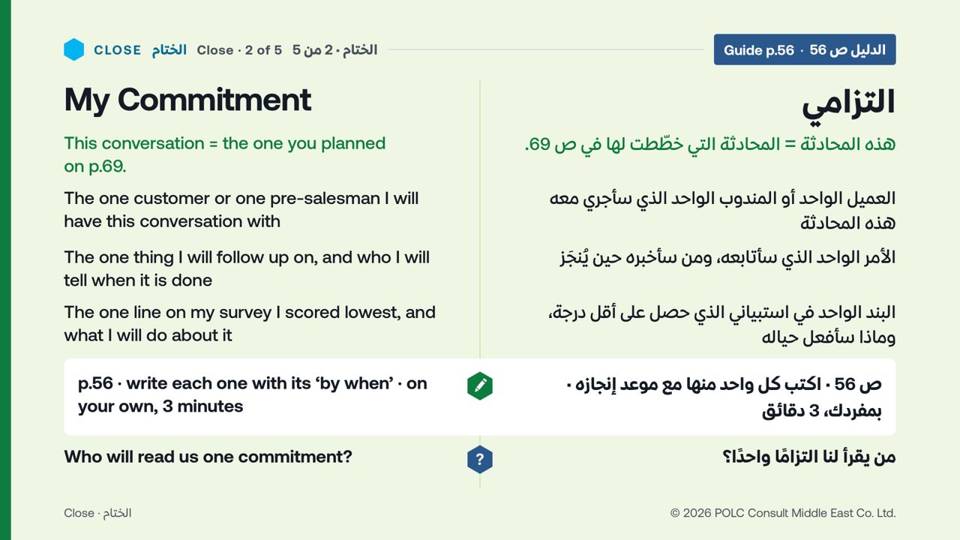
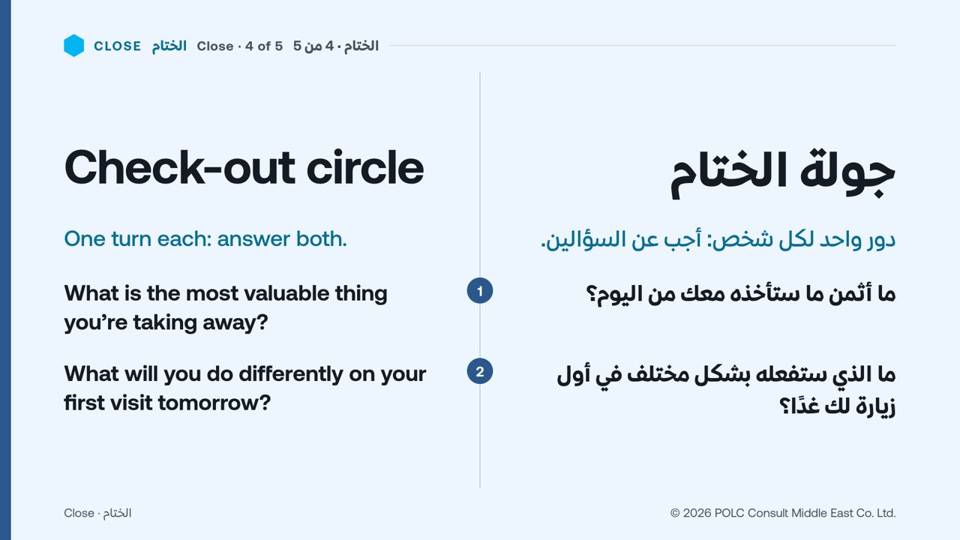
Recap → My Commitment → Knowledge check (completes attendance) → Check-out circle → Evaluation. The overview slide and the tracker "Close · n of 5" tell people what is left, so nobody leaves early.

Running late? In the check-out circle, ask only the second question.

Break drill

At each break we set a timer; when it rings, we come back; a quick headcount when we are back.
The icons on the slides

?Real question
Ask the room and take a few answers, your way.
↪Linking question or statement
Say it, answer it yourself if it is a question, move on.
iExplain
Explain in your own words; the content is on the slide and in this guide.
✎Activity
Learners do something: page, grouping and time are on the slide.
★Key point
Say it as written: it is what the slide is built to land.
✆WhatsApp or producer
The producer acts: link, QR code, checking the group.

Opening

1O1

Cover

Cover
Slide
Slide 1: Cover
Facilitator
ShowOn screen as the call opens, while rooms join.
RoomsJoin the call.
2O2

Room check

Explain5 steps
Slide
Slide 2: Room check
Facilitator
ProducerThe producer calls each depot and ticks it off. Anyone not in the group scans the QR code on screen.
DoThe facilitator moves to Welcome when every room is in.
RoomsOne person from the room answers by voice; rooms check kits and WhatsApp; anyone missing scans the code.
3O3

Welcome

Explain
Slide
Slide 3: Welcome
Facilitator
SayGood morning, and welcome to Service Ready. The producer is with me today: they look after the call and our WhatsApp group.
RoomsListen.
4O4

How we work today

Question7 steps
Slide
Slide 4: How we work today
Facilitator
SayReads each line.
RoomsOne person from each room ask by voice if needed.
5O5

Introduce yourself

Activity
Slide
Slide 5: Introduce yourself
Facilitator
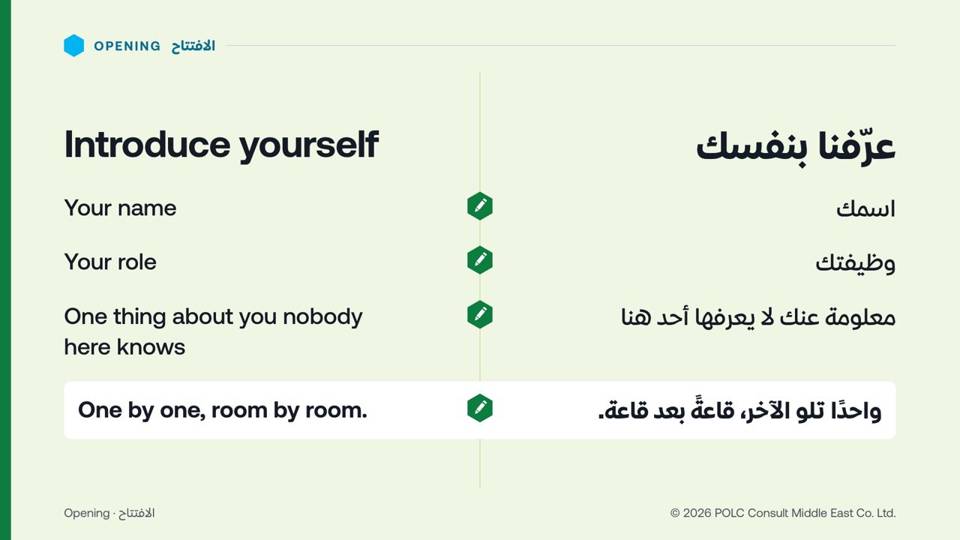
DoGoes room by room, in their own way. People alone answer for themselves.
NoteThe licensed original opens the same way: a 'safe' personal fact no one else knows.
In the roomsEach person, by voice.
6O6

WhatsApp check

Explain
Slide
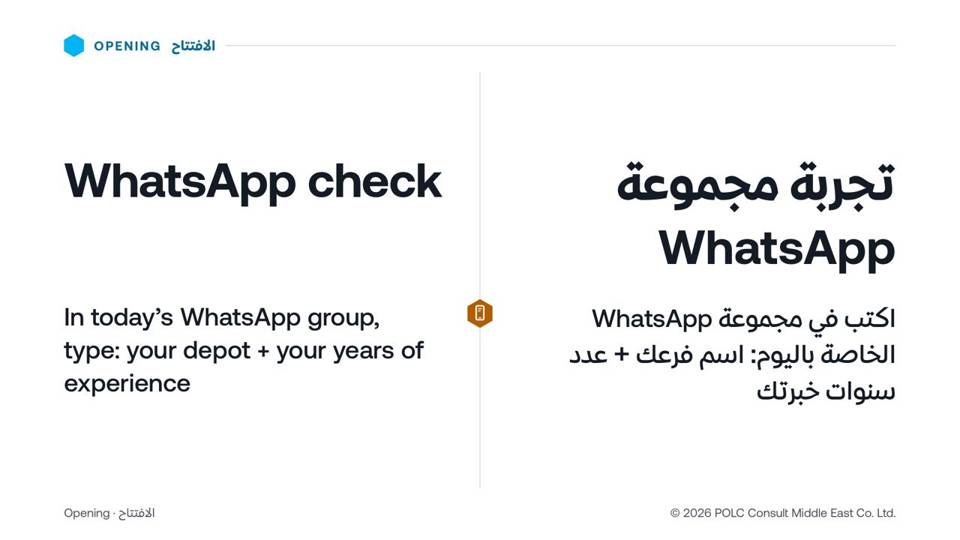
Slide 6: WhatsApp check
Facilitator
DoReads a few aloud; confirms the group works.
ProducerChecks every room appears in the group.
RoomsEach person types.
7O7

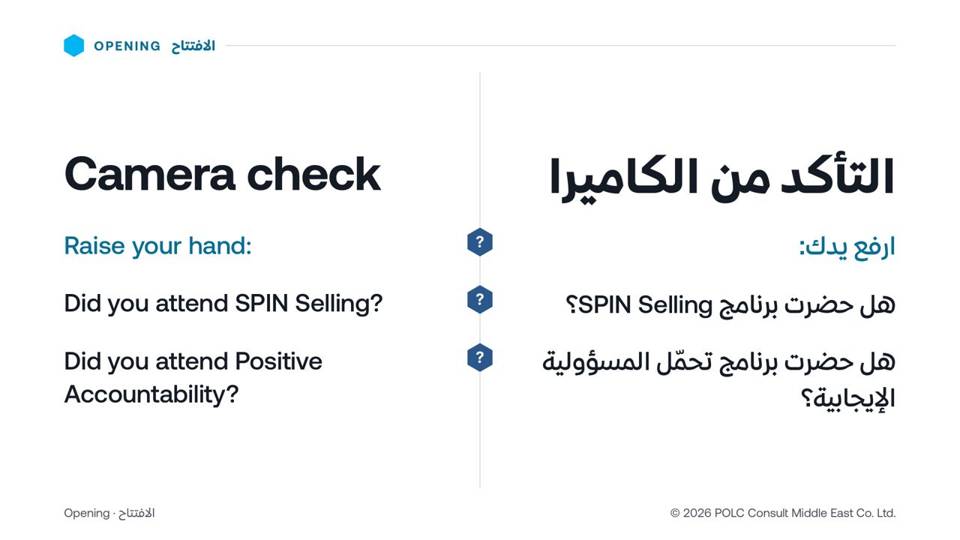
Camera check

Explain
Slide
Slide 7: Camera check
Facilitator
DoConfirms he can see every room's hands.
RoomsHands up on camera.
8O8

Your Facilitator

Explain
Slide
Slide 8: Your Facilitator
Facilitator
SayIntroduces themselves in their own words.
RoomsListen.
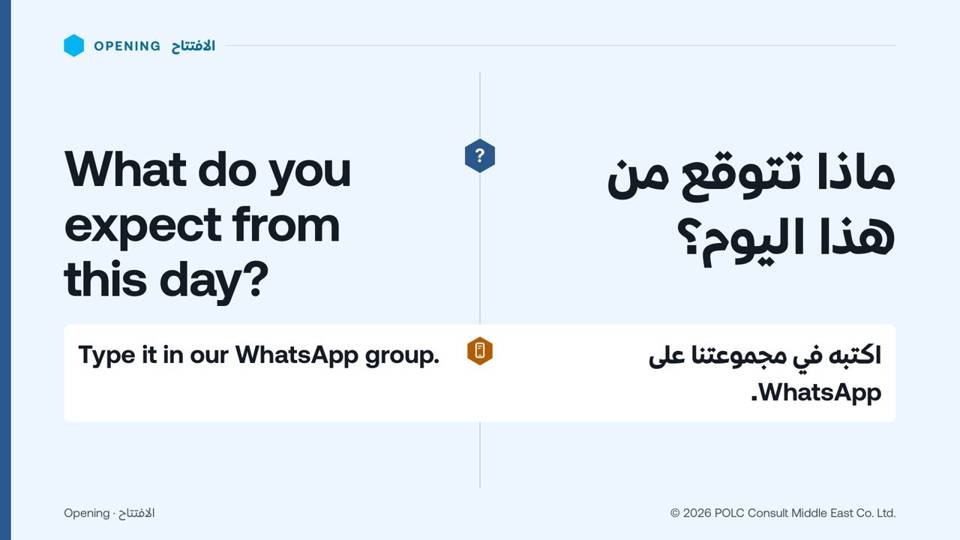
9O9

What do you expect from this day?

Question
Slide
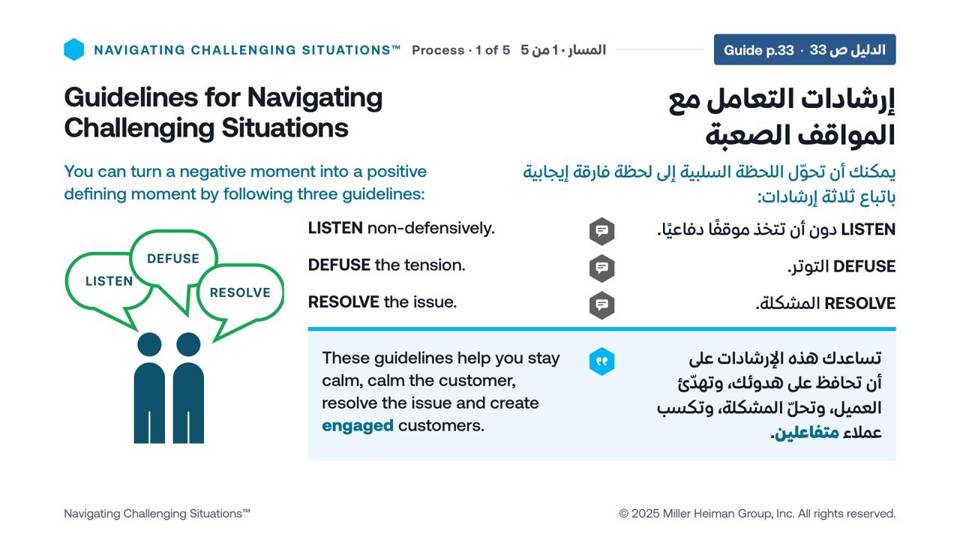
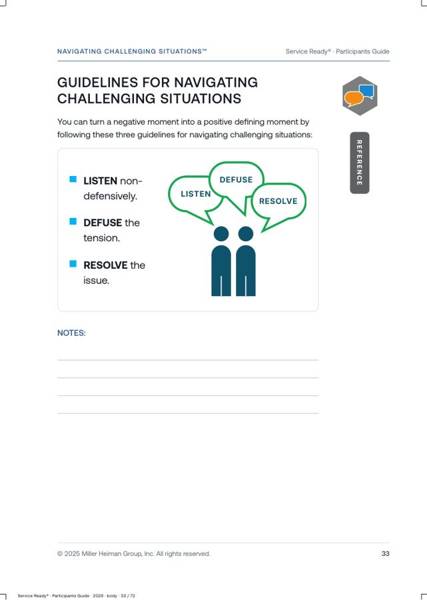
Slide 9: What do you expect from this day?
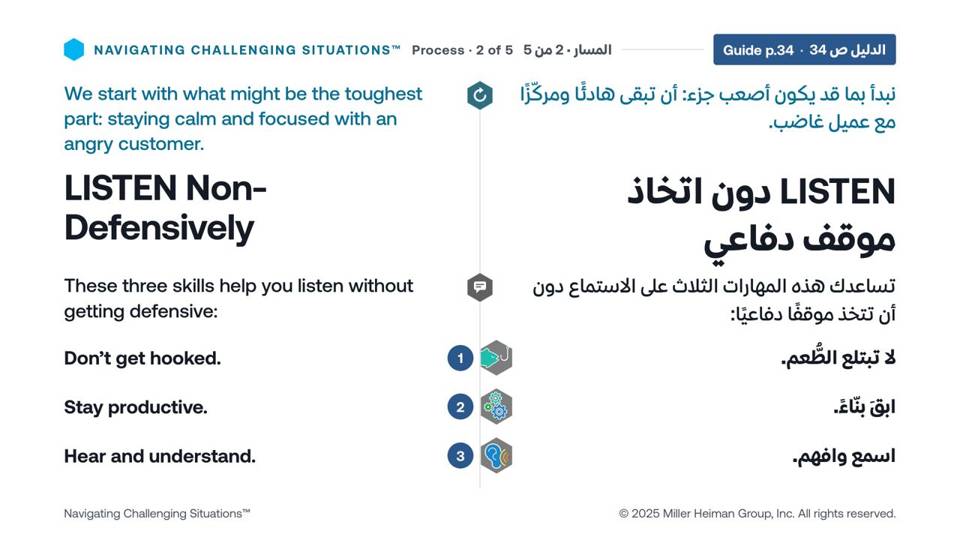
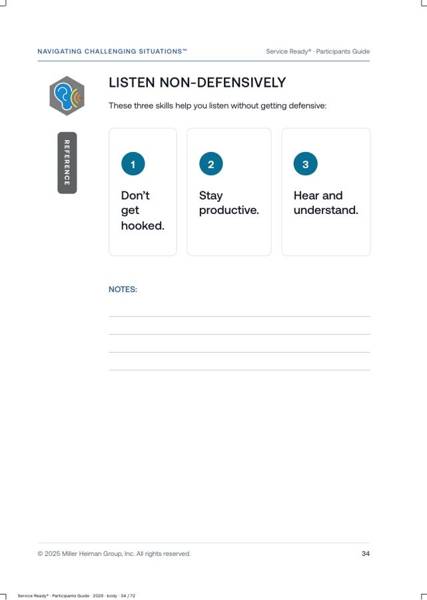
Facilitator
DoWhile people type, takes two or three answers by voice.
ProducerKeeps the chat for the close: 'Did we meet them?'
RoomsType in WhatsApp; two or three say it aloud.
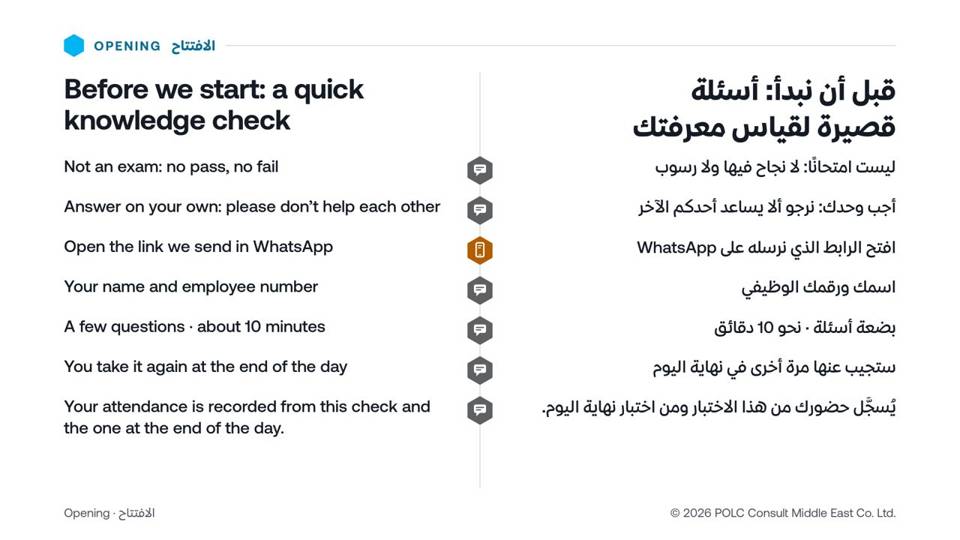
10O10

Quick knowledge check

Explain8 steps
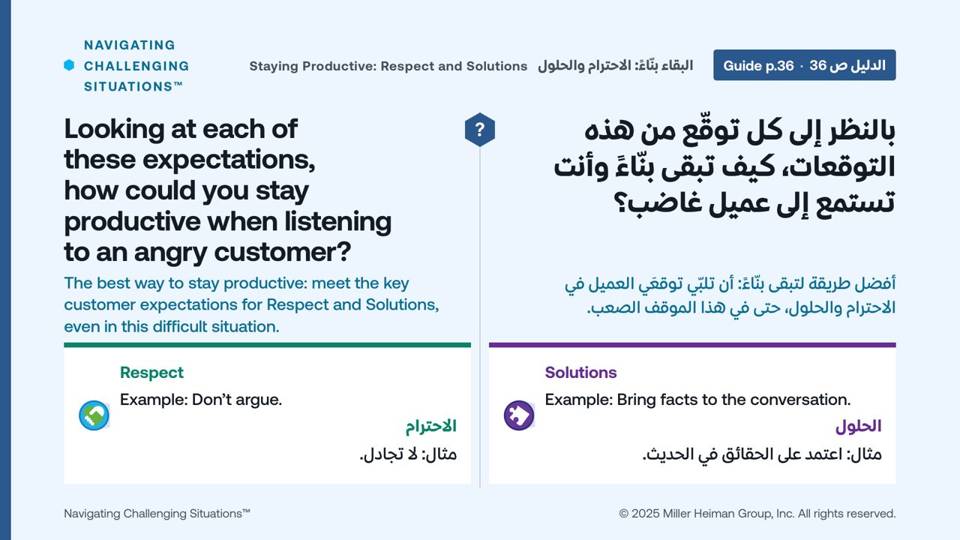
Slide
Slide 10: Quick knowledge check
Facilitator
SayBefore we start, a quick check of what you already know. It's not an exam: there's no pass and no fail. Answer on your own, please don't help each other.
ProducerThe producer posts the link now. Watches the count; tells the facilitator 'All in'.
RoomsEach person answers on their phone, alone.
11O11

Today

Explain
Slide
Slide 11: Today
Facilitator
ExplainWalks through the four parts and the break drill; says today's start, break and finish times aloud.
ProducerGives the facilitator the run's times; shows the break timer on screen at each break; takes the quick headcount when rooms return.
NoteNo clock times on screen, only break lengths, so the facilitator can flex the day. Planned (Riyadh time): start 8:30 · breaks 10:00, 11:30, 14:00 · finish 16:00.
RoomsPick the phone that will hold the timer.
12O12

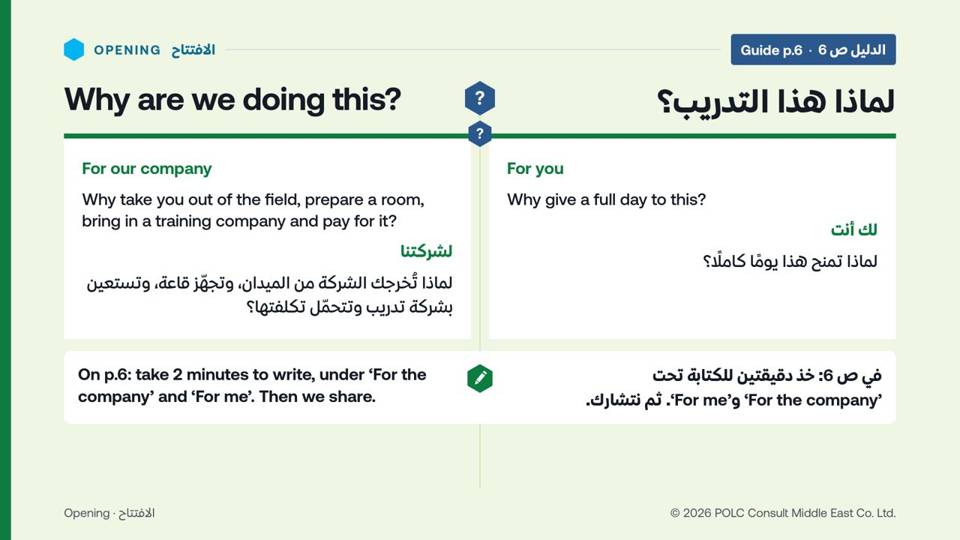
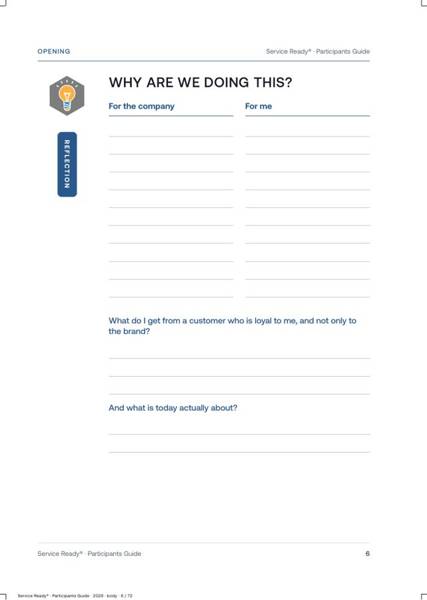
Why are we doing this?

ActivityGuide p.6
Slide
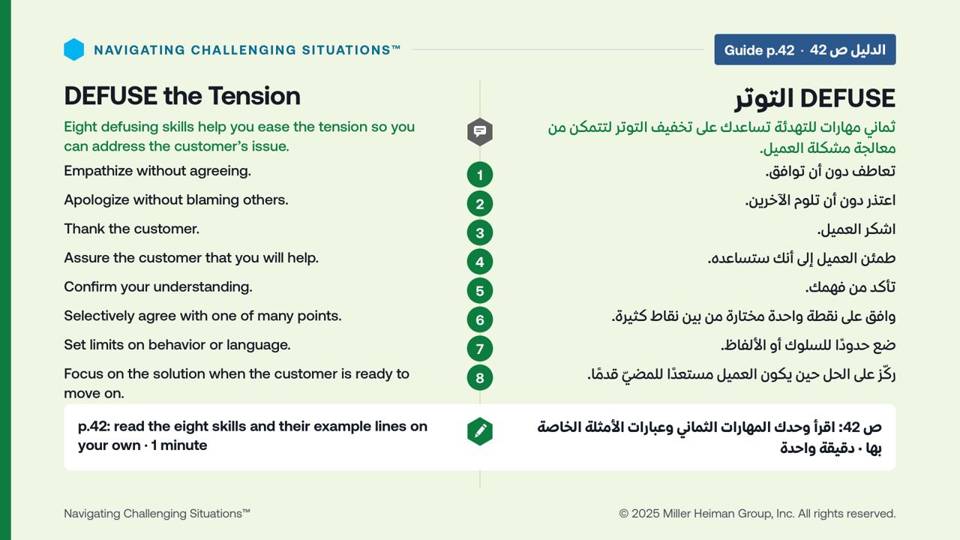
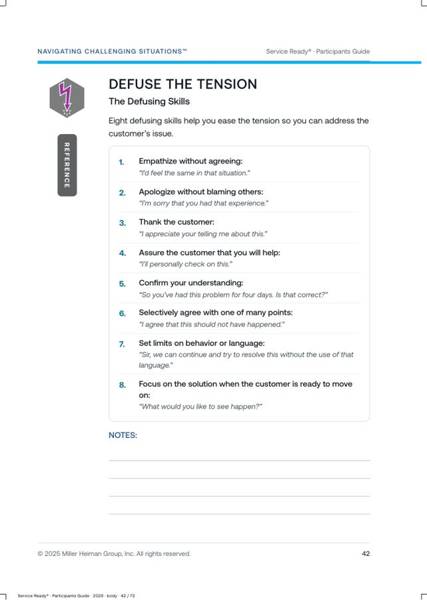
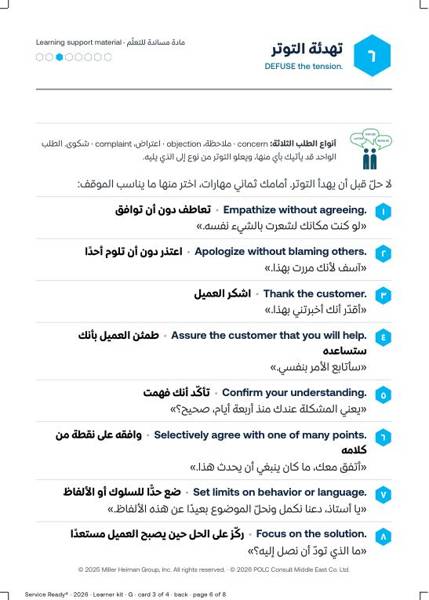
Slide 12: Why are we doing this?
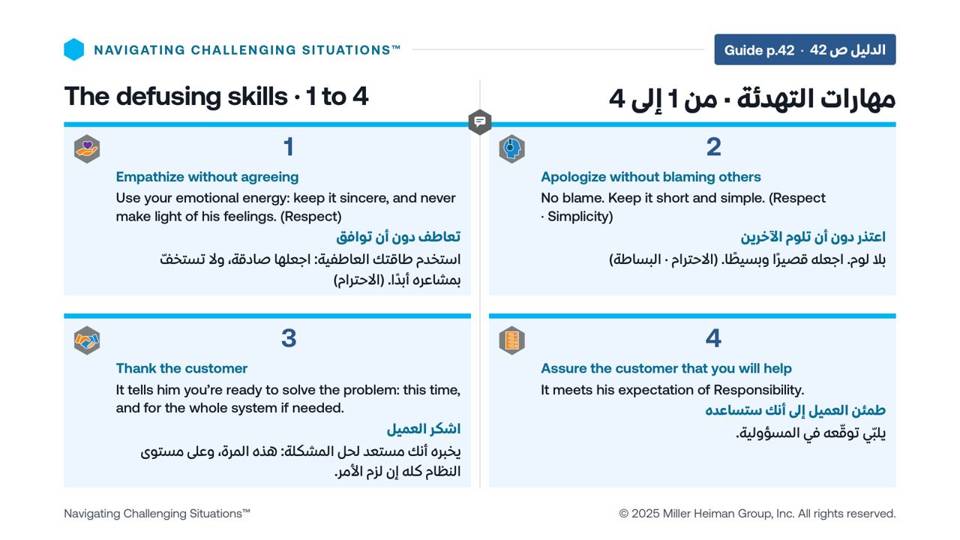
Learner material
Participant Guide p.6Participant Guide p.6Participant Guide p.6, large
Facilitator
AskTwo sides. For you personally: why would you give a full day to this? And it wasn't easy to do it in person because of the situation, ربنا يحفظ السعودية وكل بلادنا. And for the company: why would it take you out of the field, prepare a room, bring in a training company and pay for you?
DoTakes a few answers, in their own way.
SayLet's start with our company, from what you were saying.
In the roomsWrite on p.6 for 2 minutes; a few share by voice.
13O13

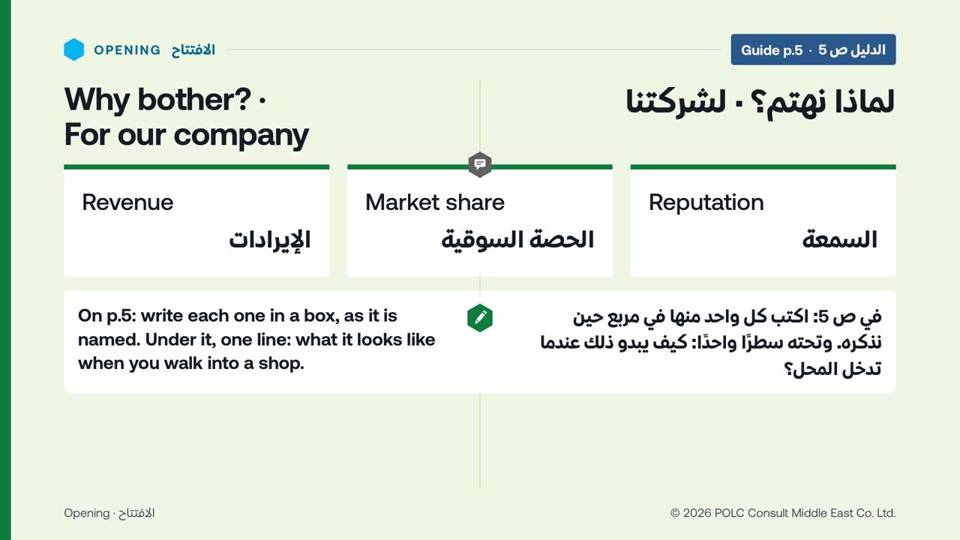
Why bother? For our company

ActivityGuide p.55 steps
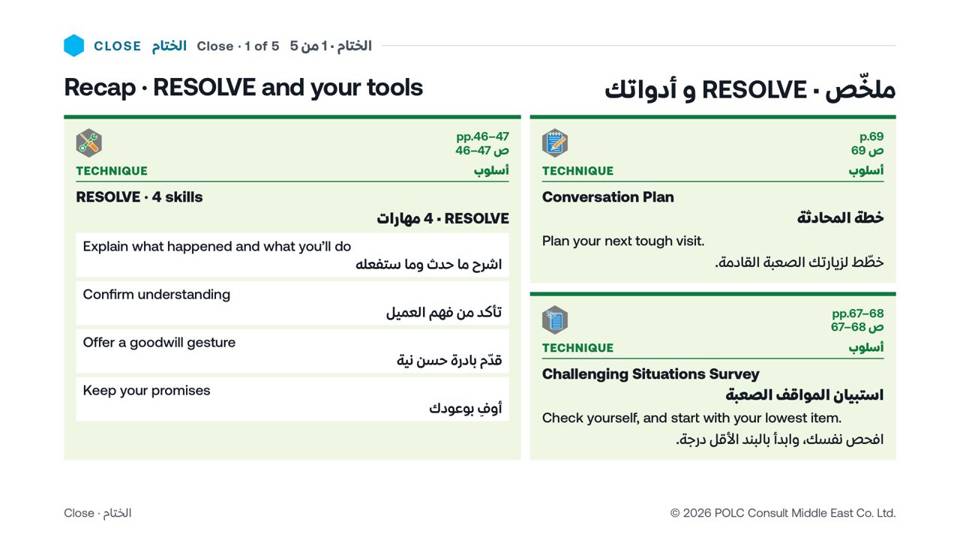
Slide
Slide 13: Why bother? For our company
Learner material
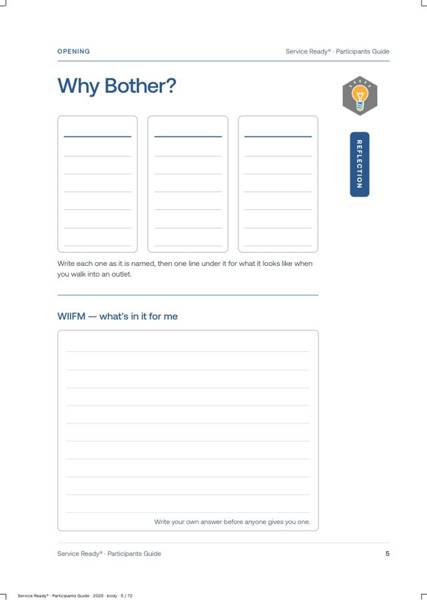
Participant Guide p.5Participant Guide p.5Participant Guide p.5, large
Facilitator
SayYou said ___ and ___. For our company it comes to three things.
DoAfter two minutes, takes a few answers.
In the roomsWrite in the three boxes on p.5.
14O15

Our company's success is my success

ActivityGuide p.55 steps
Slide
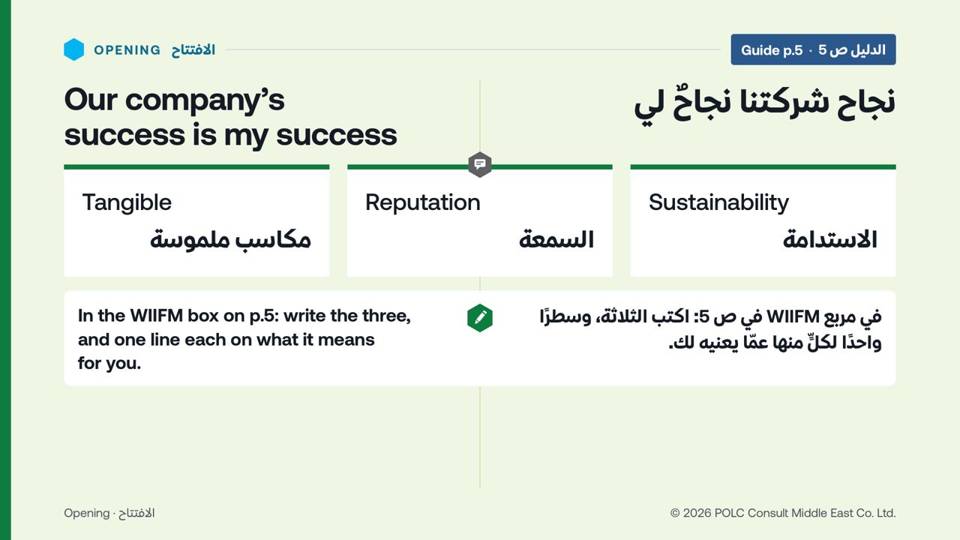
Slide 14: Our company's success is my success
Learner material
Participant Guide p.5Participant Guide p.5Participant Guide p.5, large
Facilitator
SaySo you said ___, ___, ___. It comes to three things.
ExplainTangible: my job, my route, our freezers in the shops. Reputation: a strong name in the market, the shop's trust. Sustainability: a company with high revenue, market share and reputation doesn't close in a crisis; it keeps its people, and my job stays.
NoteReplaces the separate WIIFM question (old O14): p.6 'For me' already asked it.
In the roomsWrite the three in the WIIFM box on p.5.
15O20

Our company's market share?

Question
Slide
Slide 15: Our company's market share?
Facilitator
AskAnd our company: what is our market share? (He may say the company name aloud; it never appears on screen.)
DoTakes a few guesses, then: 'Hold on to your number. Let me tell you a story.'
If askedNot on screen. Full year 2025: long-life (UHT) milk about 58%, tomato paste about 51%, ice cream about 31% (company results, via the press).
RoomsGuess by voice.
16O16

Nokia: the question

Question
Slide
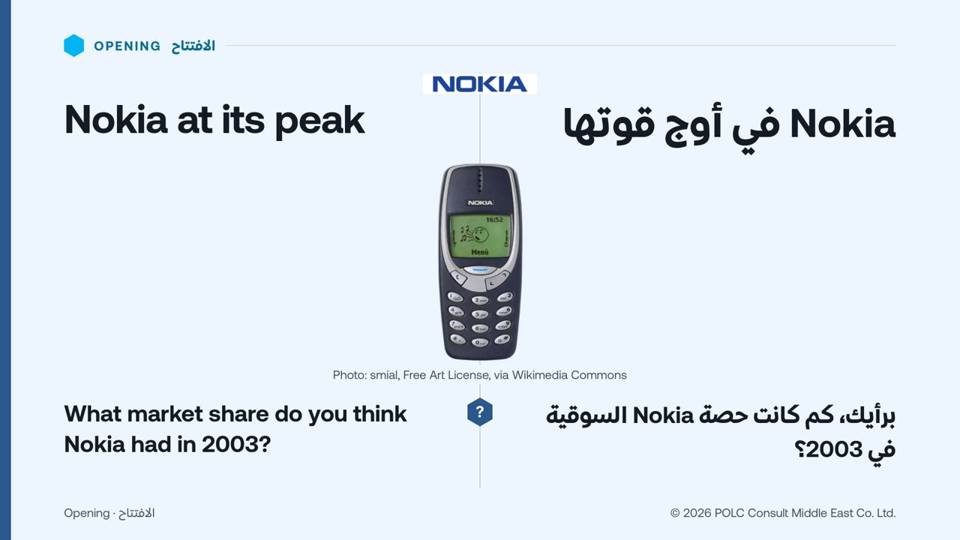
Slide 16: Nokia: the question
Facilitator
DoTakes a few guesses.
RoomsGuess by voice.
17O17

Nokia: 2007

Explain
Slide
Slide 17: Nokia: 2007
Facilitator
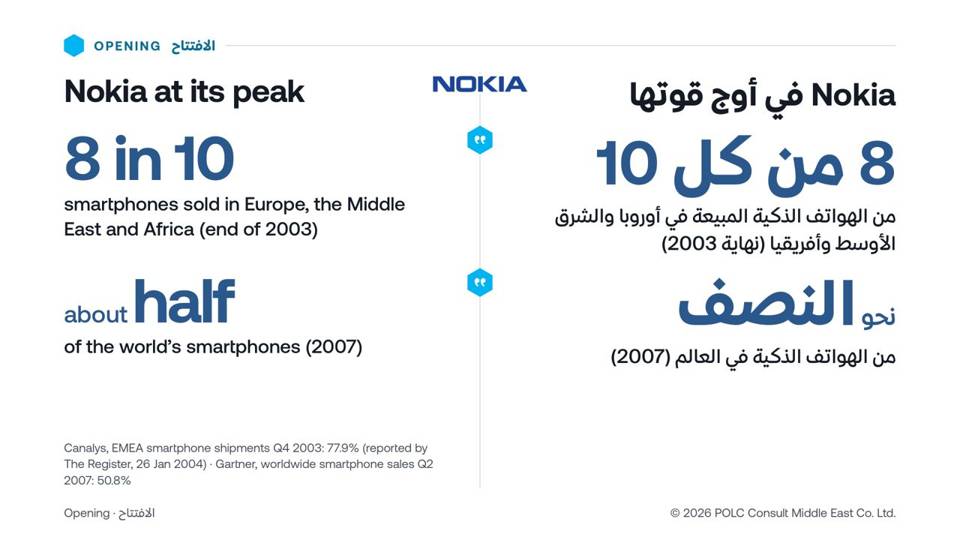
SayReads the two numbers: the world's biggest phone maker.
RoomsListen.
18O17b

Five years later: guess

Question
Slide
Slide 18: Five years later: guess
Facilitator
DoTakes a few guesses.
RoomsGuess by voice.
19O18

Nokia: 2012

Explain4 steps
Slide
Slide 19: Nokia: 2012
Facilitator
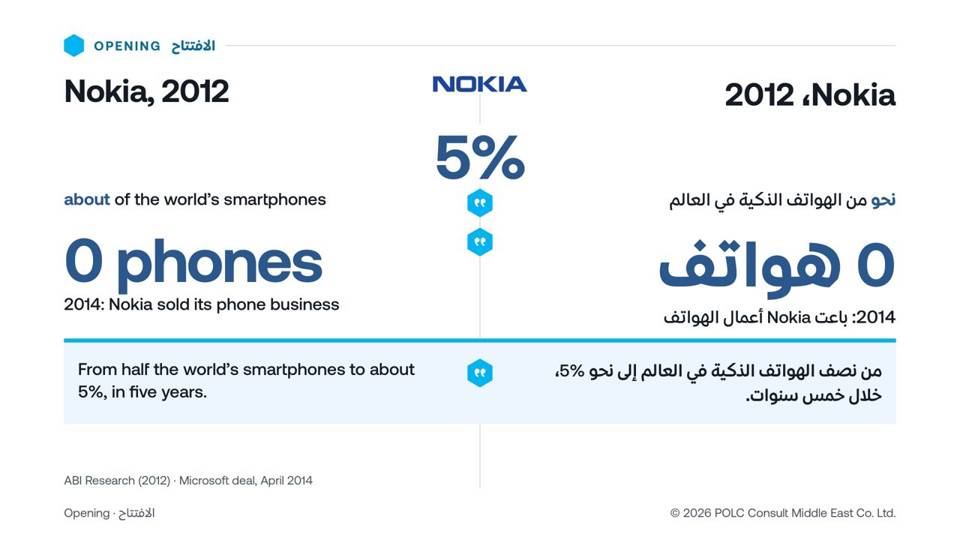
SayLands the drop.
RoomsListen.
20O19

Not only Nokia

Explain5 steps
Slide
Slide 20: Not only Nokia
Facilitator
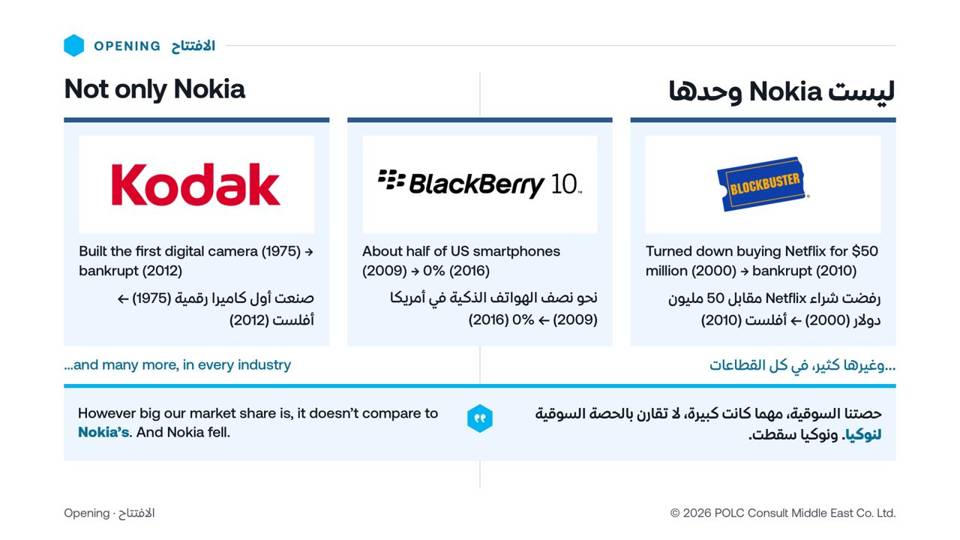
SayIt's not only Nokia. Then calls back the guesses from the start.
RoomsListen.
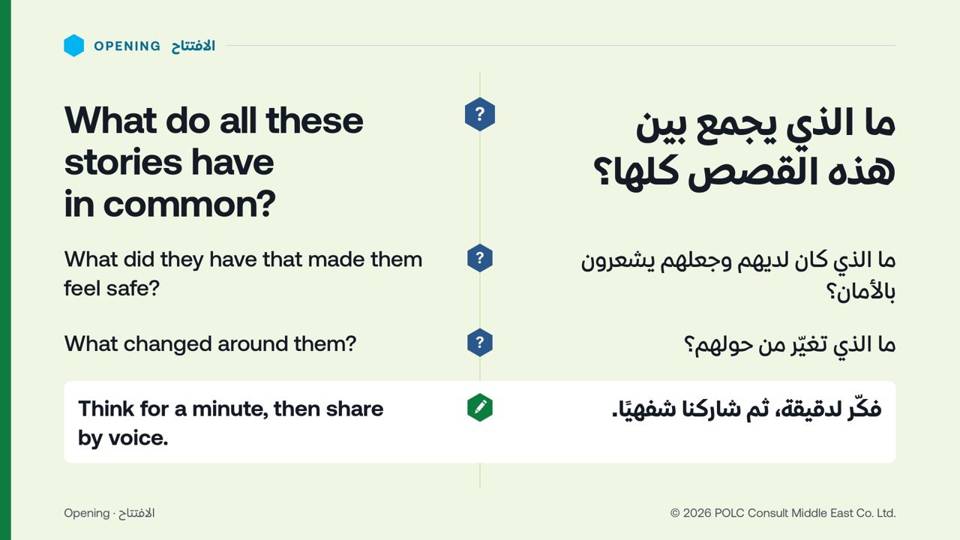
21O21

What do these stories have in common?

Activity
Slide
Slide 21: What do these stories have in common?
Facilitator
DoGives a minute to think, then takes a few quick reflections by voice, in their own way. No writing.
In the roomsThink, then a few share by voice.
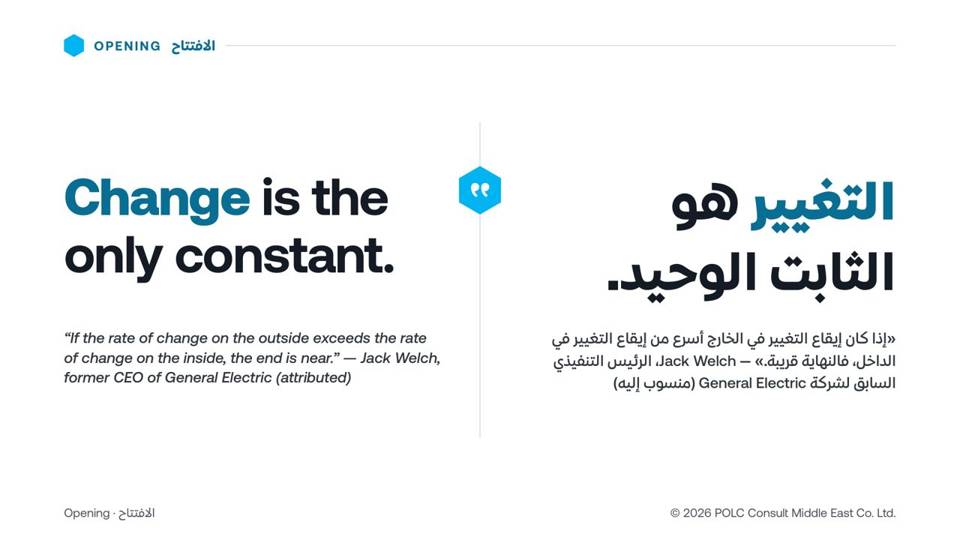
22O21b

Key point: change

Key point
Slide
Slide 22: Key point: change
Facilitator
SayLands it after the answers.
RoomsListen.
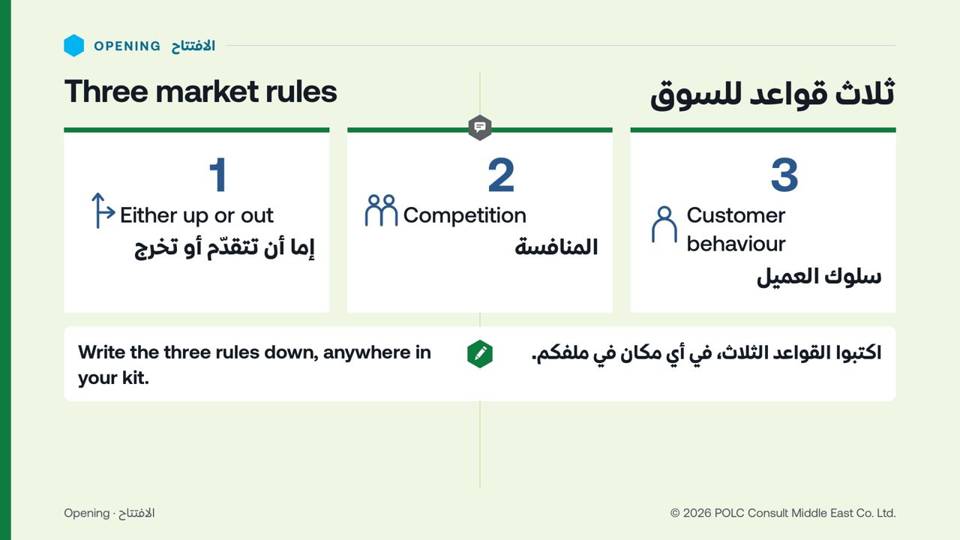
23O22

Three market rules

Activity5 steps
Slide
Slide 23: Three market rules
Facilitator
ExplainTakes the rules one by one, by voice, in their own words.
NoteThere's no page for this; any free space works, the back cover too.
In the roomsListen; write the three rules down.
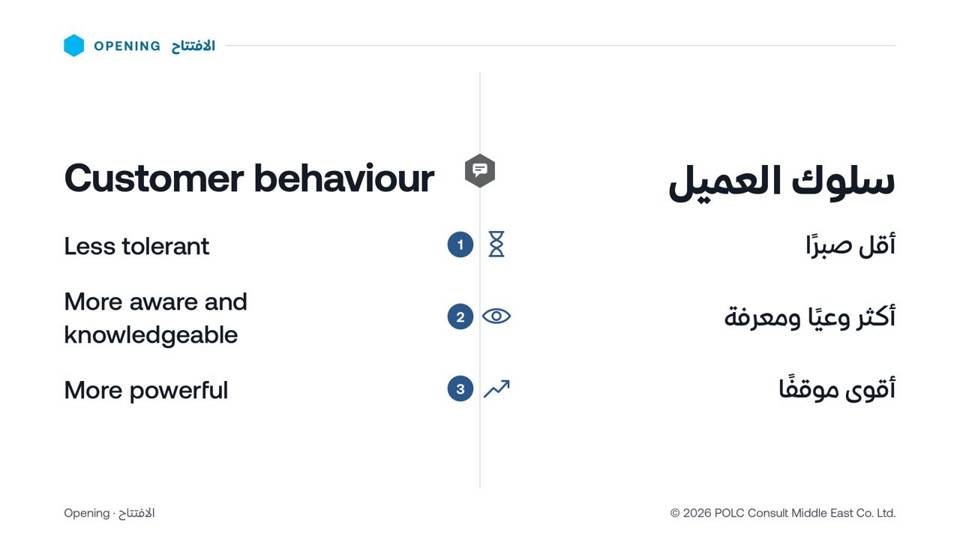
24O23

Customer behaviour

Explain4 steps
Slide
Slide 24: Customer behaviour
Facilitator
SayExplains each, in their own way.
RoomsListen.
25O23b

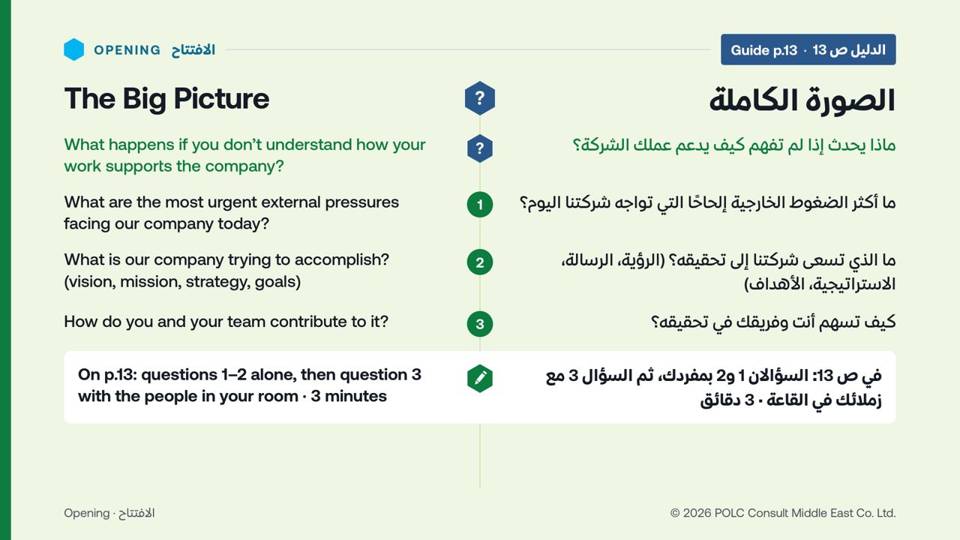
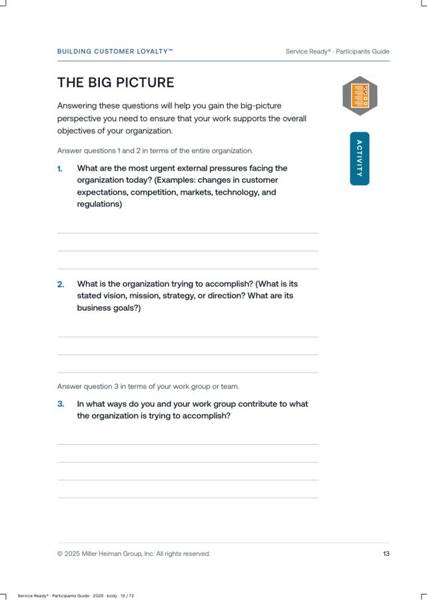
The Big Picture

ActivityGuide p.13
Slide
Slide 25: The Big Picture
Learner material
Participant Guide p.13Participant Guide p.13Participant Guide p.13, large
Facilitator
NoteIt follows the market rules (= external pressures) and leads into 'What is in our control?'.
DoHears a few answers to each question.
NotePrep: the company's stated vision, mission and goals, to guide the debrief (to obtain).
In the roomsWrite on p.13; question 3 in the room.
26O23c

Big Picture debrief

Question
Slide
Slide 26: Big Picture debrief
Facilitator
NoteExpected (original): we focus on the right things; we know what is expected to create good experiences; I see how important I am to loyalty.
RoomsA few answer by voice.
27O24

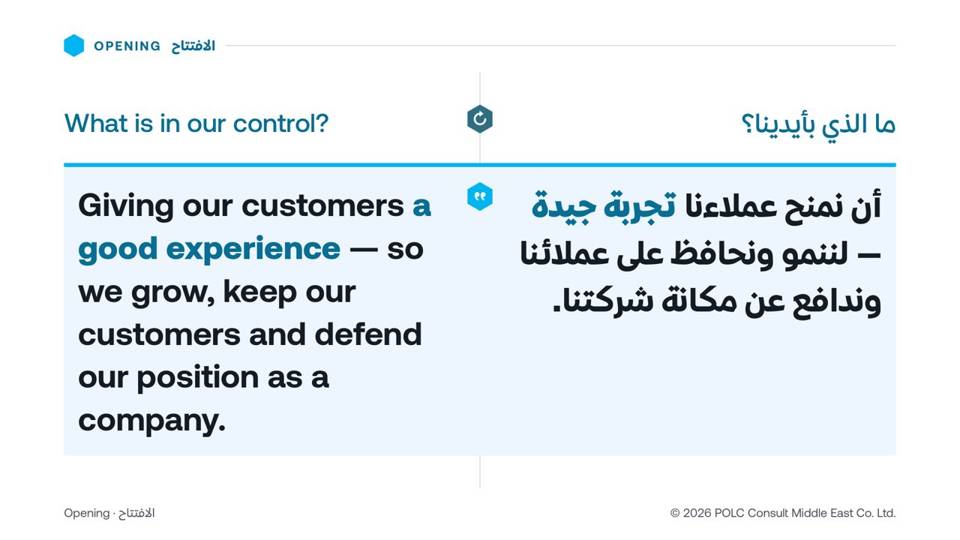
What is in our control?

Explain
Slide
Slide 27: What is in our control?
Facilitator
AskAsks it as a rhetorical question, then lands the answer.
RoomsListen.
28O25

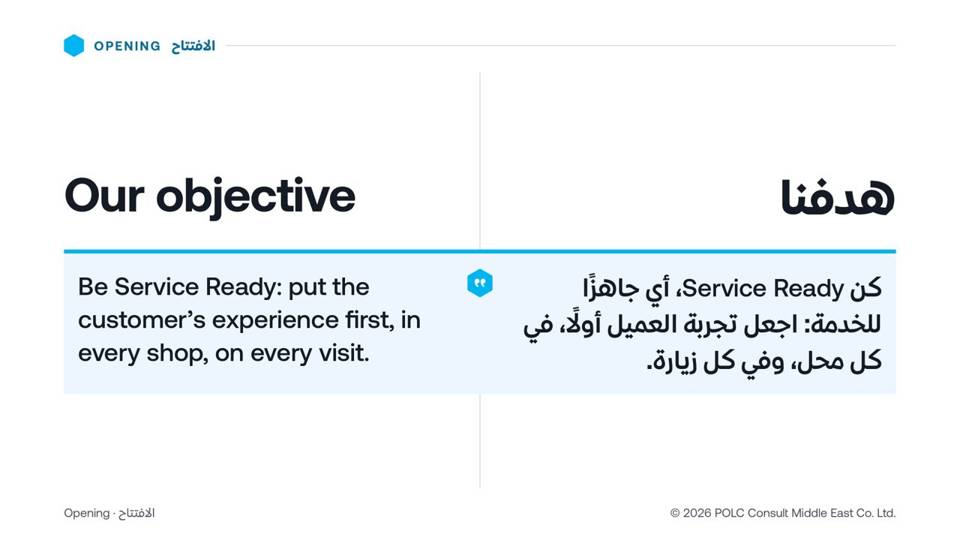
Our objective

Explain
Slide
Slide 28: Our objective
Facilitator
SayReads it.
RoomsListen.
29O26

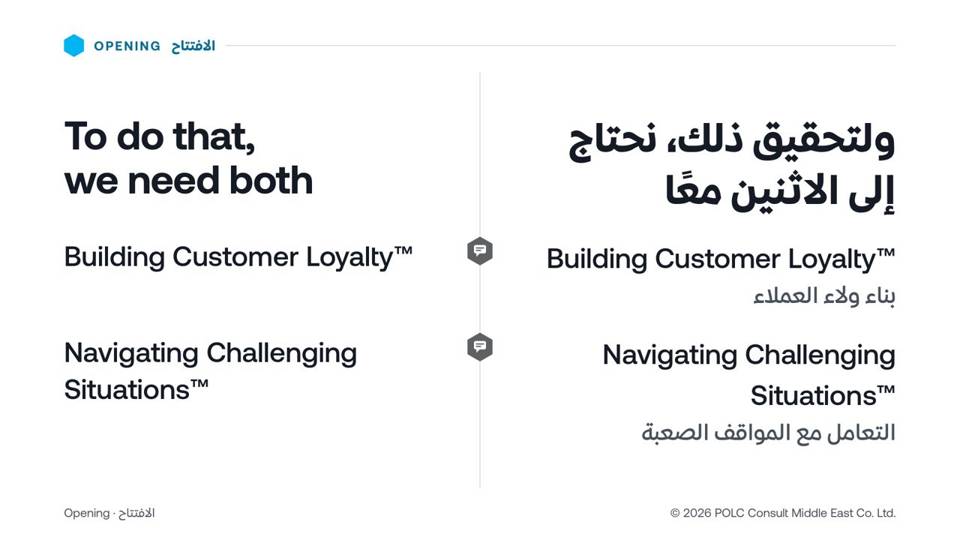
To do that, we need both

Explain
Slide
Slide 29: To do that, we need both
Facilitator
SayThat's why we cover these two today.
RoomsListen.
30O27

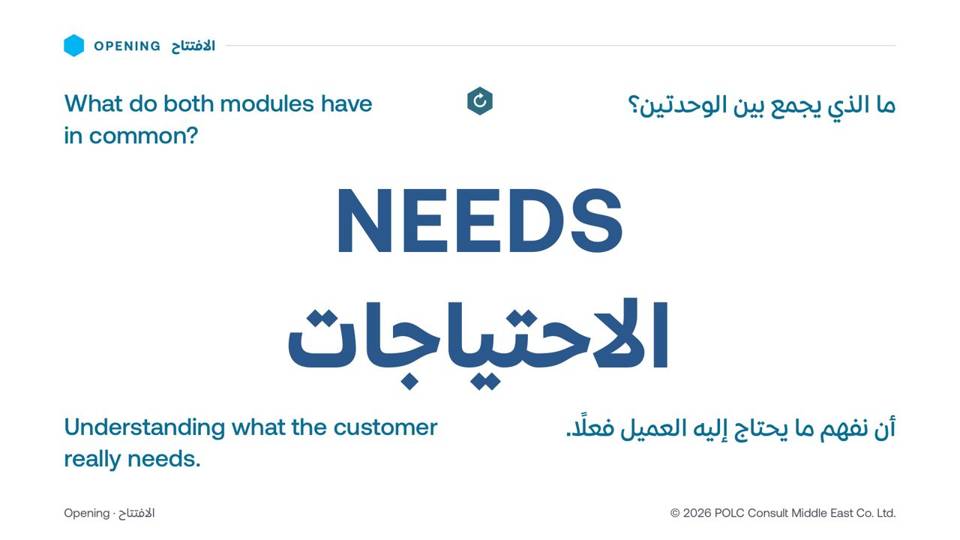
What do both have in common?

Explain
Slide
Slide 30: What do both have in common?
Facilitator
SayWhat that means, you'll find out yourselves in a minute.
RoomsListen.

Building Customer Loyalty™

31B1

Module divider · Building Customer Loyalty™

Explain
Slide
Slide 31: Module divider · Building Customer Loyalty™
Facilitator
SayFirst module: Building Customer Loyalty.
Rooms—
32B2

A customer experience you'll never forget

Activity
Slide
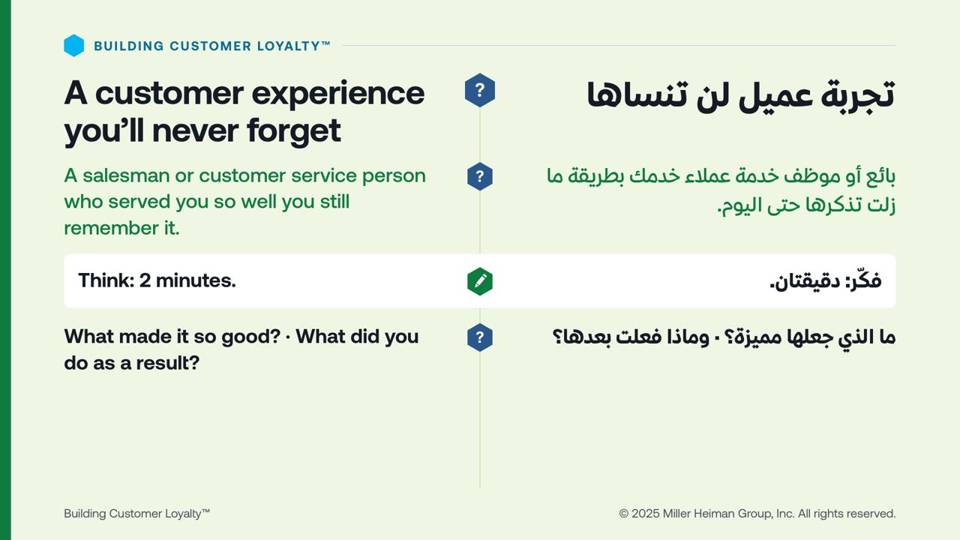
Slide 32: A customer experience you'll never forget
Facilitator
DoGives two minutes, then hears one or two stories, in their own way.
NoteLicensed original step 'Your Experience as a Customer: Good'. Expected: treated as an individual, problem solved, knowledgeable, quick / told friends, bought more, looked for the same salesperson.
In the roomsThink; one or two share by voice.
33B2b

Key point: great experiences

Key point
Slide
Slide 33: Key point: great experiences
Facilitator
SayLands it after the stories (licensed key point).
RoomsListen.
34B2c

Link: switch sides

Link
Slide
Slide 34: Link: switch sides
Facilitator
SaySays the link, then goes straight into the case.
RoomsListen.
35B3

What Would YOU Do?: the case

ActivityGuide p.8
Slide
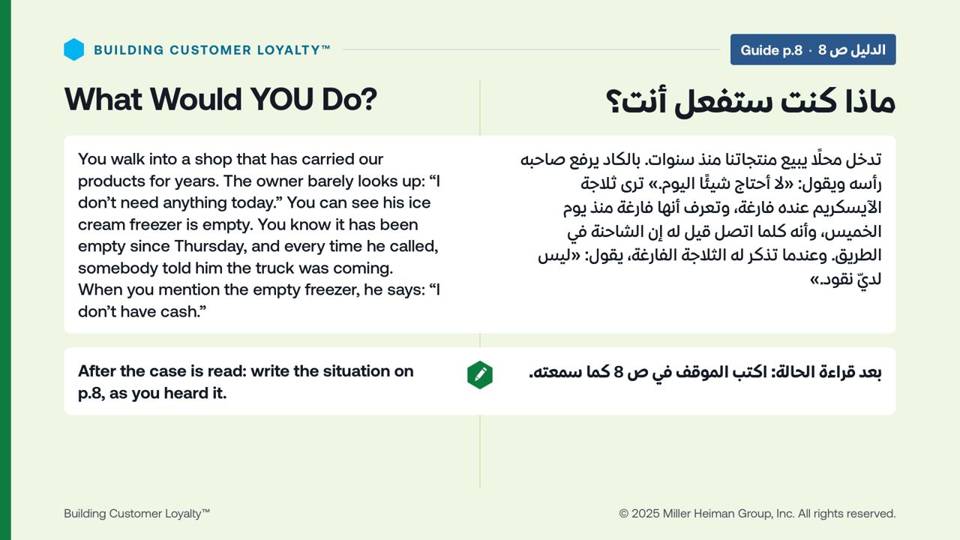
Slide 35: What Would YOU Do?: the case
Learner material
Participant Guide p.8Participant Guide p.8Participant Guide p.8, large
Facilitator
SayReads the case aloud.
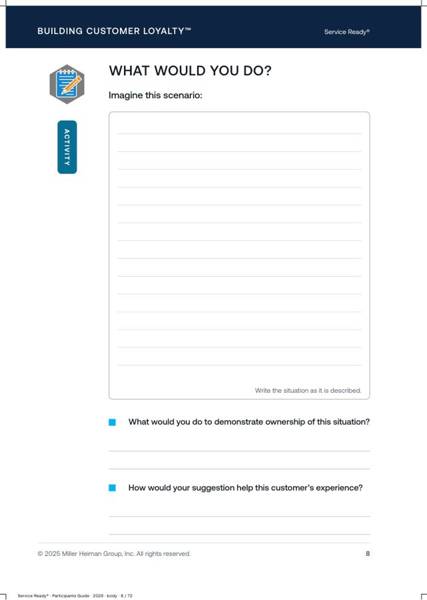
In the roomsWrite on p.8.
36B4

What Would YOU Do?: in pairs

ActivityGuide p.8
Slide
Slide 36: What Would YOU Do?: in pairs
Learner material
Participant Guide p.8Participant Guide p.8Participant Guide p.8, large
Facilitator
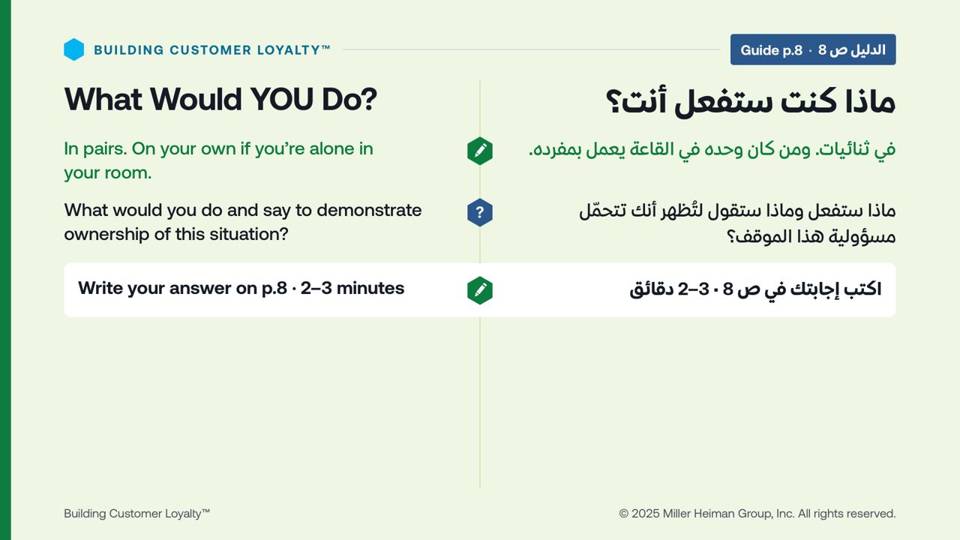
SayTo build customer loyalty, you have to demonstrate ownership of the interaction. (licensed)
DoAfter 2–3 minutes, hears a few pairs.
Ask · follow-up, by voice, as answers come inHow would your suggestion help this customer's experience?
In the roomsPairs inside each room; people alone work alone.
37B5a

Frustrated by no ownership?

Question
Slide
Slide 37: Frustrated by no ownership?
Facilitator
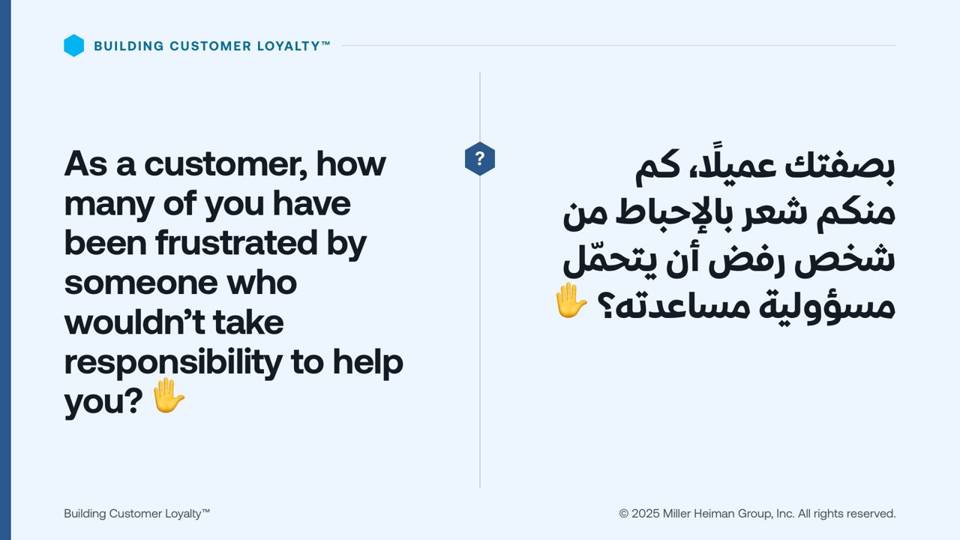
DoHands up; most will say yes.
RoomsHands up.
38B5

Owning it builds loyalty

Explain4 steps
Slide
Slide 38: Owning it builds loyalty
Facilitator
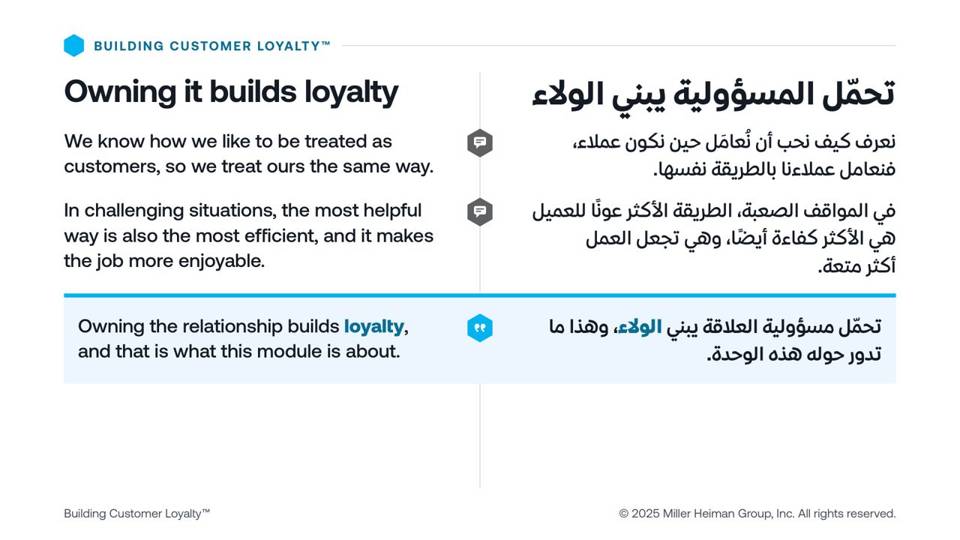
SayThe three licensed points.
RoomsListen.
39B6

Look beyond the request

ActivityGuide p.7
Slide
Slide 39: Look beyond the request
Learner material
Participant Guide p.7Participant Guide p.7Participant Guide p.7, large
Facilitator
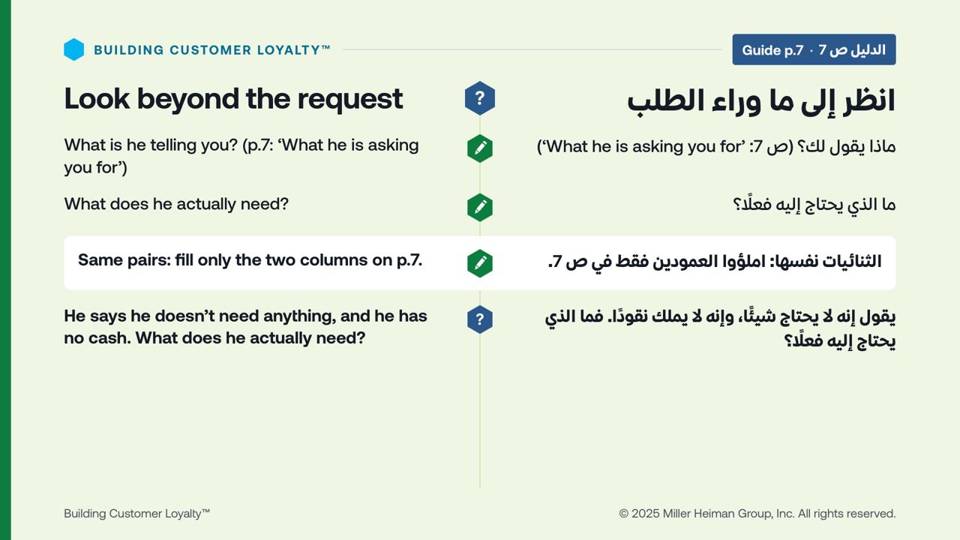
DoHears a few pairs.
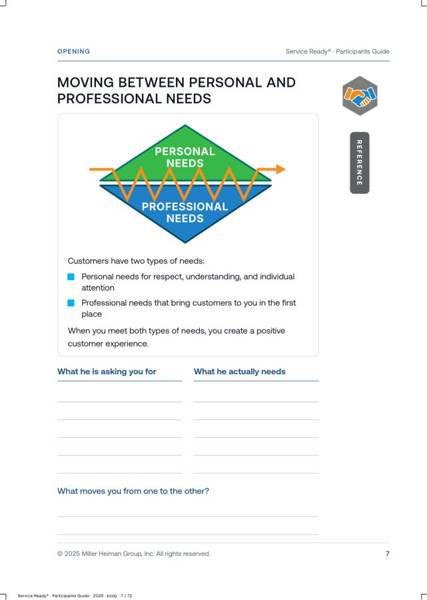
NoteThe top of p.7 already prints the answer; ask for the two columns only. The last line, 'What moves you from one to the other?', waits for the end of NCS.
In the roomsPairs write on p.7.
40B7

Every customer brings two needs

QuestionGuide p.74 steps
Slide
Slide 40: Every customer brings two needs
Learner material
Participant Guide p.7Participant Guide p.7Participant Guide p.7, large
Facilitator
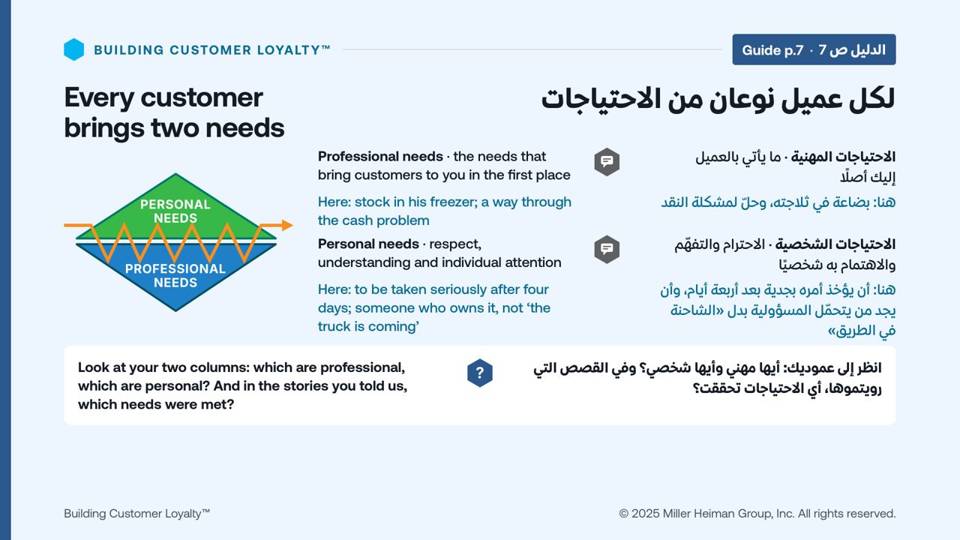
SayReads the top of p.7 with them, then asks.
RoomsLook at p.7.
41B7b

Key point: meet both needs

Key point
Slide
Slide 41: Key point: meet both needs
Facilitator
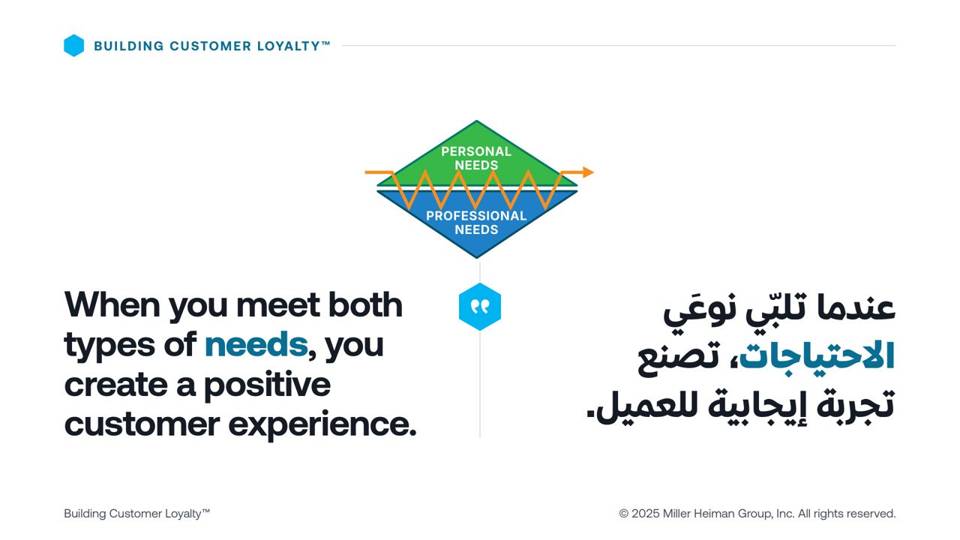
SayLands it: the licensed line printed on p.7.
RoomsListen.
42B7c

Quick recap: so far

Explain8 steps
Slide
Slide 42: Quick recap: so far
Facilitator
DoAsks the question; may take one or two answers, then walks through the lines and shows where we are in the day.
SayNow let's see where this module takes us.
NoteYour call: run it, or go straight on if time is short.
RoomsListen; one or two may answer.
43BR1

Break

Break
Slide
Slide 43: Break
Facilitator
Note10:00 Riyadh time, 15 minutes. Take it at the nearest natural stop to the clock time.
DoSays the time to be back, then starts the break.
ProducerTakes the quick headcount as each one person from the room reports back by voice.
RoomsOne person from the room sets a phone timer; the room comes back when it rings; headcount by voice.
44B8

Purpose

ExplainGuide p.9
Slide
Slide 44: Purpose
Learner material
Participant Guide p.9Participant Guide p.9Participant Guide p.9, large
Facilitator
ExplainThose feelings raise loyalty, bring value to the customer and to us, and build long-term, personal connections. These skills also have a big impact on your own stress. (licensed key points, FG p.8)
RoomsListen; p.9 open if they like.
45B9

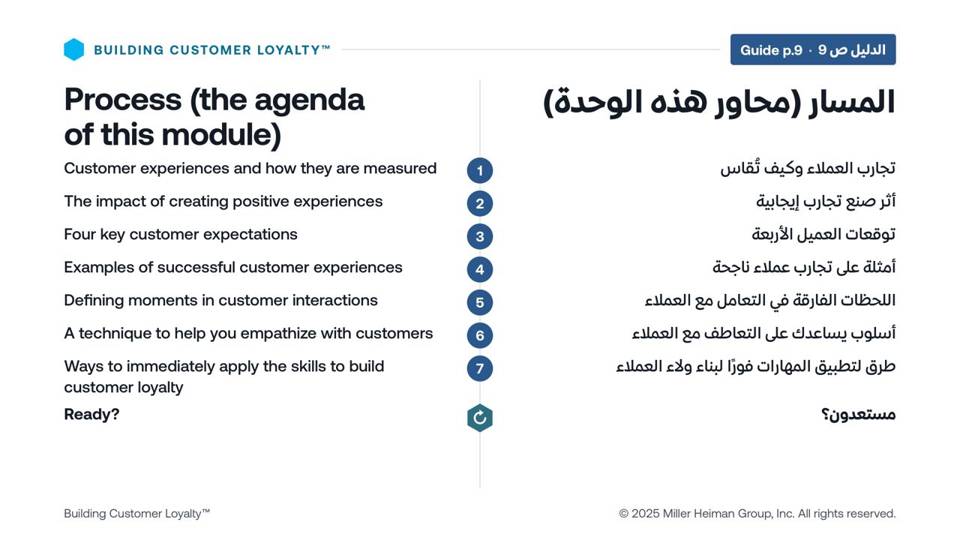
Process

ExplainGuide p.99 steps
Slide
Slide 45: Process
Learner material
Participant Guide p.9Participant Guide p.9Participant Guide p.9, large
Facilitator
ExplainWalks through the seven topics as the agenda for this module, then: 'Ready?' and moves on.
NoteNo payoffs activity. The payoffs stay printed on p.9.
RoomsListen.
46B10

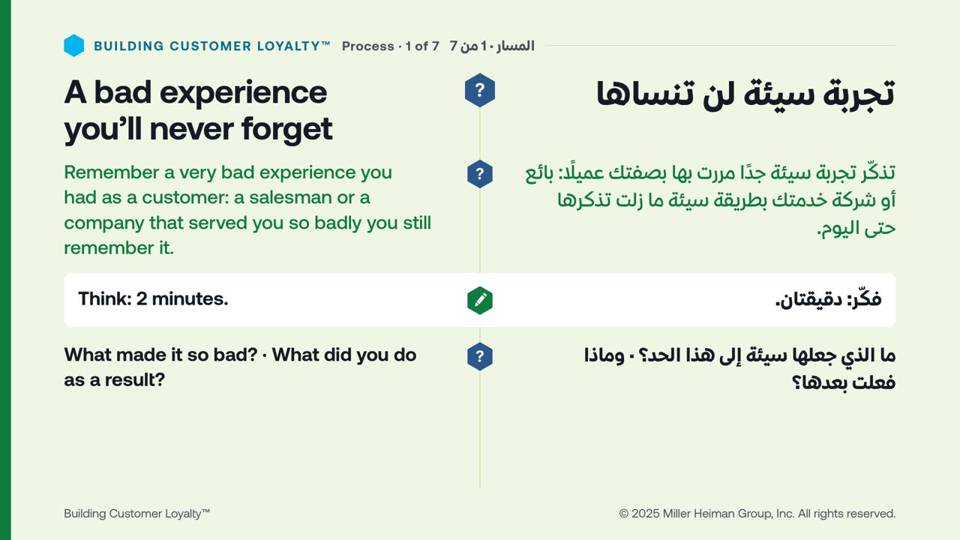
A bad experience you'll never forget

Activity
Slide
Slide 46: A bad experience you'll never forget
Facilitator
DoGives two minutes, then hears one or two stories, in their own way.
NoteExpected: poor service, no information, a return trip, bad attitude, no follow-up / changed brand, complained online, escalated to a supervisor.
In the roomsThink; one or two share by voice.
47B10b

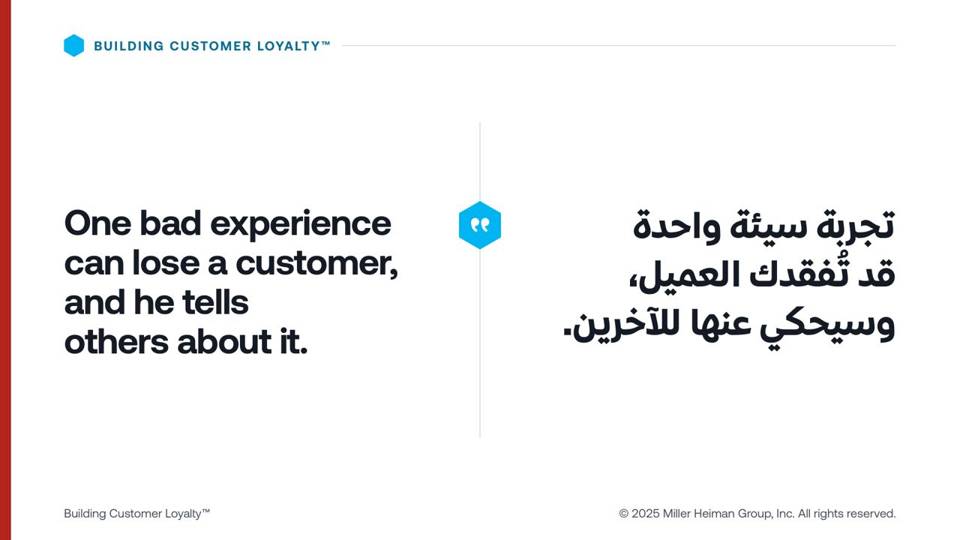
Key point: bad experiences

Key point
Slide
Slide 47: Key point: bad experiences
Facilitator
SayLands it after the stories, mirroring the good-experience point (B2b).
RoomsListen.
48B11a

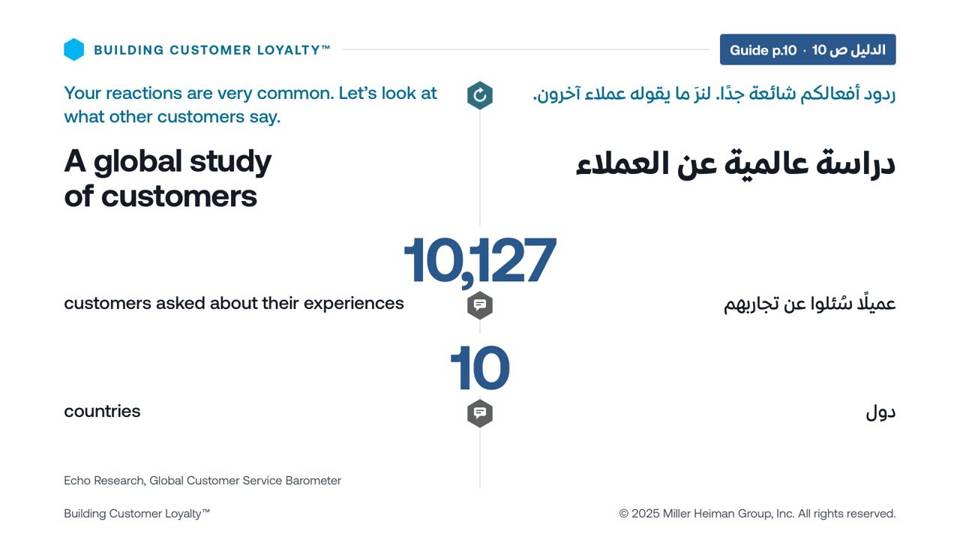
The research

ExplainGuide p.103 steps
Slide
Slide 48: The research
Learner material
Participant Guide p.10Participant Guide p.10Participant Guide p.10, large
Facilitator
ExplainBuilds the hype: a big international study asked ordinary customers what good and bad service does to them. 'Let's see what they said.'
RoomsListen.
49B11

What Customers Say

ExplainGuide p.106 steps
Slide
Slide 49: What Customers Say
Learner material
Participant Guide p.10Participant Guide p.10Participant Guide p.10, large
Facilitator
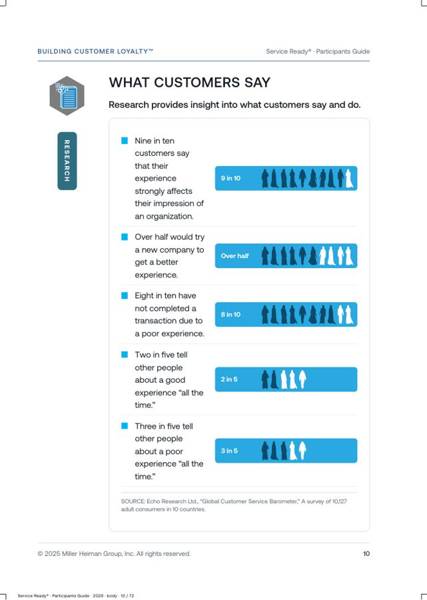
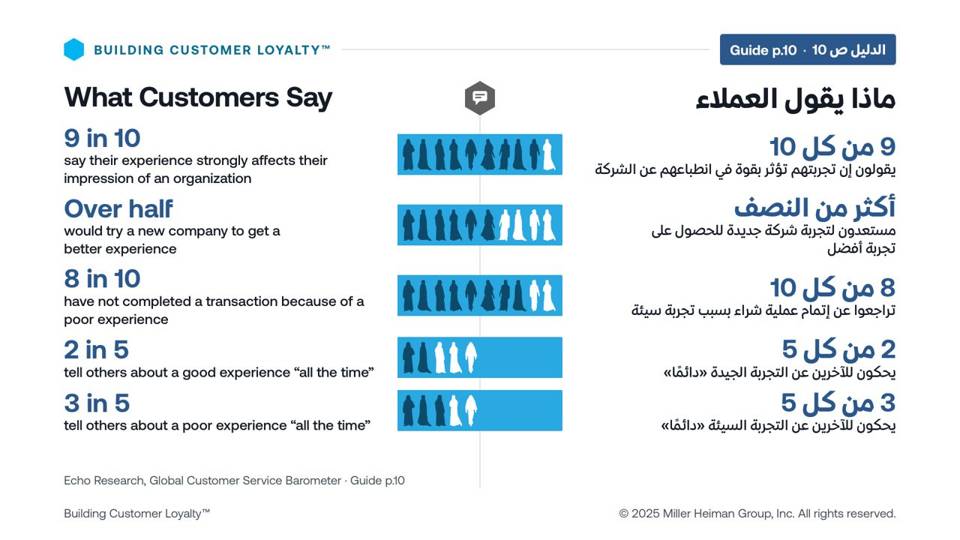
ExplainReveals the five figures one by one; learners can follow on p.10 (nothing to write).
NoteDesign: Saudi characters and a build-up of the numbers.
RoomsFollow on p.10.
50B11b

Do you relate?

Question
Slide
Slide 50: Do you relate?
Facilitator
DoShow of hands, once all five figures are on screen; may ask one or two to say why.
RoomsHands up.
51B11d

Key point: the hard truth

Key point
Slide
Slide 51: Key point: the hard truth
Facilitator
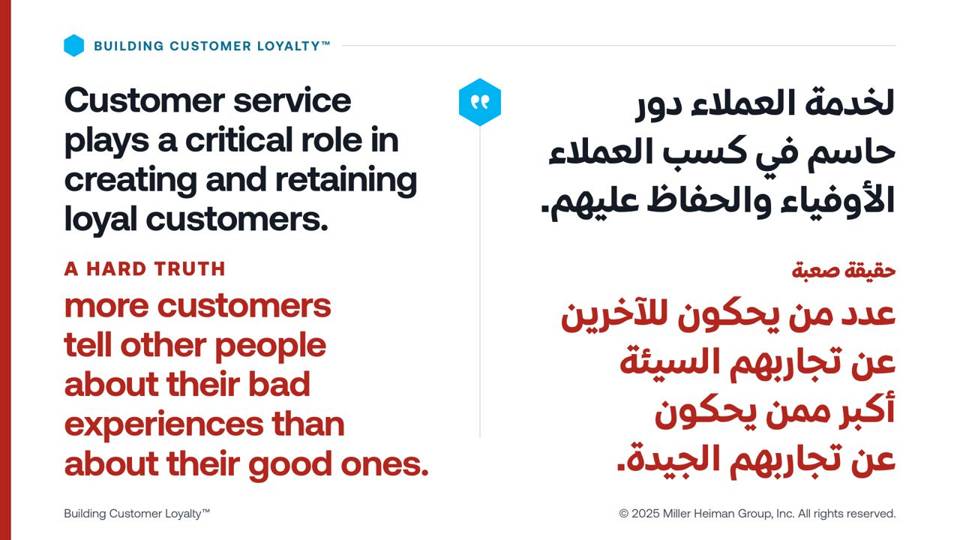
SayLands it after the show of hands (licensed important concept, FG p.13).
NoteIt lines up with p.10: 2 in 5 tell others about a good experience 'all the time', 3 in 5 about a poor one.
RoomsListen.
52B11c

Link: where is the problem?

Link
Slide
Slide 52: Link: where is the problem?
Facilitator
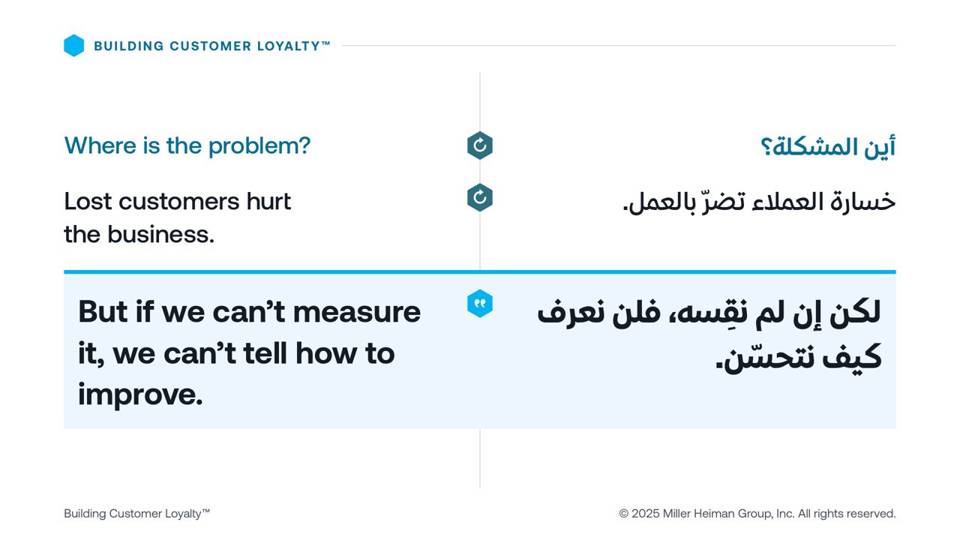
SayAsks it rhetorically, then answers it themselves.
RoomsListen.
53B12

Do you measure it?

QuestionGuide p.11
Slide
Slide 53: Do you measure it?
Learner material
Participant Guide p.11Participant Guide p.11Participant Guide p.11, large
Facilitator
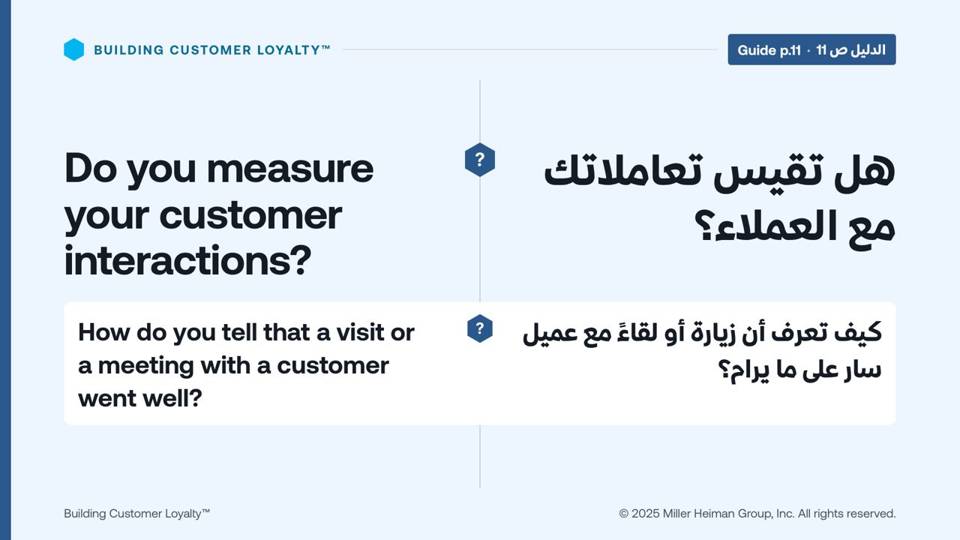
DoTakes a few answers to each question, in their own way.
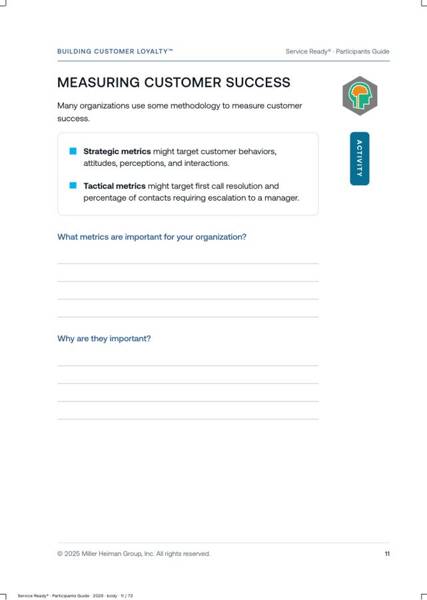
Notep.11's printed questions ('What metrics are important for your organization? Why?') can hold notes for anyone who wants to write.
If askedWhich customer metrics the company itself uses: to confirm with the client before the run.
RoomsA few answer by voice.
54B13

Net Promoter Score

Explain4 steps
Slide
Slide 54: Net Promoter Score
Facilitator
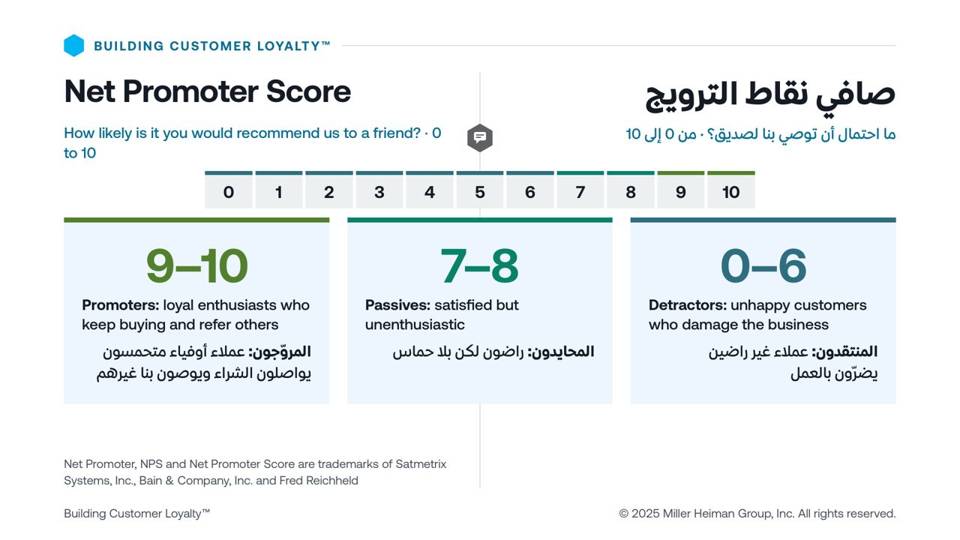
ExplainOne popular, simple metric that sums up good and bad experiences: it measures the customer's attitude.
If askedNPS = % promoters minus % detractors, from −100 to +100. Above 0 is good; +50 is excellent.
RoomsListen.
55B14b

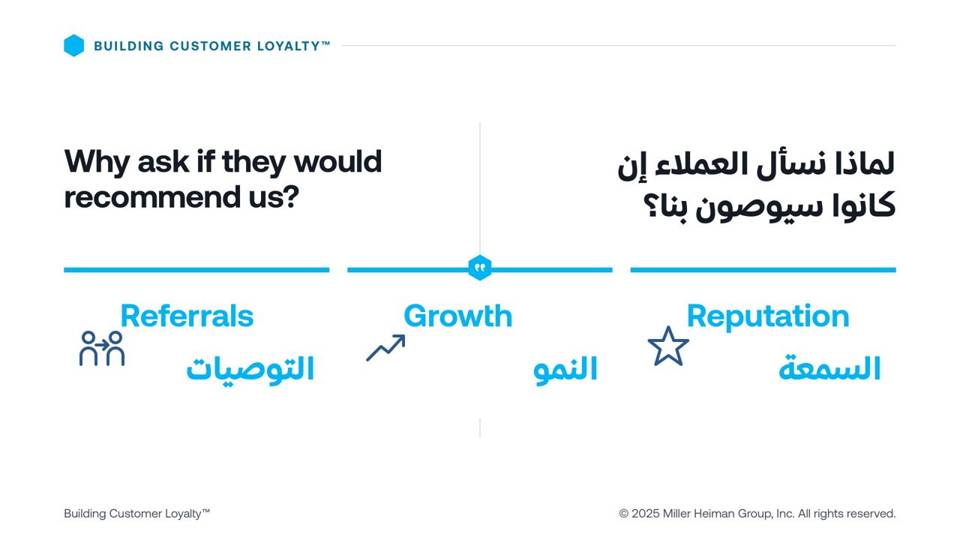
Key point: referrals, growth, reputation

Key point4 steps
Slide
Slide 55: Key point: referrals, growth, reputation
Facilitator
SayReferrals bring new business; without referrals there is no growth; and every recommendation builds our reputation.
RoomsListen.
56B16

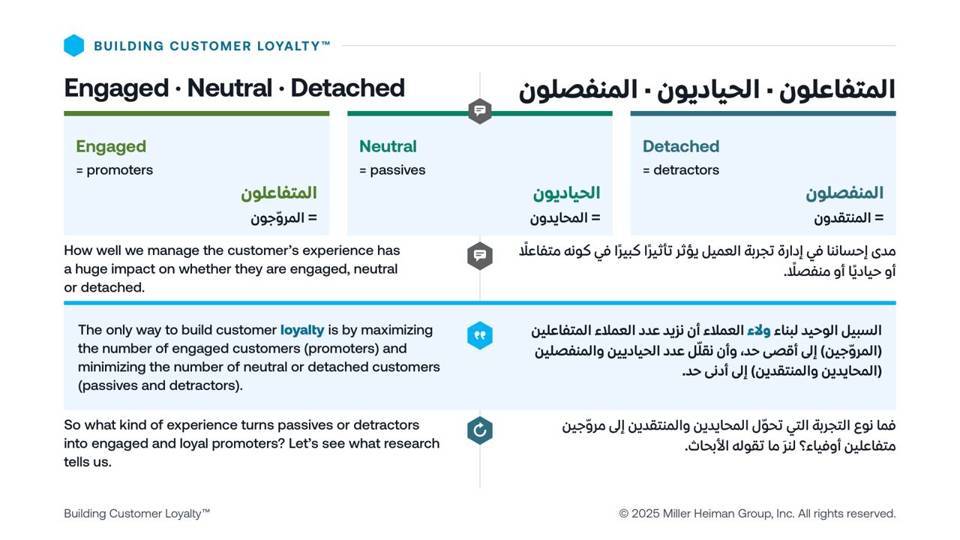
Engaged · neutral · detached

Explain7 steps
Slide
Slide 56: Engaged · neutral · detached
Facilitator
ExplainThe licensed 'important concept' (FG p.18), as written.
RoomsListen.
57B17

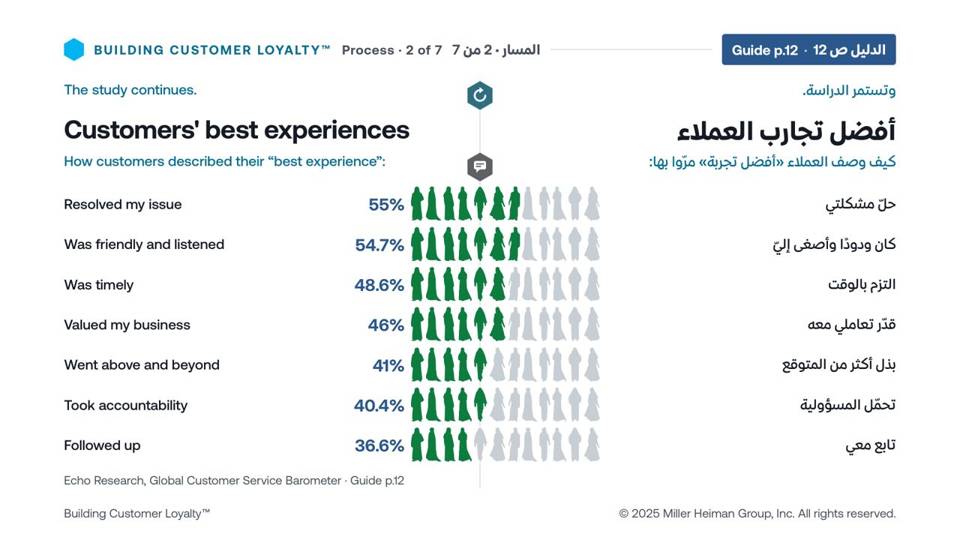
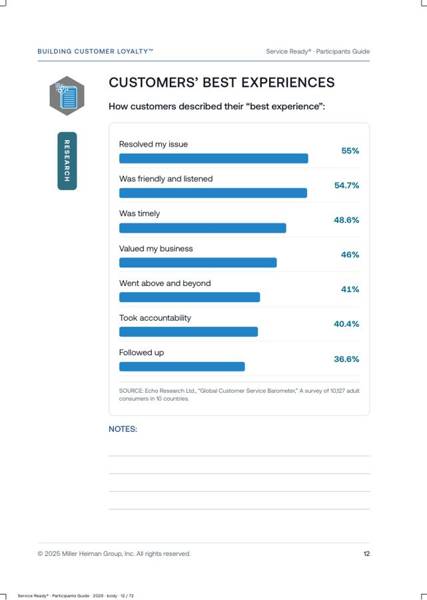
Customers' Best Experiences

ExplainGuide p.128 steps
Slide
Slide 57: Customers' Best Experiences
Learner material
Participant Guide p.12Participant Guide p.12Participant Guide p.12, large
Facilitator
ExplainReads the seven; learners follow on p.12.
RoomsFollow on p.12.
58B17d

EXPECTATIONS

Explain
Slide
Slide 58: EXPECTATIONS
Facilitator
SayPoints back over the seven results: resolved my issue, friendly and listened, timely... All of these are what we call expectations.
SayLets the word sit, then moves into the four key customer expectations.
RoomsListen.
59B18

Four Key Customer Expectations

ExplainGuide p.146 steps
Slide
Slide 59: Four Key Customer Expectations
Learner material
Participant Guide p.14Participant Guide p.14Participant Guide p.14, large
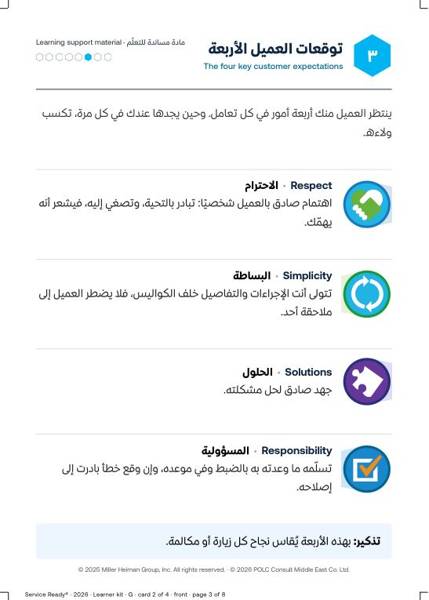
Arabic support card 3 (Arabic runs)Arabic support card 3 (Arabic runs)Arabic support card 3 (Arabic runs), large
Facilitator
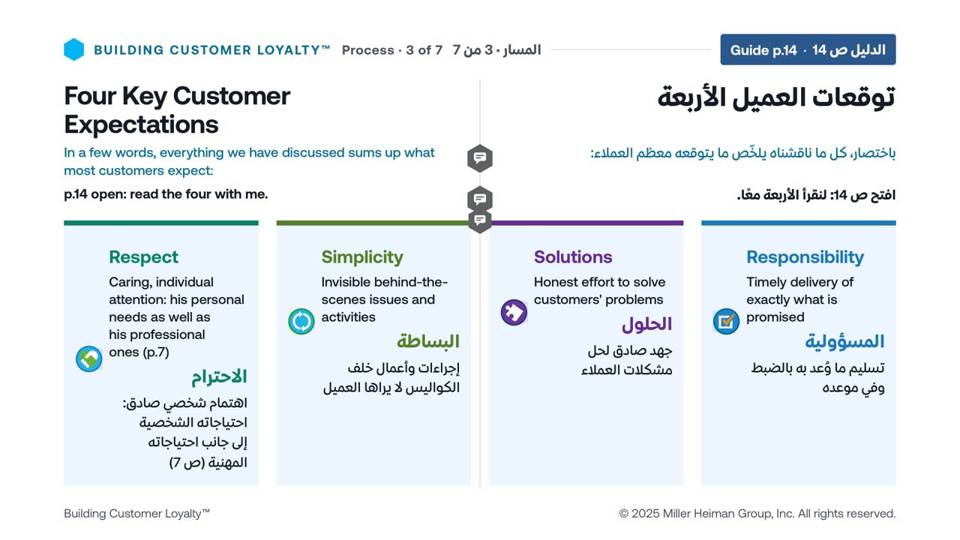
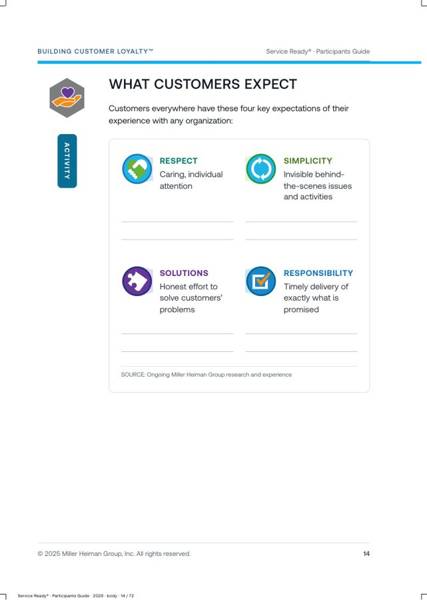
SayIn a few words, we can sum up our discussion of what most customers expect: Respect, Simplicity, Solutions and Responsibility. (licensed, FG p.23) Then reads the four with them from p.14.
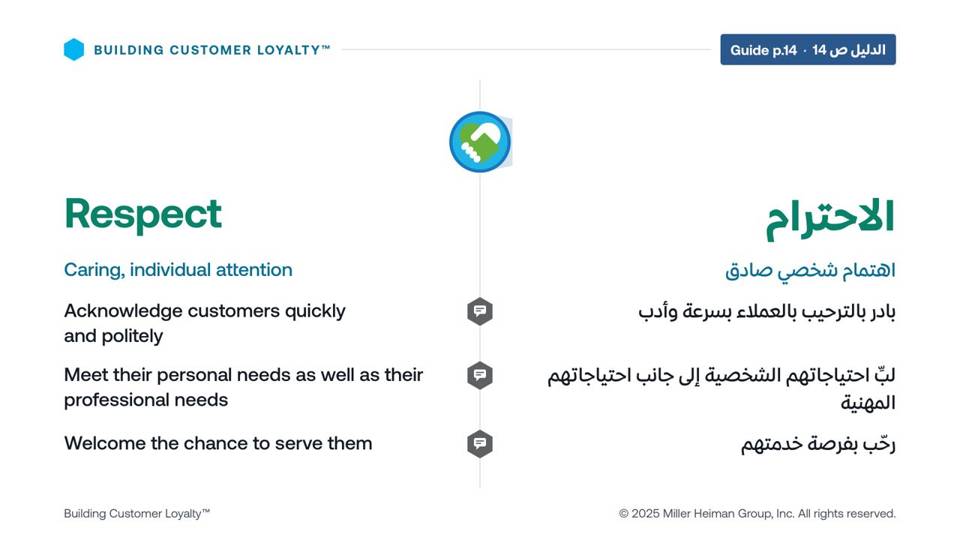
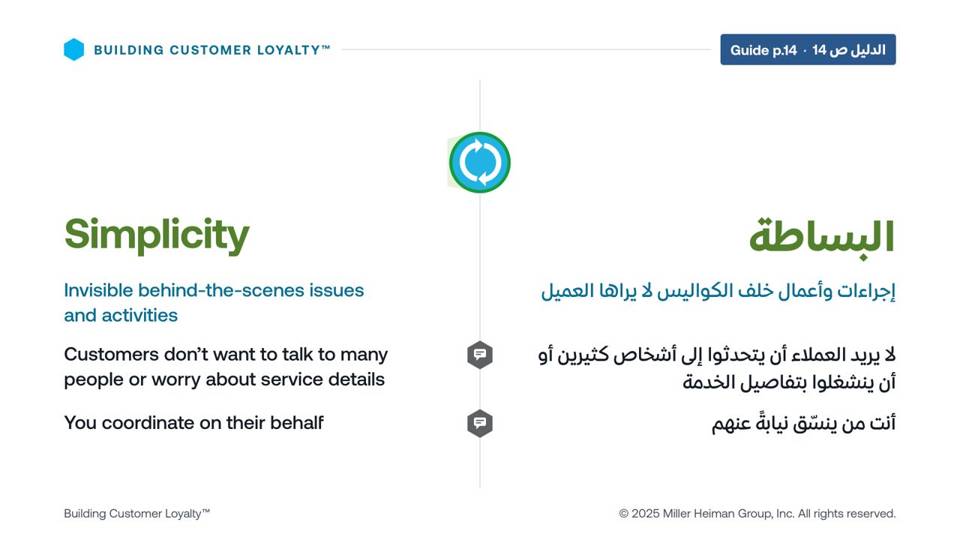
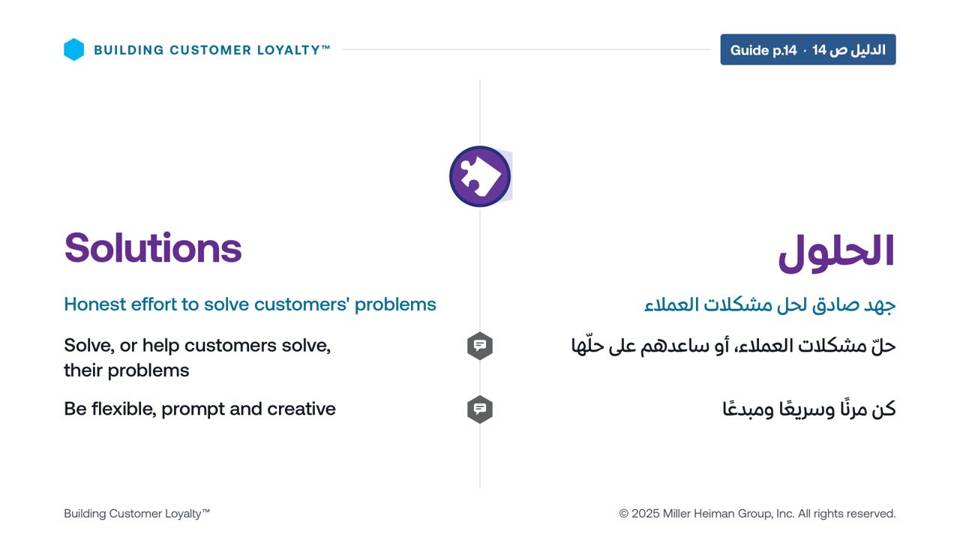
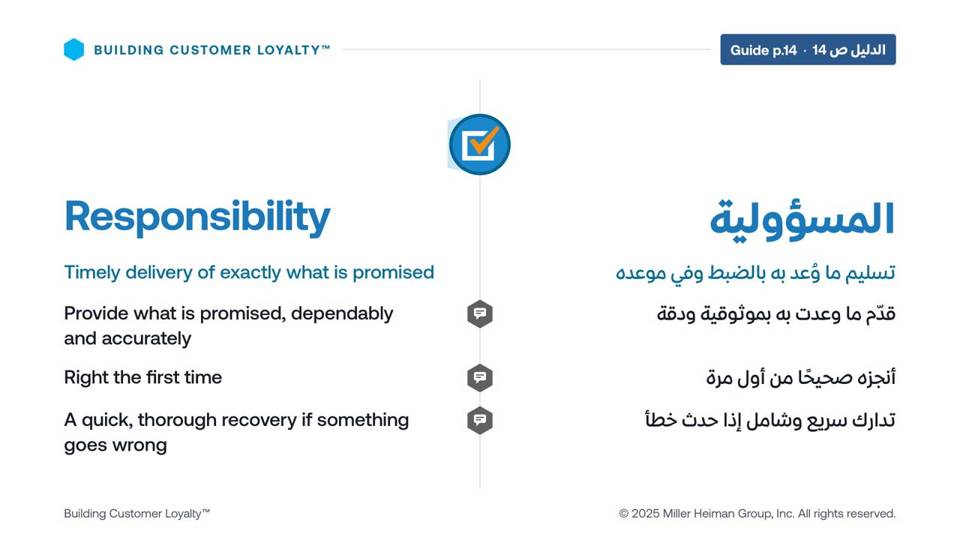
ExplainThe full licensed meanings (also printed on p.59): Respect · caring and individual attention: acknowledge customers quickly and politely, meet their personal needs as well as their professional needs, welcome the chance to serve them. Simplicity · managing invisible behind-the-scenes issues and activities: customers don't want to talk to many people or worry about service details; you coordinate on their behalf. Solutions · an honest effort to solve, or help customers solve, their problems: flexible, prompt and creative. Responsibility · providing what is promised, dependably and accurately: right the first time, and a quick, thorough recovery if something goes wrong.
NoteNeeds thread: Respect's full meaning names both needs from p.7 ('personal as well as professional'); the callback is now on screen in the Respect box.
Roomsp.14 open; read the four with the facilitator; listen.
60B18a

Respect

ExplainGuide p.144 steps
Slide
Slide 60: Respect
Learner material
Participant Guide p.14Participant Guide p.14Participant Guide p.14, large
Facilitator
ExplainLicensed meaning (FG p.23, printed p.59). Callback: the two needs from p.7.
RoomsListen; p.14 open.
61B18b

Simplicity

ExplainGuide p.143 steps
Slide
Slide 61: Simplicity
Learner material
Participant Guide p.14Participant Guide p.14Participant Guide p.14, large
Facilitator
ExplainLicensed meaning (FG p.23, printed p.59).
RoomsListen.
62B18c

Solutions

ExplainGuide p.143 steps
Slide
Slide 62: Solutions
Learner material
Participant Guide p.14Participant Guide p.14Participant Guide p.14, large
Facilitator
ExplainLicensed meaning (FG p.23, printed p.59).
RoomsListen.
63B18d

Responsibility

ExplainGuide p.144 steps
Slide
Slide 63: Responsibility
Learner material
Participant Guide p.14Participant Guide p.14Participant Guide p.14, large
Facilitator
ExplainLicensed meaning (FG p.23, printed p.59).
RoomsListen.
64B18e

Key point: four key expectations

Key point
Slide
Slide 64: Key point: four key expectations
Facilitator
SayLicensed key point (FG p.23).
RoomsListen.
65B18f

Link: what does it look like?

Link
Slide
Slide 65: Link: what does it look like?
Facilitator
SayMoves into the room activity.
RoomsListen.
66B19

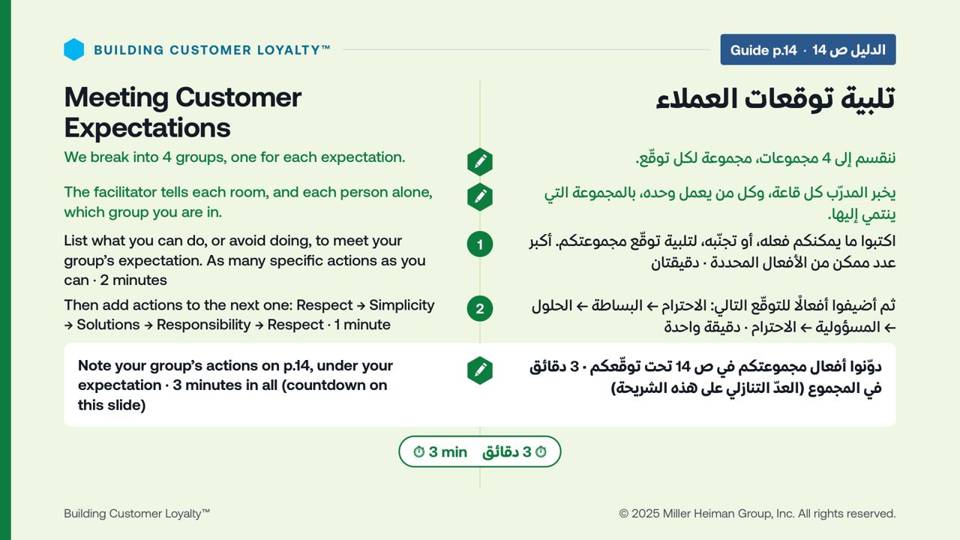
Meeting Customer Expectations: in your room

ActivityGuide p.14
Slide
Slide 66: Meeting Customer Expectations: in your room
Learner material
Participant Guide p.14Participant Guide p.14Participant Guide p.14, large
Facilitator
SayIn this activity, you'll brainstorm with your room what you can do, or avoid doing, to meet each expectation for your customers. List as many specific actions as you can think of. (licensed, FG p.25)
DoBreaks everyone into 4 groups, one per expectation: tells each room, and each person alone, its group by voice, spreading the four evenly. Each room works on its group's expectation where it sits; the one person from each room of the same group report together at the debrief. Takes questions, then starts the clock. At 2 minutes: 'Now add to the next one on the list.'
Do4 groups: 2 groups in the Riyadh room + 2 groups in Teams breakout rooms (auto-assign). 3 minutes, then 1 minute to share per group.
ProducerStarts the 3-minute countdown built into this slide; the slide stays up while rooms work. No WhatsApp post (rule 6).
NoteReplaces the original rotation round four wall charts (FG pp.24–25) and the four named breakout rooms: Android Teams Rooms cannot join breakouts on 7 Nov. Step 2 keeps the rotation's idea: every expectation gets ideas from more than one room.
In the roomsEach depot room works on one expectation together and notes on p.14; people alone work alone.
67B19b

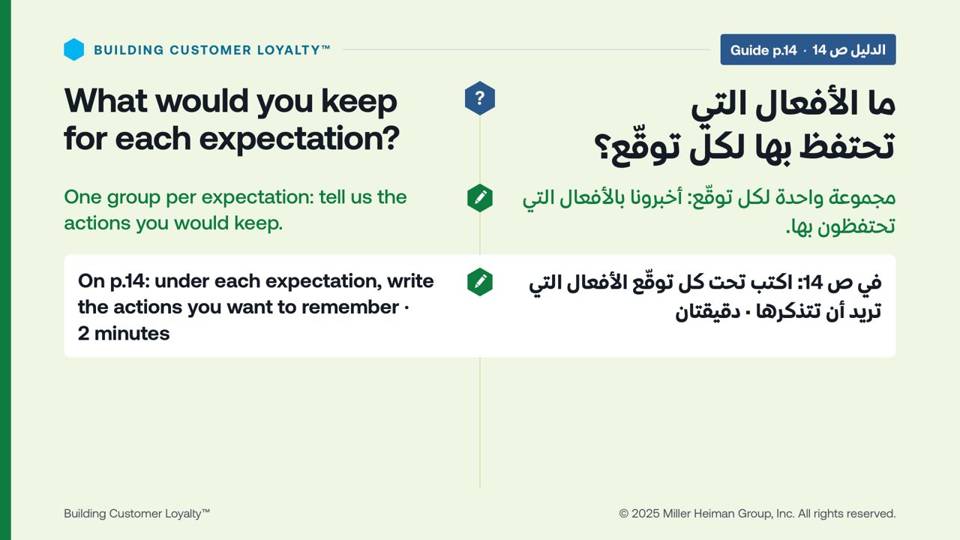
What would you keep?

ActivityGuide p.14
Slide
Slide 67: What would you keep?
Learner material
Participant Guide p.14Participant Guide p.14Participant Guide p.14, large
Facilitator
DoGoes expectation by expectation and hears one room for each, in their own way.
Notep.14 prints two blank lines under each expectation and no instruction: this slide gives it (the original's debrief step, FG p.26).
If askedRoute examples if a room is stuck (built from the survey items on pp.24–27): Respect · greet the owner by name; look up from the tablet. Simplicity · sort the delivery or the return with the warehouse yourself; don't send him to call three people. Solutions · offer options: a smaller order, another pack, another delivery day. Responsibility · do what you said, when you said it; follow up; tell him the date yourself.
In the roomsOne person from each room report by voice; everyone writes on p.14.
68B19c

Key point: the Golden Rule

Explain
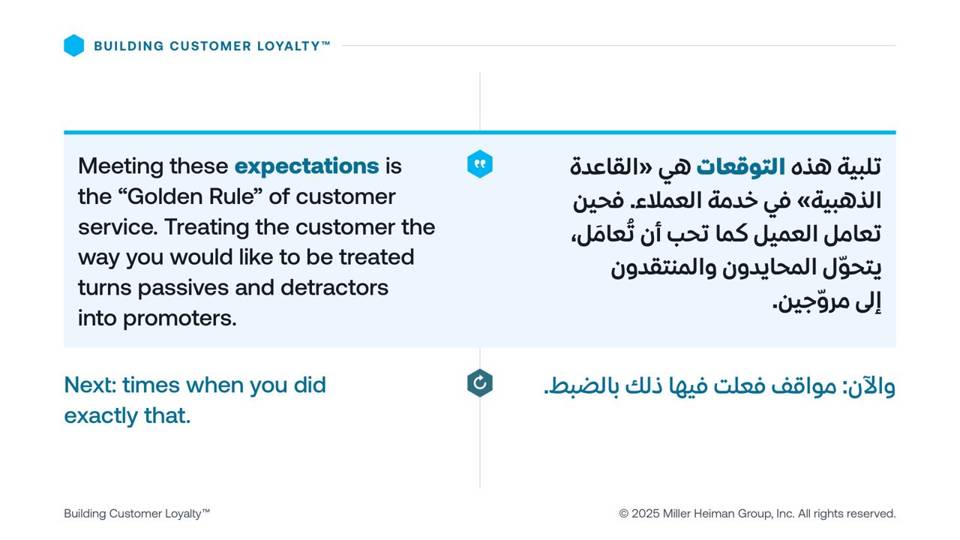
Slide
Slide 68: Key point: the Golden Rule
Facilitator
SayLands it after the reports (licensed transition, FG p.26).
NoteIt echoes B5's licensed line 'we treat ours the same way': a callback, not a new idea.
RoomsListen.
69B20

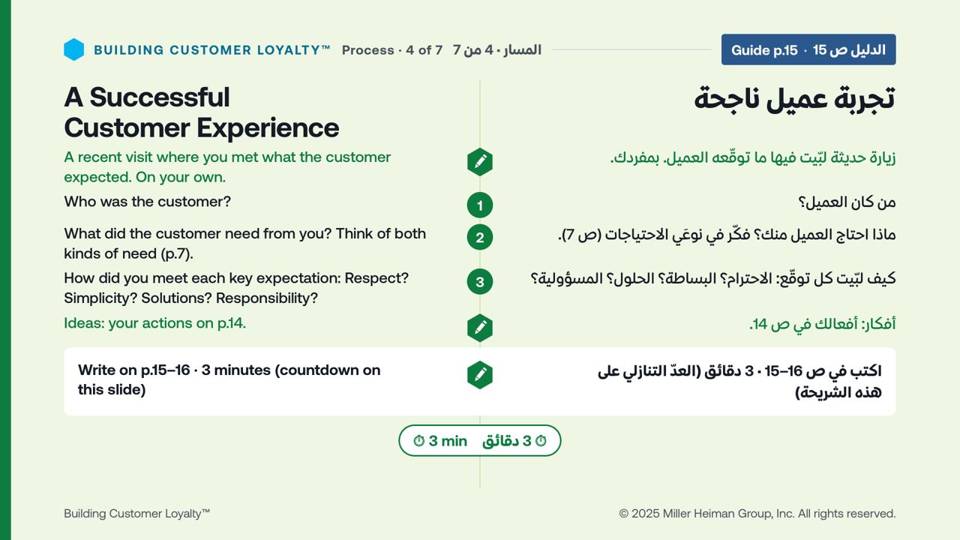
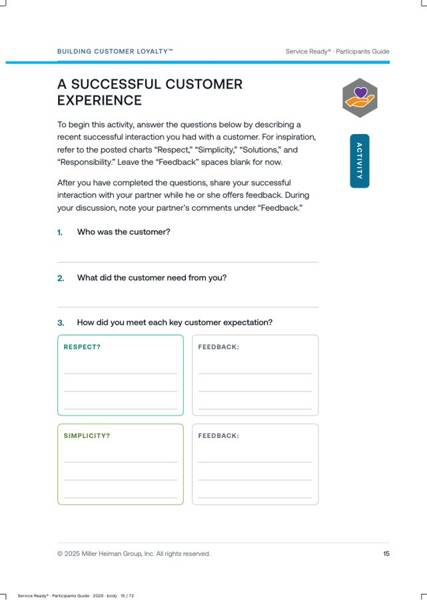
A Successful Customer Experience: on your own

ActivityGuide p.15
Slide
Slide 69: A Successful Customer Experience: on your own
Learner material
Participant Guide p.15Participant Guide p.15Participant Guide p.15, large
Facilitator
SayIn this activity, you'll share how you met the customer's expectations with a real customer. (licensed, FG p.27)
NoteThe 'Ideas' line comes from printed p.15's instruction ('For ideas, look at the posted charts'), with the charts replaced by p.14.
ProducerStarts the 3-minute countdown built into this slide; the slide stays up.
NotePrinted p.15 tells learners to look at 'the posted charts' and to share with a partner: say 'your notes on p.14' and 'we'll hear one or two of you'.
NoteNeeds thread: question 2 is the licensed callback to p.7 (kit p.15).
In the roomsEach person writes alone.
70B20b

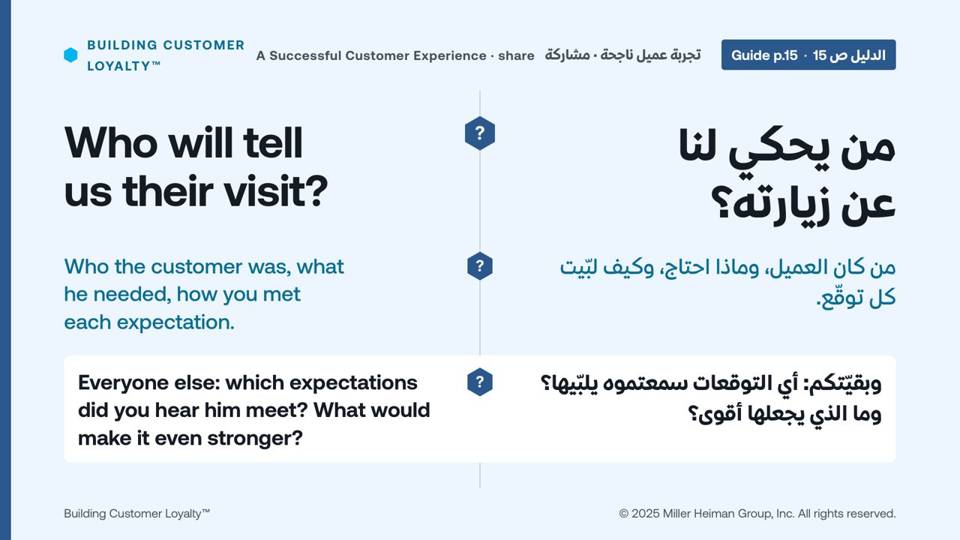
One or two stories, feedback from the room

QuestionGuide p.15
Slide
Slide 70: One or two stories, feedback from the room
Learner material
Participant Guide p.15Participant Guide p.15Participant Guide p.15, large
Facilitator
DoHears one or two volunteers, in their own way. After each story, takes feedback from a few rooms, expectation by expectation.
NoteOriginal: pairs; each partner gives feedback per expectation, then they switch roles (FG p.28). The facilitator made it individual + one or two stories with feedback from the room. If time allows, pairs inside each room (as on B4) are the original's version.
RoomsOne or two volunteers tell their story by voice; one person from each room give feedback; the storyteller writes it down.
71B21

Defining Moment

ExplainGuide p.17
Slide
Slide 71: Defining Moment
Learner material
Participant Guide p.17Participant Guide p.17Participant Guide p.17, large
Arabic support card 4 (Arabic runs)Arabic support card 4 (Arabic runs)Arabic support card 4 (Arabic runs), large
Facilitator
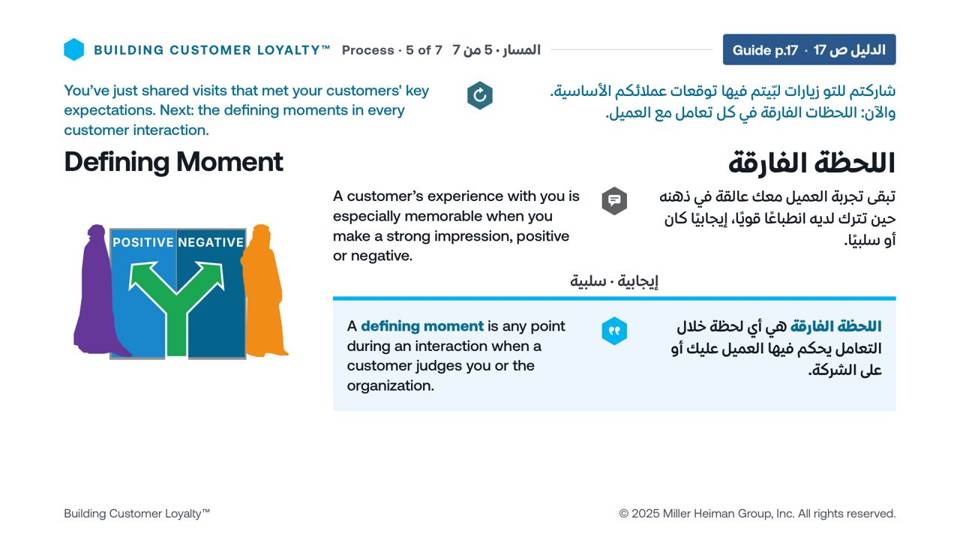
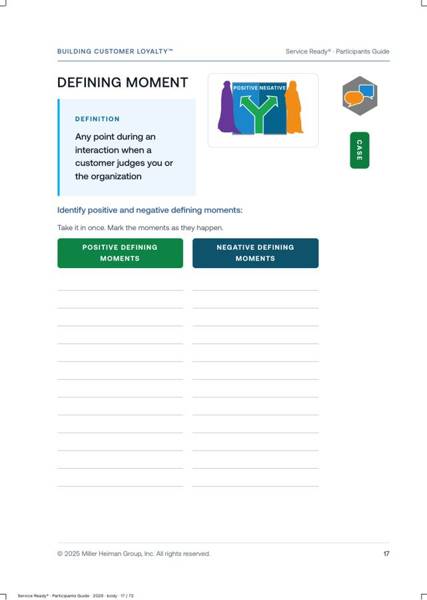
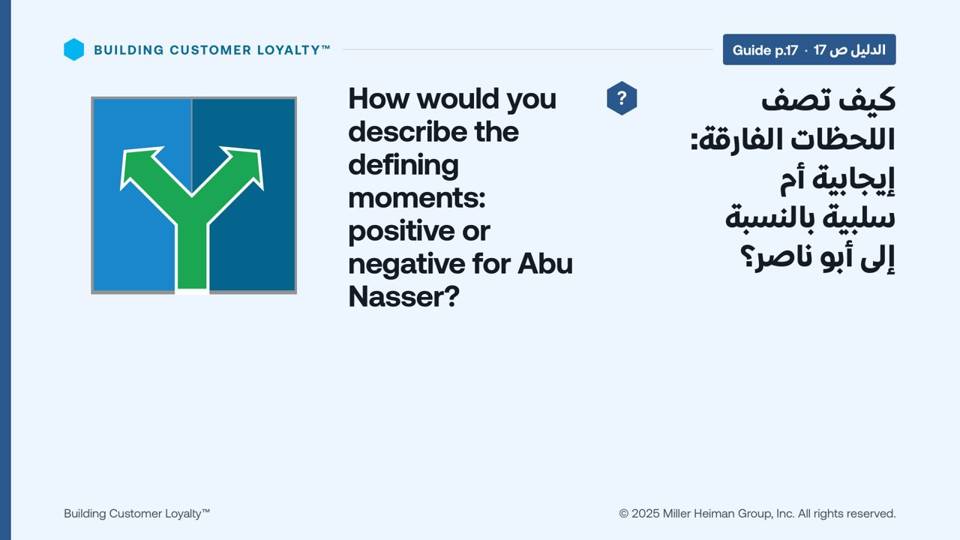
SayFor better or worse, a customer's experience with you is especially memorable when you create a strong impression. We call this event, positive or negative, a 'defining moment'. (licensed, FG p.31)
RoomsListen; p.17 open.
72B21b

Common defining moments

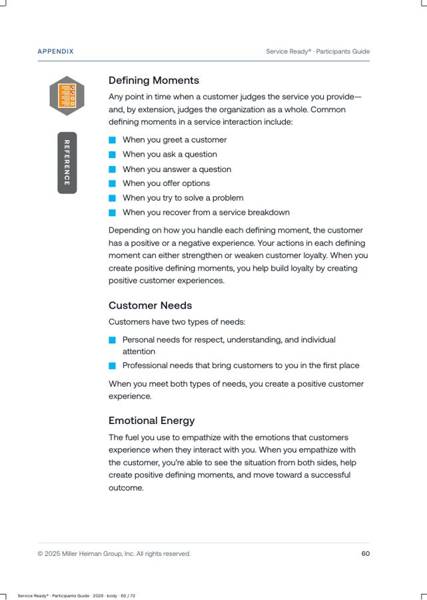
ExplainGuide p.608 steps
Slide
Slide 72: Common defining moments
Learner material
Participant Guide p.60Participant Guide p.60Participant Guide p.60, large
Facilitator
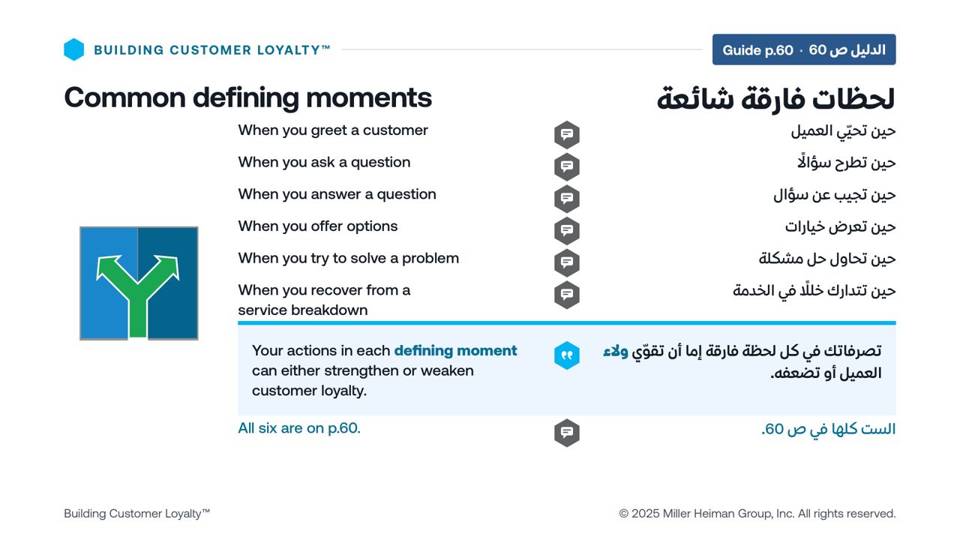
ExplainDepending on how you handle each moment, the customer has a positive or a negative experience. When you create positive defining moments, you build loyalty. (licensed, FG Sec.1 p.5)
If askedOn a route (my examples): greeting the owner at the door · asking about his stock · answering about a price or a promotion · offering a smaller order or another day · sorting an empty shelf · recovering from a missed delivery.
RoomsListen; p.60 if they want it.
73B21c

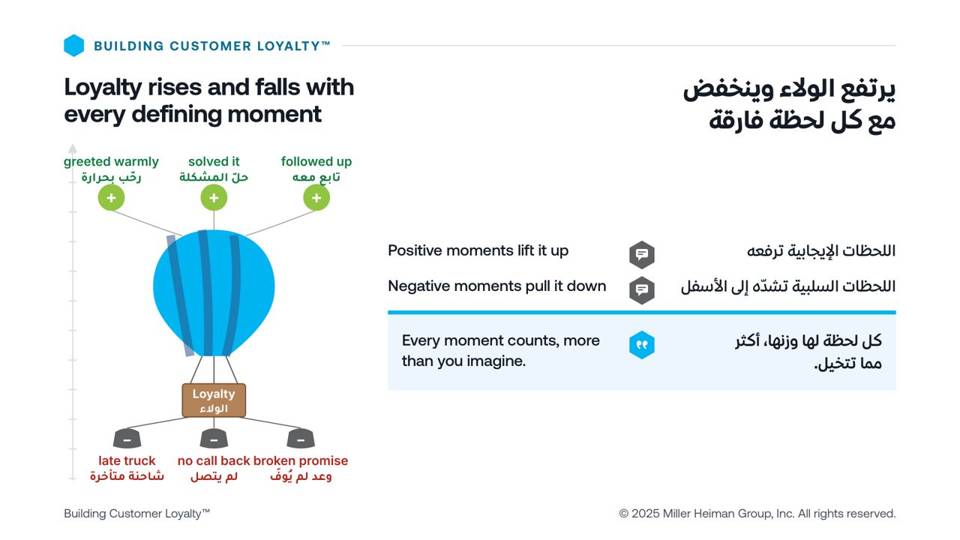
Every moment counts

Explain4 steps
Slide
Slide 73: Every moment counts
Facilitator
ExplainThe more positive defining moments, the higher loyalty rises; every negative one is a stone that pulls it down. Customers count every moment, more than we imagine.
RoomsListen.
74BR2

Break

Break
Slide
Slide 74: Break
Facilitator
Note11:30 Riyadh time, 30 minutes. Take it at the nearest natural stop to the clock time.
DoSays the time to be back, then starts the break.
ProducerTakes the quick headcount as each one person from the room reports back by voice.
RoomsOne person from the room sets a phone timer; the room comes back when it rings; headcount by voice.
75B22

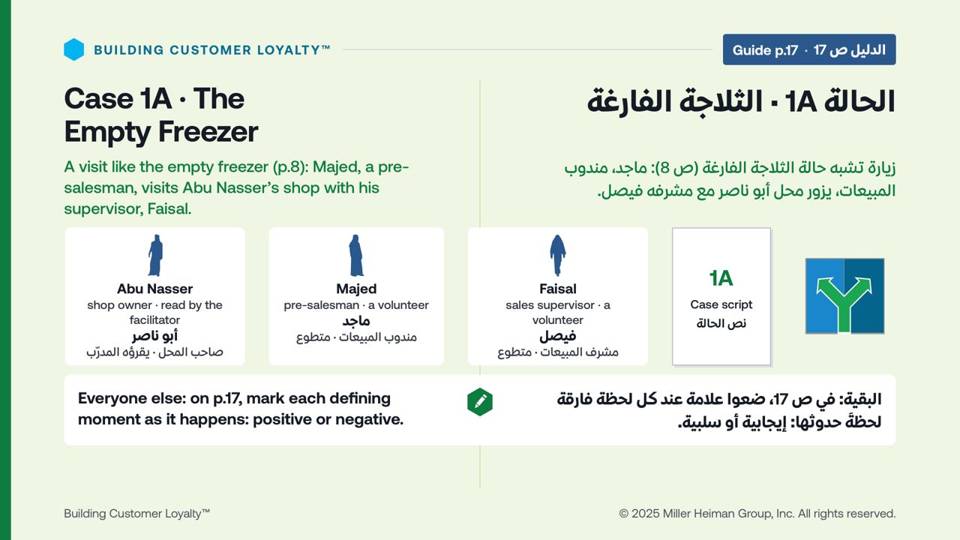
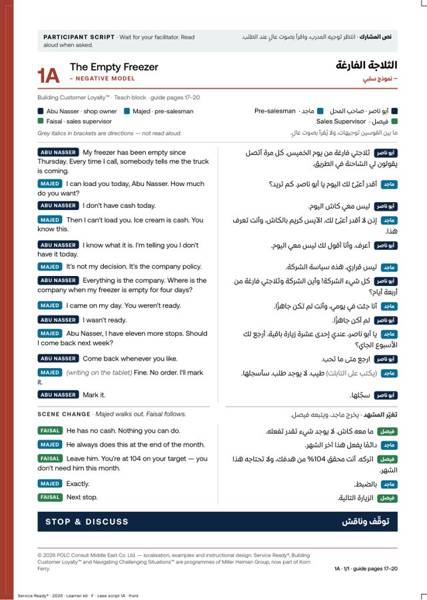
Case 1A · The Empty Freezer

ActivityGuide p.17
Slide
Slide 75: Case 1A · The Empty Freezer
Learner material
Participant Guide p.17Participant Guide p.17Participant Guide p.17, large
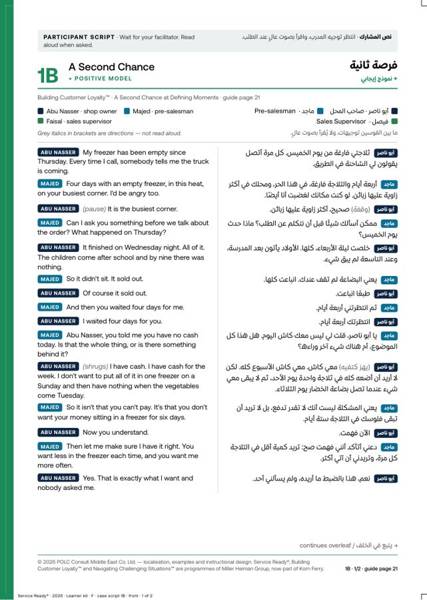
Case script, page 1Case script, page 1Case script, page 1, large
Facilitator
SayRemember the empty freezer from earlier (p.8)? Now listen to how Majed handles a visit like it. Then: To see how defining moments can turn neutral customers into detached or engaged customers, let's listen to a short visit. As you listen, see how many defining moments, positive or negative, you can find for the customer. (licensed, FG pp.31–32)
DoAsks for two volunteers, in their own way (no names called). Readers read from the sheet into their room's mic. Arabic runs read the Arabic side.
NoteRead, not acted. The other three sheets stay in the pocket: 1B is the second chance and must not be read first.
In the roomsThree readers; everyone else marks p.17.
76B22b

Case 1A: what happened?

QuestionGuide p.17
Slide
Slide 76: Case 1A: what happened?
Learner material
Participant Guide p.17Participant Guide p.17Participant Guide p.17, large
Case script, page 1Case script, page 1Case script, page 1, large
Facilitator
DoTakes a few answers to each, in their own way.
NoteExpected (the original's samples, set in the case): all negative · no empathy ('Ice cream is cash. You know this.'); blunt to the point of rudeness ('You weren't ready'); no ownership ('It's not my decision. It's the company policy.'); no options ('Should I come back next week?'), then 'No order' on the tablet.
NoteLikely next (original: look elsewhere, warn others, post a bad review, escalate): lets another company's freezer in · tells other shop owners · calls the supervisor or the company · orders less.
NoteFaisal (POLC case panel): he confirmed that a hit target closes the conversation ('You're at 104… you don't need him this month'). Nobody asked what was behind 'no cash'.
Ask · follow-up, by voiceWhat did Majed do to create these moments?
Ask · follow-up, by voiceWhat is Abu Nasser likely to do now?
Ask · follow-up, by voiceAnd Faisal, in the van: what did he do?
RoomsA few answer by voice.
77B23

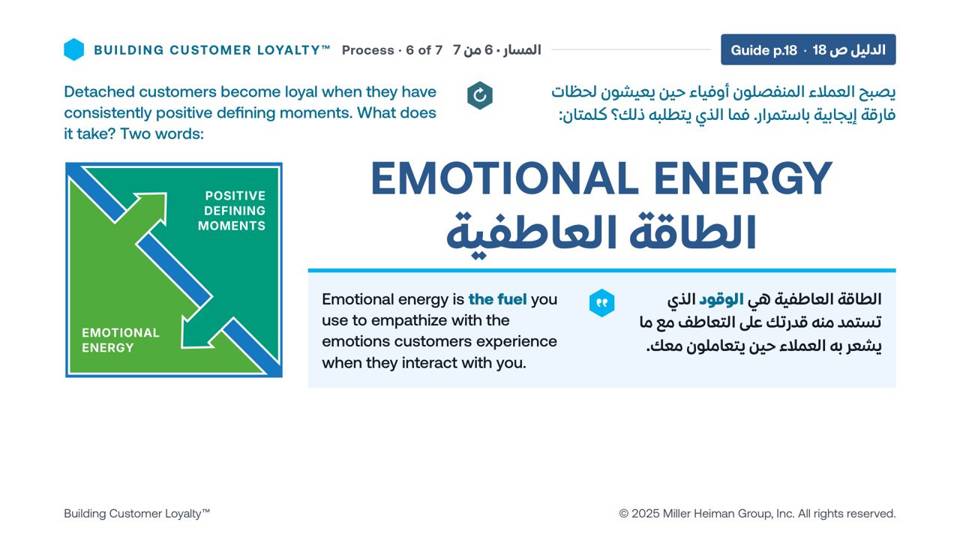
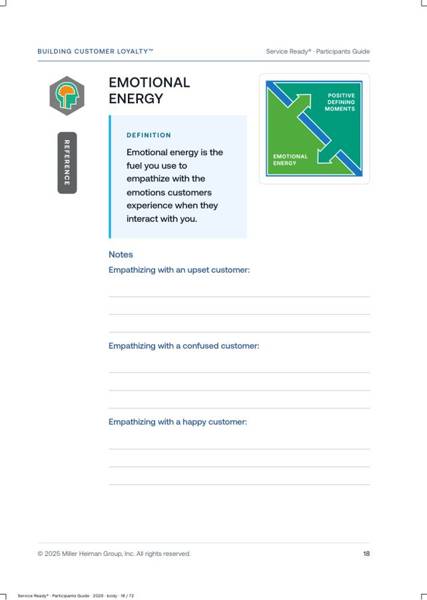
Emotional Energy

ExplainGuide p.184 steps
Slide
Slide 77: Emotional Energy
Learner material
Participant Guide p.18Participant Guide p.18Participant Guide p.18, large
Facilitator
SayWe've seen negative defining moments and what they do to loyalty. Now: one way to create positive ones. Then the licensed transition, hook and definition (FG pp.32–33), as written.
RoomsListen; p.18 open.
78B23e

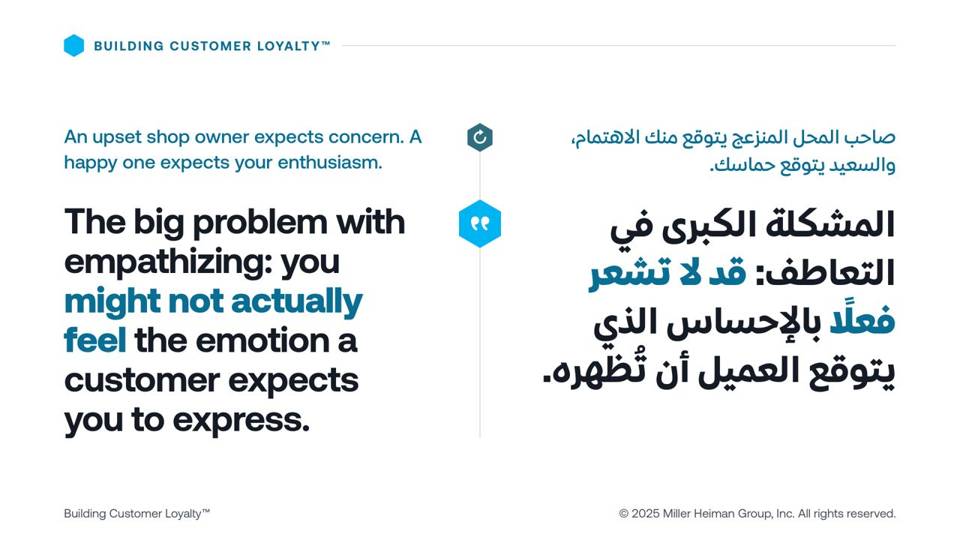
Key point: the problem with empathizing

Key point
Slide
Slide 78: Key point: the problem with empathizing
Facilitator
SayThe licensed important concept (FG p.34), as written. It sets up the next question.
RoomsListen.
79B23c

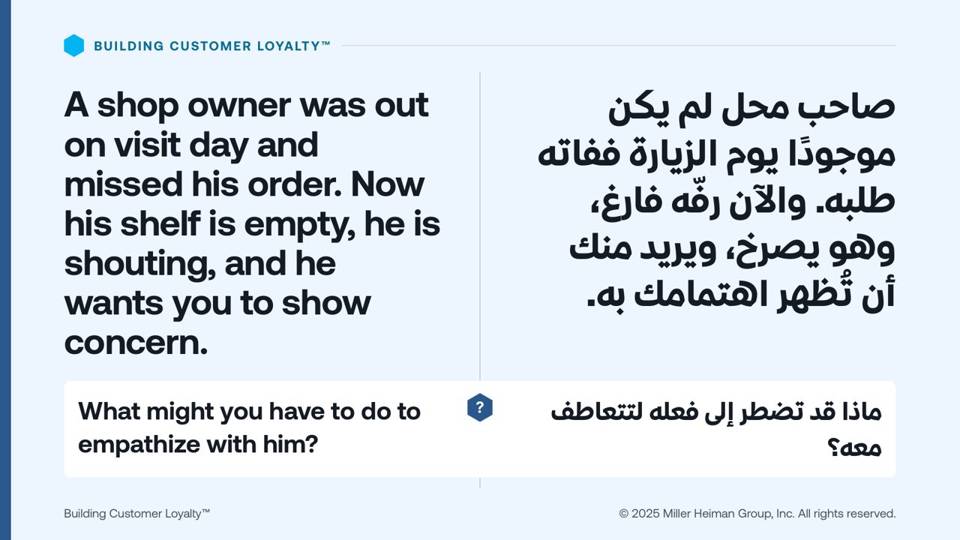
The angry customer who caused it

Question
Slide
Slide 79: The angry customer who caused it
Facilitator
DoTakes a few answers.
NoteAnticipated (original): pretend to feel the emotion.
RoomsA few answer by voice.
80B23d

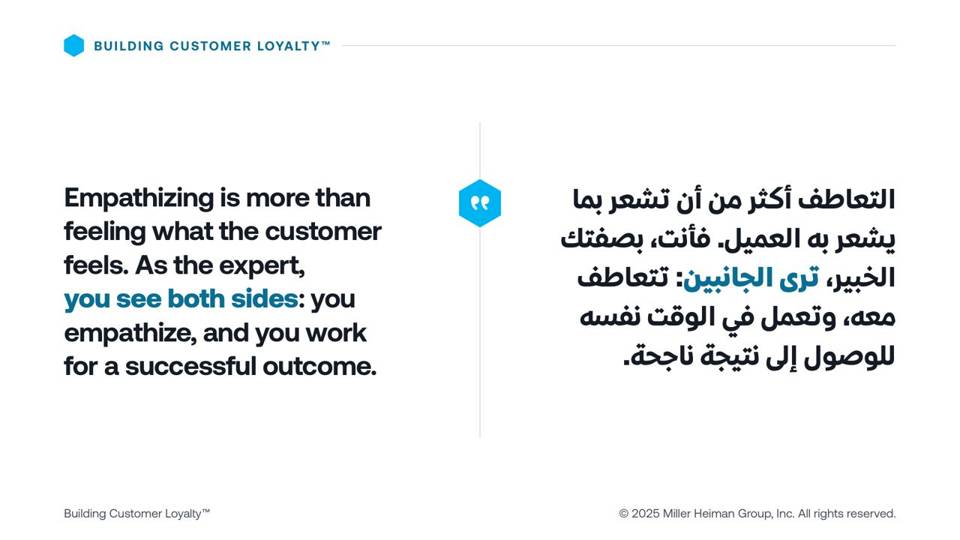
Key point: you see both sides

Key point
Slide
Slide 80: Key point: you see both sides
Facilitator
SayThe second licensed important concept (FG p.34), after the answers to B23c.
NoteThe first concept ('the big problem with empathizing') now has its own slide before B23c (B23e), as in FG p.34's order.
RoomsListen.
81B24

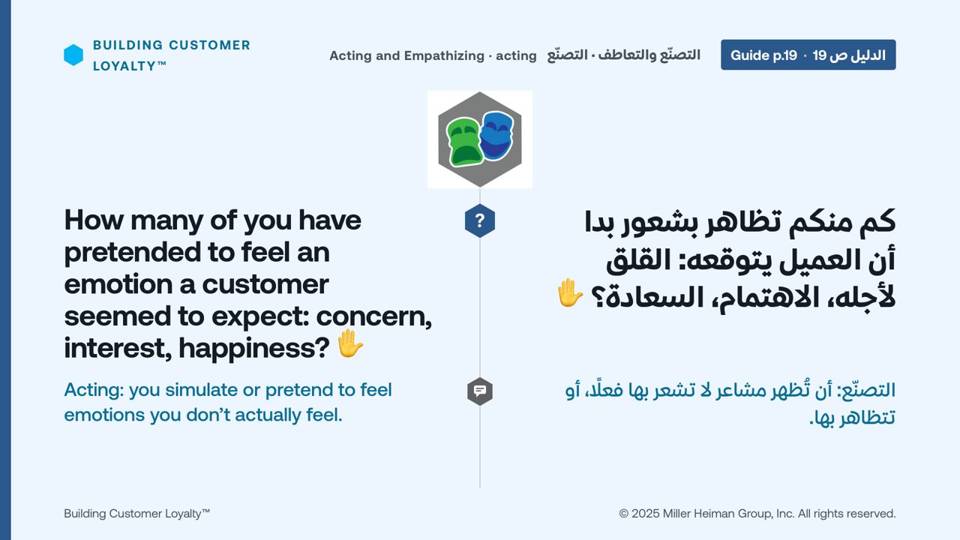
Acting

QuestionGuide p.19
Slide
Slide 81: Acting
Learner material
Participant Guide p.19Participant Guide p.19Participant Guide p.19, large
Facilitator
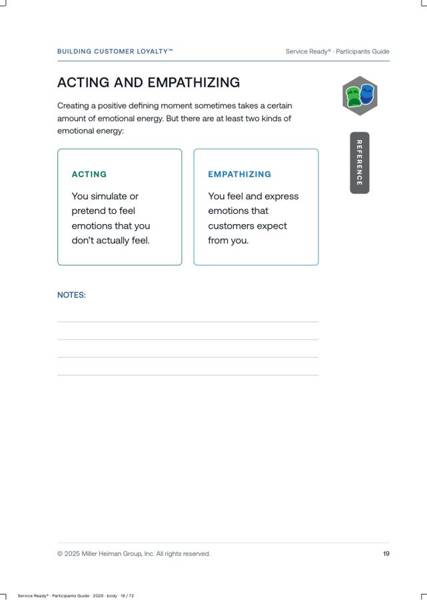
DoRaises their own hand to show what to do (licensed cue), then takes a few answers.
NoteAnticipated (original): stress, exhaustion, bad mood · you can seem insecure; it can become a negative defining moment.
Ask · follow-up, by voiceWhat's the impact on you, doing that customer after customer?
Ask · follow-up, by voiceAnd what does this acting do to your customers?
RoomsHands up on camera; a few answer by voice.
82B24b

Empathizing

QuestionGuide p.19
Slide
Slide 82: Empathizing
Learner material
Participant Guide p.19Participant Guide p.19Participant Guide p.19, large
Facilitator
DoTakes a few answers to each.
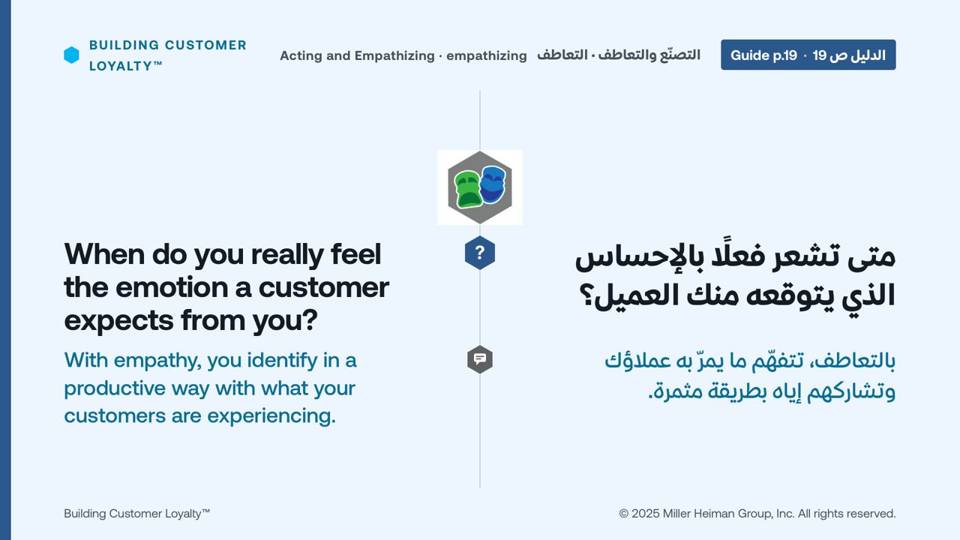
NoteAnticipated (original): when you can relate to the problem because you've had that experience, or a similar one · your stress is probably lower.
Ask · follow-up, by voiceWhat happens to your stress when you don't have to pretend?
RoomsA few answer by voice.
83B24c

Key point: empathy lowers stress

Explain
Slide
Slide 83: Key point: empathy lowers stress
Facilitator
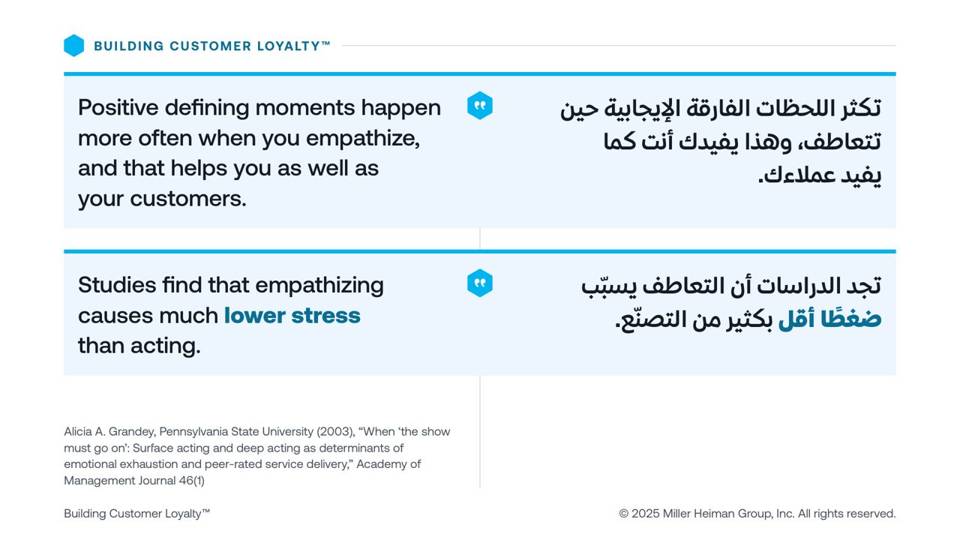
SayThe licensed important concept (FG p.36), as written.
RoomsListen.
84B25

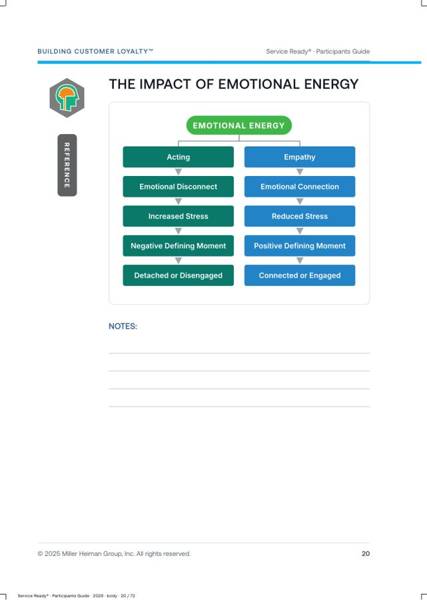
The Impact of Emotional Energy

ExplainGuide p.203 steps
Slide
Slide 84: The Impact of Emotional Energy
Learner material
Participant Guide p.20Participant Guide p.20Participant Guide p.20, large
Facilitator
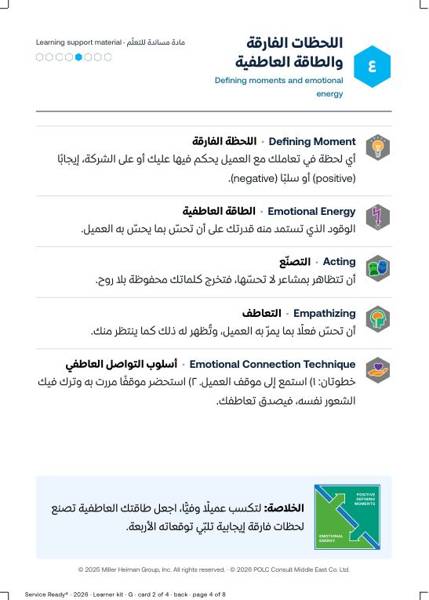
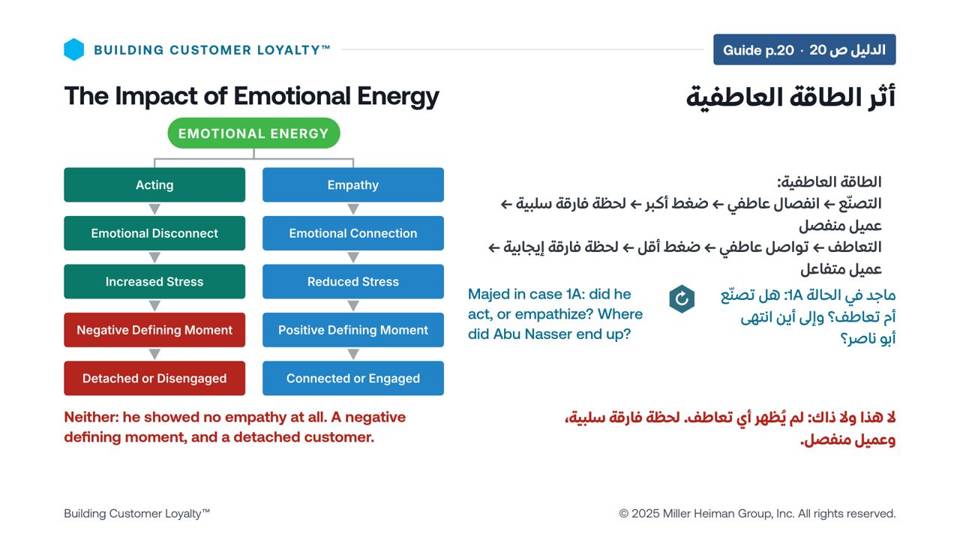
ExplainLicensed points (FG p.37): emotional energy is the fuel to empathize · two types: acting (pretending) and empathizing (truly identifying) · acting causes a disconnect: customers know when you're insincere, and you feel it too, because you're expressing what you don't feel · it means stress for you and a negative moment for the customer, who becomes detached · empathy benefits the customer and you.
SayAnswers his own link question with the line on screen.
NoteActing = pretending to feel emotions you don't feel (FG p.35). In 1A Majed pretends nothing: he is blunt ('You weren't ready'). Never call 1A 'acting'.
RoomsListen; p.20 open.
85B25c

Link: emotional connection

Link6 steps
Slide
Slide 85: Link: emotional connection
Facilitator
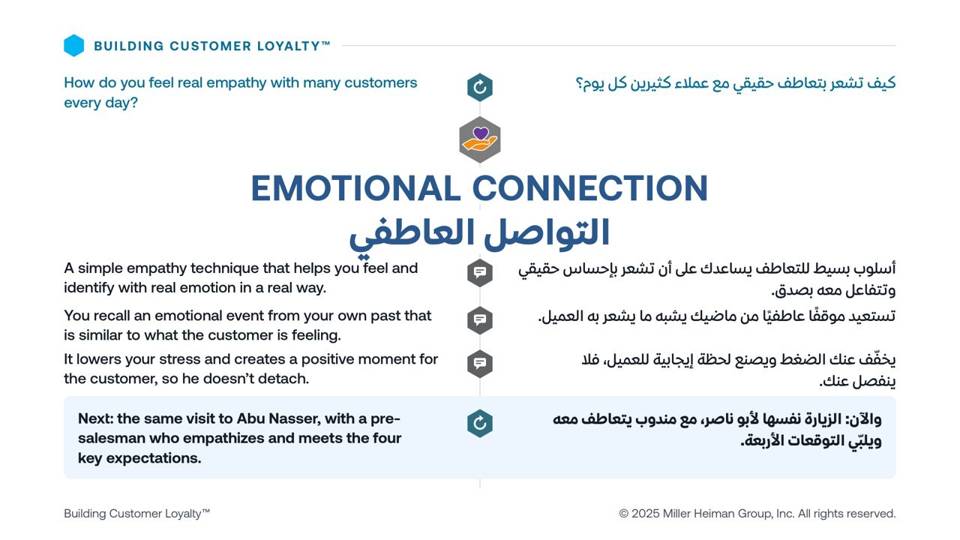
SayWhen you use empathy, you are ready to feel the expected emotions, positive or negative, so you go into each visit with the right attitude and less stress. Then he answers the question with the three lines. (licensed, FG p.38)
RoomsListen.
86B26

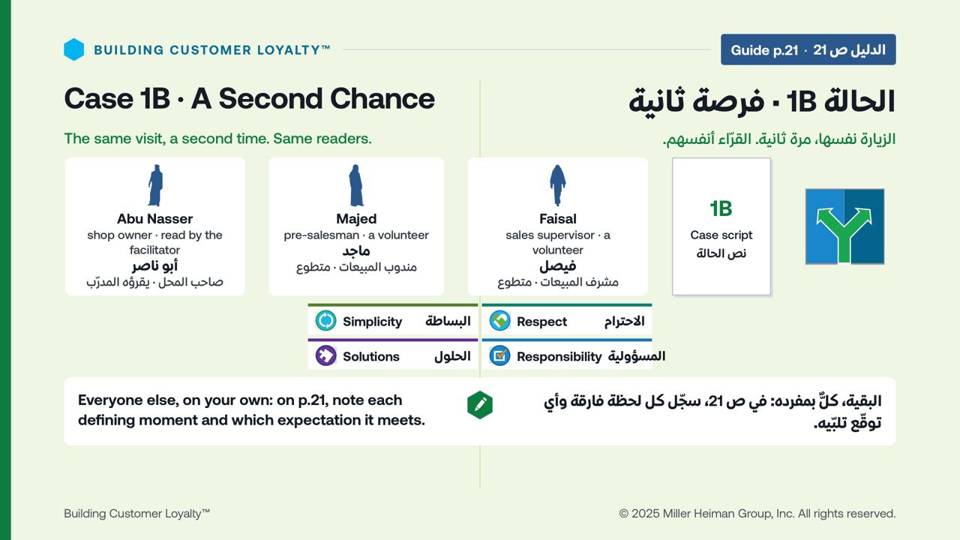
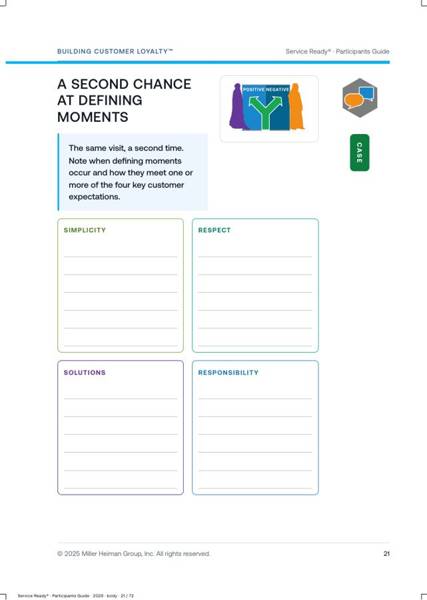
Case 1B · A Second Chance

ActivityGuide p.21
Slide
Slide 86: Case 1B · A Second Chance
Learner material
Participant Guide p.21Participant Guide p.21Participant Guide p.21, large
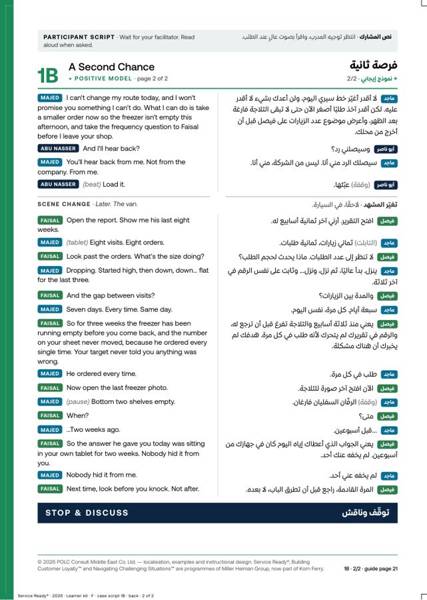
Case script, page 3Case script, page 3Case script, page 3, large
Case script, page 4Case script, page 4Case script, page 4, large
Facilitator
SayEarlier we heard a visit that ended in negative defining moments. Now we'll hear the same people again. (licensed, FG p.39)
DoSame readers as 1A; the facilitator reads Abu Nasser. Arabic runs read the Arabic side.
Notep.21 prints the boxes as Simplicity, Respect (top row), Solutions, Responsibility: tell learners the order differs.
In the roomsThree readers; everyone else notes on p.21.
87B26b

Case 1B: what changed?

QuestionGuide p.21
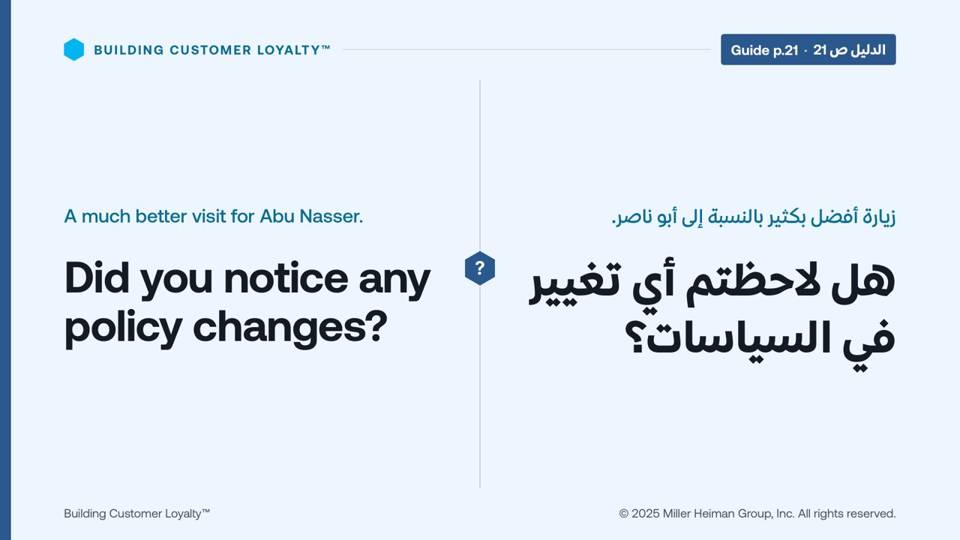
Slide
Slide 87: Case 1B: what changed?
Learner material
Participant Guide p.21Participant Guide p.21Participant Guide p.21, large
Facilitator
DoTakes a few answers to each.
NoteExpected (the original's samples, set in the case): no policy change · ice cream is still cash; the route still can't change today. Majed empathized ('Four days with an empty freezer… I'd be angry too'); was eager to help; positive and proactive; polite; offered options (a smaller order now; the visit frequency taken to Faisal).
NotePast event (my sample; the original's is being charged in error and feeling outraged): a time he waited days for something he was promised, and every call got 'it's coming'.
Ask · follow-up, by voiceSo what did Majed do to create the best possible experience?
Ask · follow-up, by voiceIf Majed used emotional energy, what event from his own past might he have recalled?
RoomsA few answer by voice.
88B26c

Case 1B: the four expectations

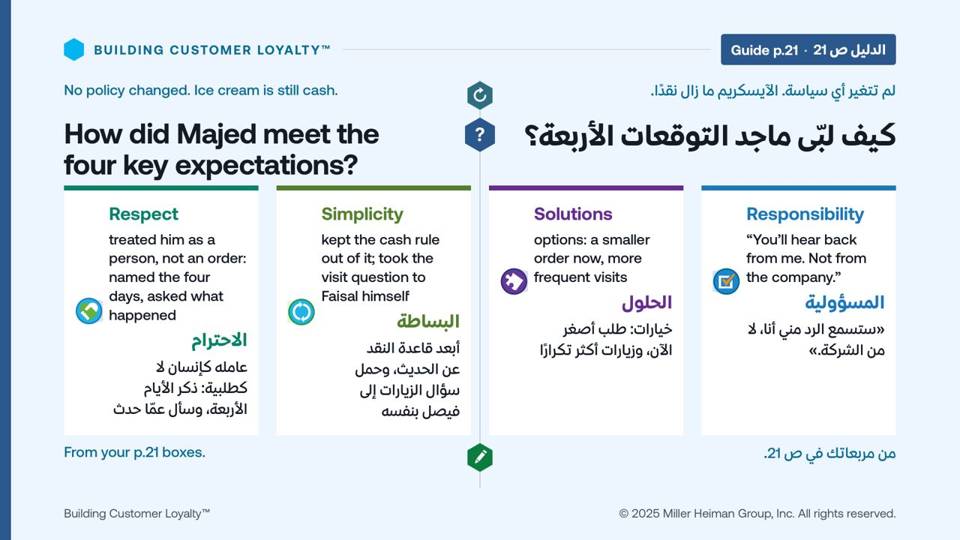
QuestionGuide p.215 steps
Slide
Slide 88: Case 1B: the four expectations
Learner material
Participant Guide p.21Participant Guide p.21Participant Guide p.21, large
Facilitator
DoGoes box by box and takes a few answers to each.
NoteExpected (the original's four samples, set in the case): Respect · treated Abu Nasser as a person, not an order: named the four days, asked what happened. Simplicity · left out what didn't help (the cash rule) and took the visit-frequency question to Faisal himself, before leaving the shop. Solutions · offered options: a smaller order now, more frequent visits. Responsibility · took ownership ('You'll hear back from me. Not from the company.') and promised nothing he couldn't do.
RoomsA few answer by voice.
89B26d

Case 1B: his needs, and Faisal

QuestionGuide p.7
Slide
Slide 89: Case 1B: his needs, and Faisal
Learner material
Participant Guide p.7Participant Guide p.7Participant Guide p.7, large
Facilitator
DoTakes a few answers to each.
NoteExpected: he asked before selling ('What happened on Thursday?' · 'Is that the whole thing, or is there something behind it?') and checked ('Let me make sure I have it right'). Professional · stock without tying up his week's cash: less each time, more often. Personal · respect after four days; being asked ('nobody asked me').
NoteFaisal (POLC case panel): said nothing inside the shop; coached with questions; read the data with Majed (eight weeks: order size falling, a seven-day gap, a freezer photo two weeks old): 'look before you knock'.
Ask · follow-up, by voiceHow did Majed find it?
Ask · follow-up, by voiceIn the van, what did Faisal do differently this time?
RoomsLook back at p.7; a few answer by voice.
90B26e

Key point: positive moments, even when it's hard

Explain
Slide
Slide 90: Key point: positive moments, even when it's hard
Facilitator
SayThe licensed point (FG p.42), with our names.
RoomsListen.
91B27

Emotional Connection Technique

ExplainGuide p.22
Slide
Slide 91: Emotional Connection Technique
Learner material
Participant Guide p.22Participant Guide p.22Participant Guide p.22, large
Facilitator
SayEmotional connection takes preparation: coaching, learning and experience. Let's get some experience now. Then: Again, using the emotional connection technique is a simple process. (licensed, FG pp.42–43)
RoomsListen; p.22 open.
92B28

Using the Emotional Connection Technique

ExplainGuide p.23
Slide
Slide 92: Using the Emotional Connection Technique
Learner material
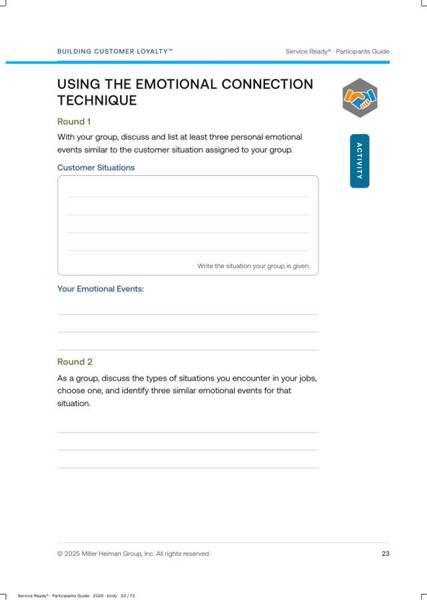
Participant Guide p.23Participant Guide p.23Participant Guide p.23, large
Facilitator
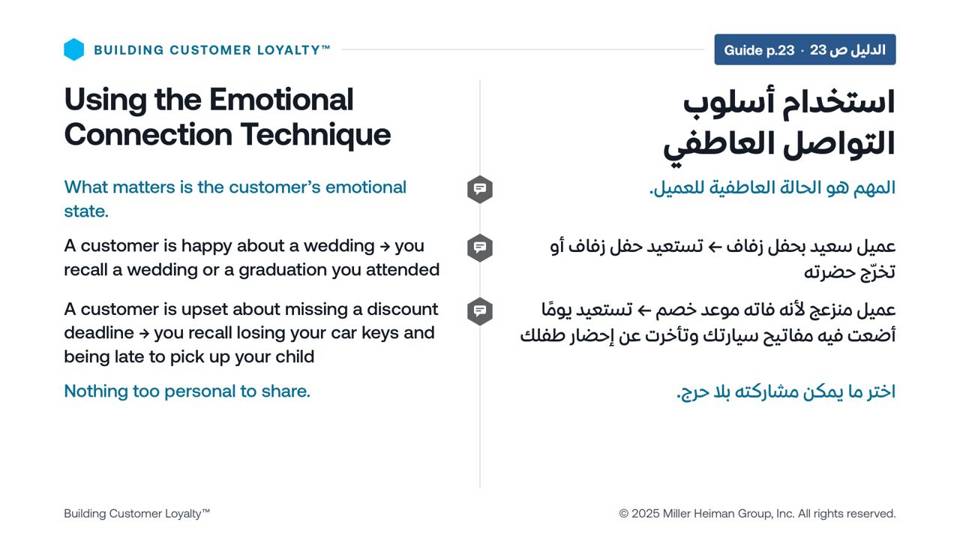
SayYou probably won't meet these exact situations at work. What matters is the customer's emotional state. For example, a customer happy about a wedding: you might recall a wedding or graduation you attended. A customer upset about missing a discount deadline: you might recall losing your car keys and being late to pick up your child. (licensed, FG p.44)
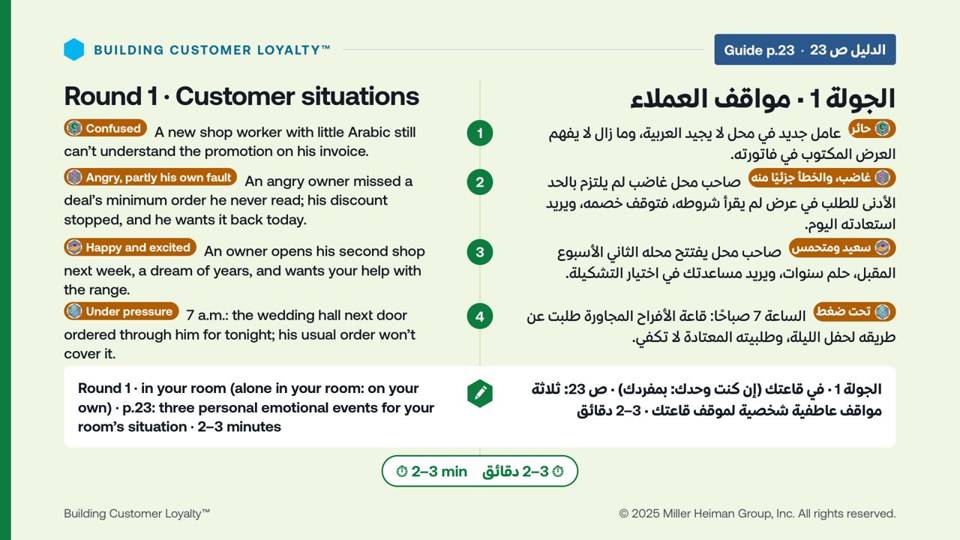
DoGives each room its situation number by voice (spread 1–4 evenly; people alone too), then shows B28b and reads the four situations. Round 2 has its own slide (B28e).
ProducerNo WhatsApp post (rule 6). Starts the countdown on B28b.
NoteFixes old slide 101 against the original: Round 1 is the given situation; Round 2 (B28e) is a situation from your own job, not a repeat of steps 1 and 2.
RoomsEach depot room works together; people alone work alone.
93B28b

Round 1: customer situations

ActivityGuide p.23
Slide
Slide 93: Round 1: customer situations
Learner material
Participant Guide p.23Participant Guide p.23Participant Guide p.23, large
Facilitator
DoReads all four aloud in full, then leaves the slide up while rooms work. At about 3 minutes, moves to B28e (Round 2).
SayFull text to read aloud: 1 · A new worker in a shop speaks little Arabic. For days he has tried to understand the new promotion on his invoice, and he still can't tell what he is paying for. 2 · A shop owner is angry. Last month he signed up for a display-stand deal without reading that it needs a minimum weekly order. He missed it, and his discount has stopped. He wants it back today. 3 · A shop owner is opening his second shop next week, a dream of many years. He wants your help to choose the range for the opening day. 4 · At 7 in the morning a shop owner calls you: the wedding hall next door has ordered milk, juice and ice cream through him for tonight. His usual order won't cover it, and the wedding can't move.
NoteThe emotional state behind each, kept from the original's four (PG p.16): 1 frustration and confusion (original: a customer with little English who can't find help online) · 2 anger at a problem he partly caused (original: a 'free' promotion with a fee he forgot to cancel; also the FG p.34 example) · 3 happiness and anticipation (original: a 25th-anniversary trip) · 4 urgency and pressure (original: a machine broken down on an important job).
ProducerStarts the countdown built into this slide. No WhatsApp post (rule 6).
In the roomsRooms work on their situation while this slide stays up.
94B28e

Round 2: your own job

ActivityGuide p.23
Slide
Slide 94: Round 2: your own job
Learner material
Participant Guide p.23Participant Guide p.23Participant Guide p.23, large
Facilitator
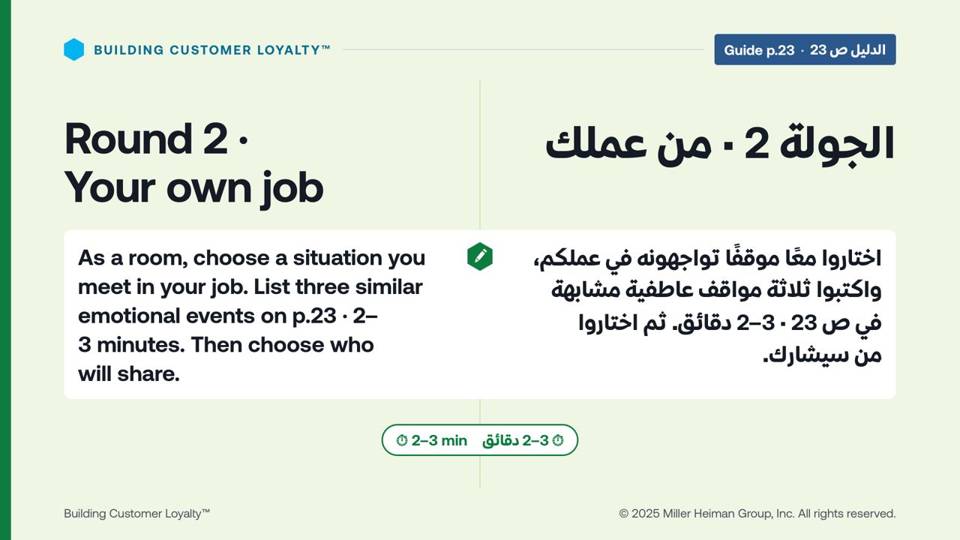
SayNow Round 2. As a room, talk about the kinds of situations you meet in your job, choose one, and find three similar emotional events for it. (licensed, FG p.44)
DoShows this at about 3 minutes into Round 1.
ProducerRestarts the countdown built into this slide.
In the roomsEach depot room works together; people alone work alone.
95B28c

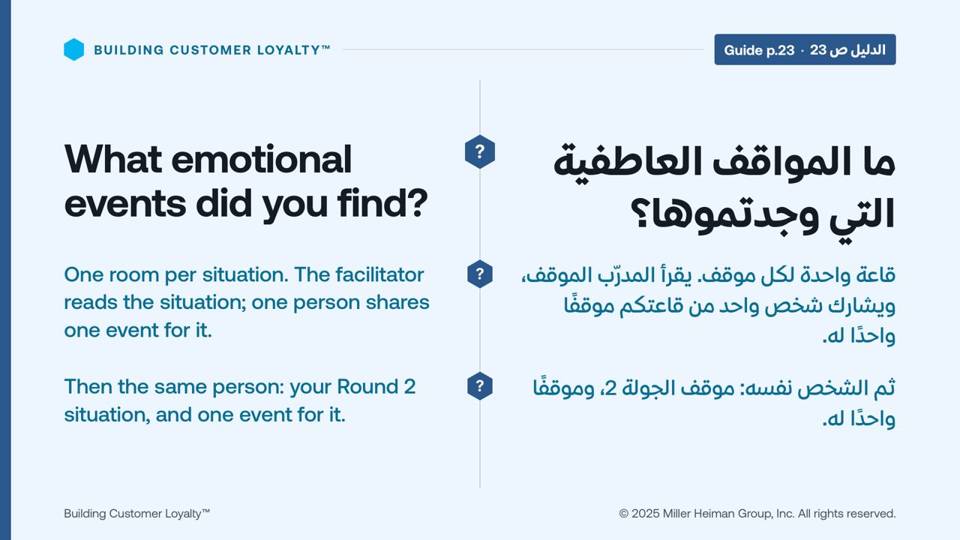
What emotional events did you find?

QuestionGuide p.23
Slide
Slide 95: What emotional events did you find?
Learner material
Participant Guide p.23Participant Guide p.23Participant Guide p.23, large
Facilitator
DoReads each Round 1 situation aloud before the room reports, and leads a round of applause after each report: rooms clap, or use the Teams reaction. (both licensed, FG p.45)
NoteThe original hears every group. With eight to ten rooms, one room per situation is enough; others add only if their event was very different.
RoomsOne person from each room report by voice; applause after each.
96SP1

Self-practice: The Emotional Connection Technique

ActivityGuide p.58
Slide
Slide 96: Self-practice: The Emotional Connection Technique
Learner material
Participant Guide p.58Participant Guide p.58Participant Guide p.58, large
Facilitator
NoteRead it aloud (30 seconds). No writing now: they write on p.58 after the day.
97B29

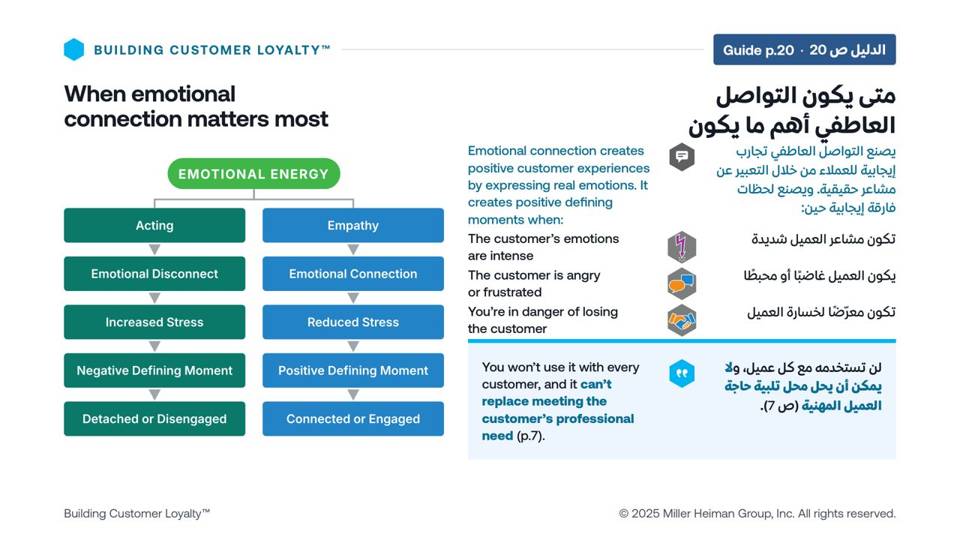
When emotional connection matters most

ExplainGuide p.205 steps
Slide
Slide 97: When emotional connection matters most
Learner material
Participant Guide p.20Participant Guide p.20Participant Guide p.20, large
Facilitator
SayThe licensed key point (FG p.46), as written.
NoteNeeds thread: 'professional need' is p.7's word; the page callback is now on screen.
RoomsListen.
98B29b

The Payoff of Emotional Energy

Question
Slide
Slide 98: The Payoff of Emotional Energy
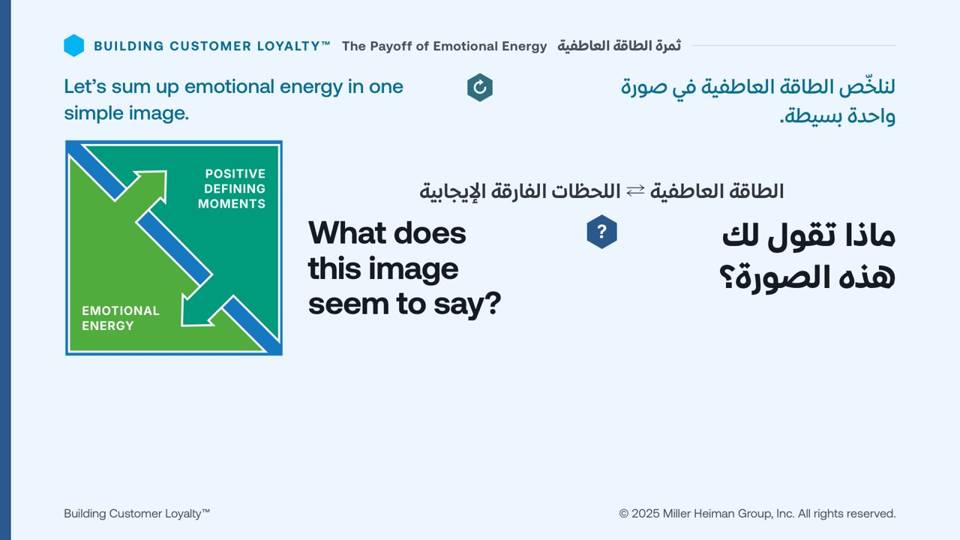
Facilitator
SayLet's sum up emotional energy in a simple image. (licensed, FG p.46)
DoTakes a few answers to each.
NoteAnticipated (original): acting is forced and spends energy; true empathy forms a connection with another person · emotional energy creates positive defining moments; the two go hand in hand.
Ask · follow-up, by voiceWhat is the difference between acting and empathy?
RoomsA few answer by voice.
99B30

Reflection and Action: self-assessment

ActivityGuide p.24
Slide
Slide 99: Reflection and Action: self-assessment
Learner material
Participant Guide p.24Participant Guide p.24Participant Guide p.24, large
Facilitator
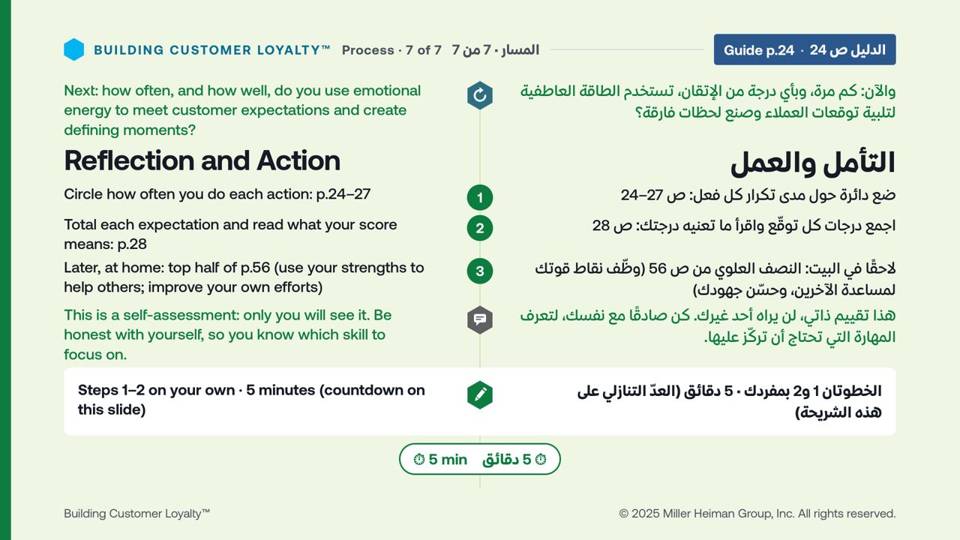
SayHow often, and how well, do you use emotional energy to meet customer expectations and create defining moments? Then: This self-assessment helps you find your strengths and areas for improvement in meeting the four customer expectations. No one will ask to see your scores, so answer honestly and use it to find ways to improve. (licensed, FG pp.47–48)
ProducerStarts the 5-minute countdown built into this slide. Cameras may go off while people write.
NoteOwnership from B5 is item 5 under Simplicity (p.25).
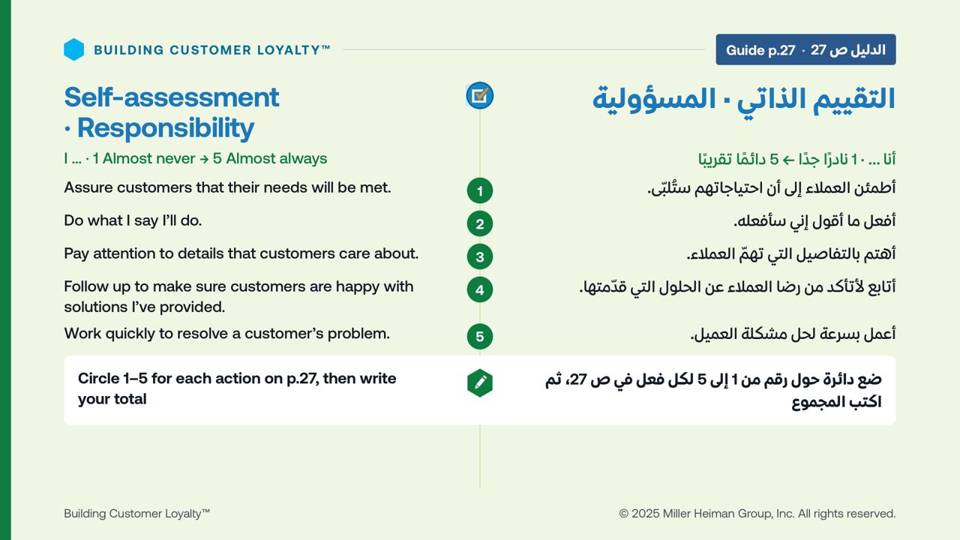
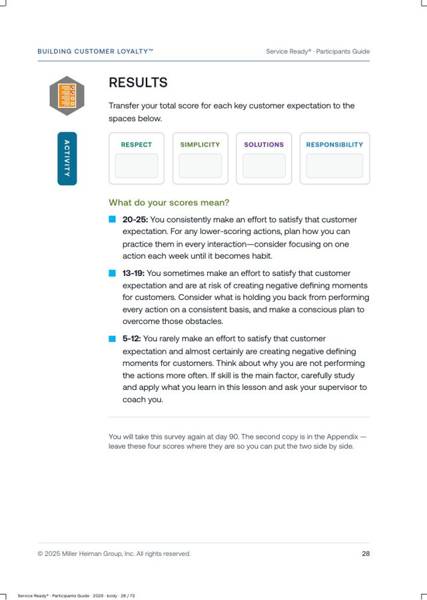
Notep.28 says 'you will take this survey again at day 90'; p.62 says 'you took this survey this morning: score it again now'. They contradict: say only 'keep your four scores on p.28'.
In the roomsEach person works alone.
100B30a

Self-assessment: Respect

ActivityGuide p.24
Slide
Slide 100: Self-assessment: Respect
Learner material
Participant Guide p.24Participant Guide p.24Participant Guide p.24, large
Facilitator
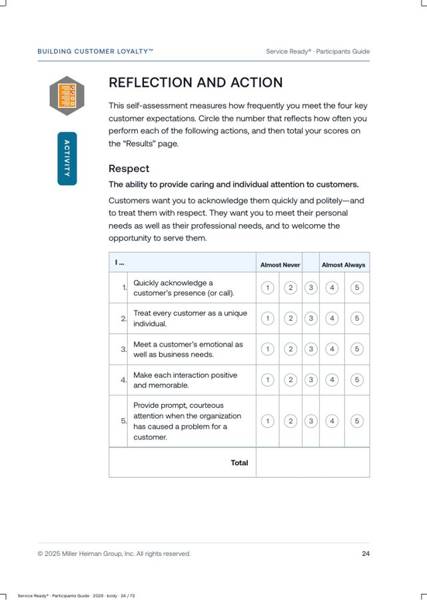
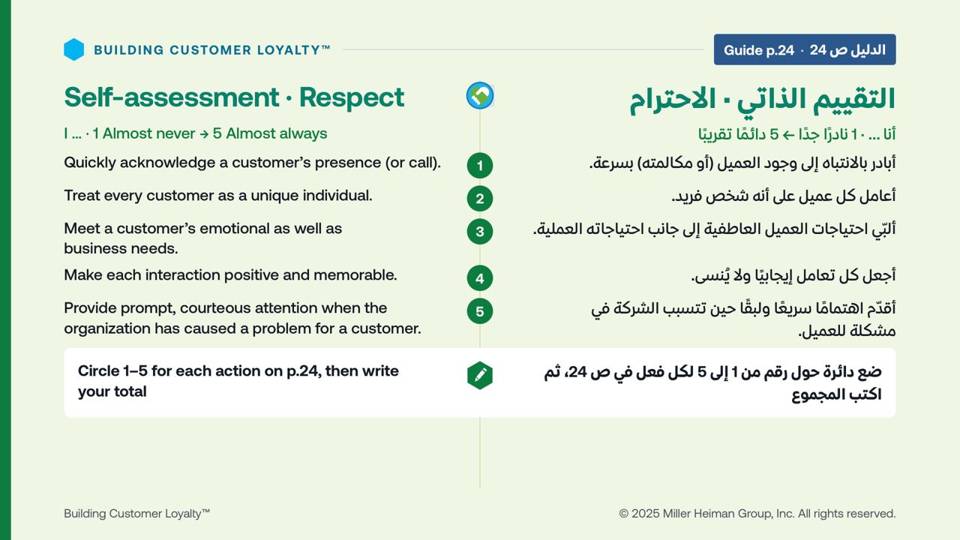
NoteLicensed survey items, word for word (printed p.24). Shown on screen so Arabic runs can read them in Arabic while circling in the English book.
In the roomsEach person circles in the book, alone.
101B30b

Self-assessment: Simplicity

ActivityGuide p.25
Slide
Slide 101: Self-assessment: Simplicity
Learner material
Participant Guide p.25Participant Guide p.25Participant Guide p.25, large
Facilitator
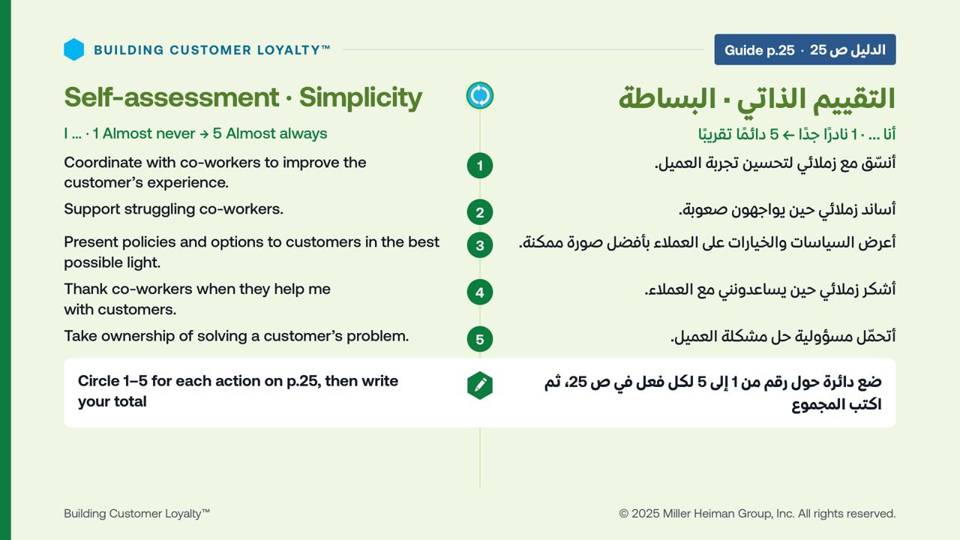
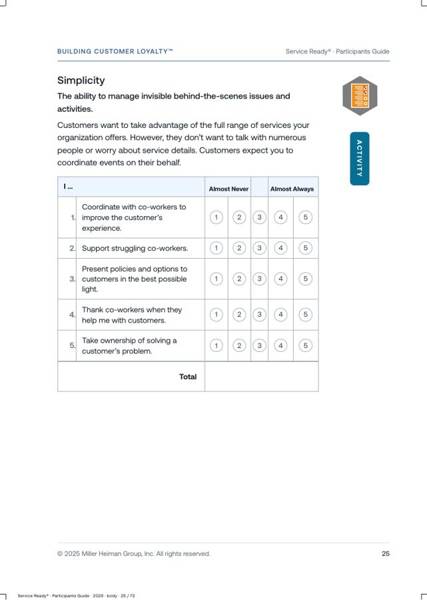
NoteLicensed survey items, word for word (printed p.25). Shown on screen so Arabic runs can read them in Arabic while circling in the English book.
In the roomsEach person circles in the book, alone.
102B30c

Self-assessment: Solutions

ActivityGuide p.26
Slide
Slide 102: Self-assessment: Solutions
Learner material
Participant Guide p.26Participant Guide p.26Participant Guide p.26, large
Facilitator
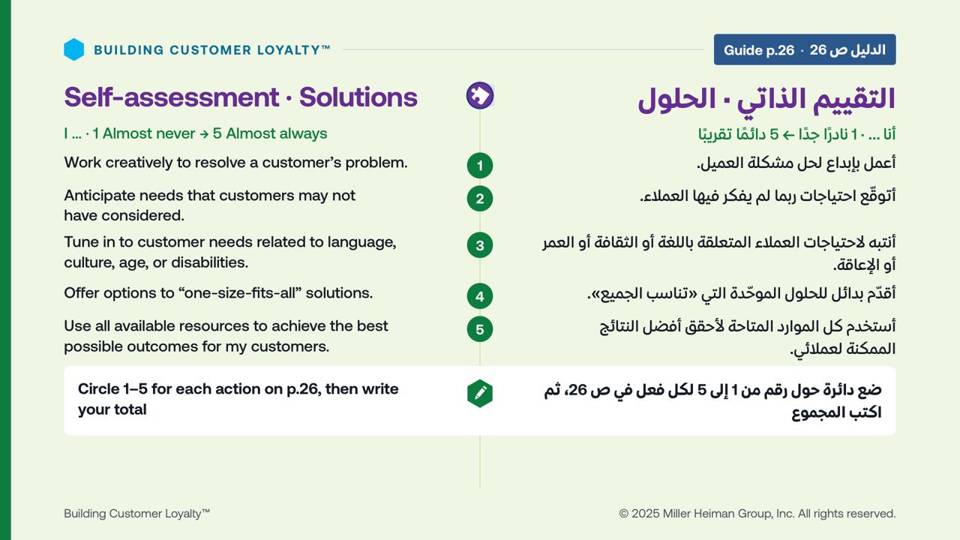
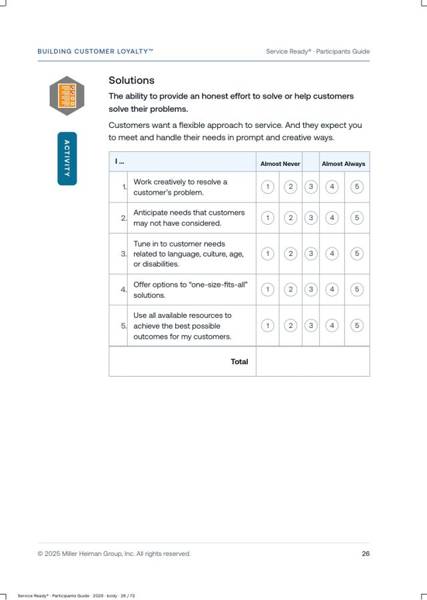
NoteLicensed survey items, word for word (printed p.26). Shown on screen so Arabic runs can read them in Arabic while circling in the English book.
In the roomsEach person circles in the book, alone.
103B30d

Self-assessment: Responsibility

ActivityGuide p.27
Slide
Slide 103: Self-assessment: Responsibility
Learner material
Participant Guide p.27Participant Guide p.27Participant Guide p.27, large
Facilitator
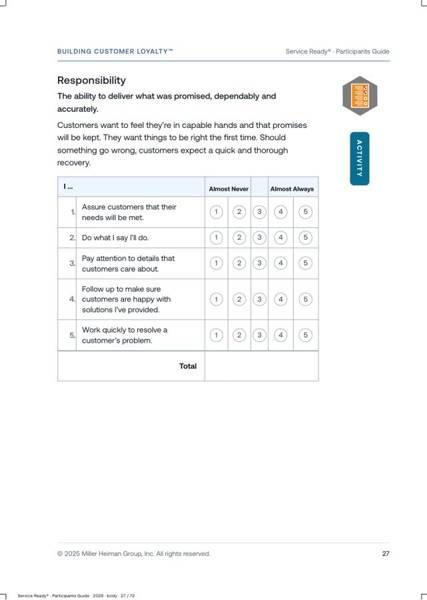
NoteLicensed survey items, word for word (printed p.27). Shown on screen so Arabic runs can read them in Arabic while circling in the English book.
In the roomsEach person circles in the book, alone.
104B30e

Self-assessment: what your scores mean

ExplainGuide p.284 steps
Slide
Slide 104: Self-assessment: what your scores mean
Learner material
Participant Guide p.28Participant Guide p.28Participant Guide p.28, large
Facilitator
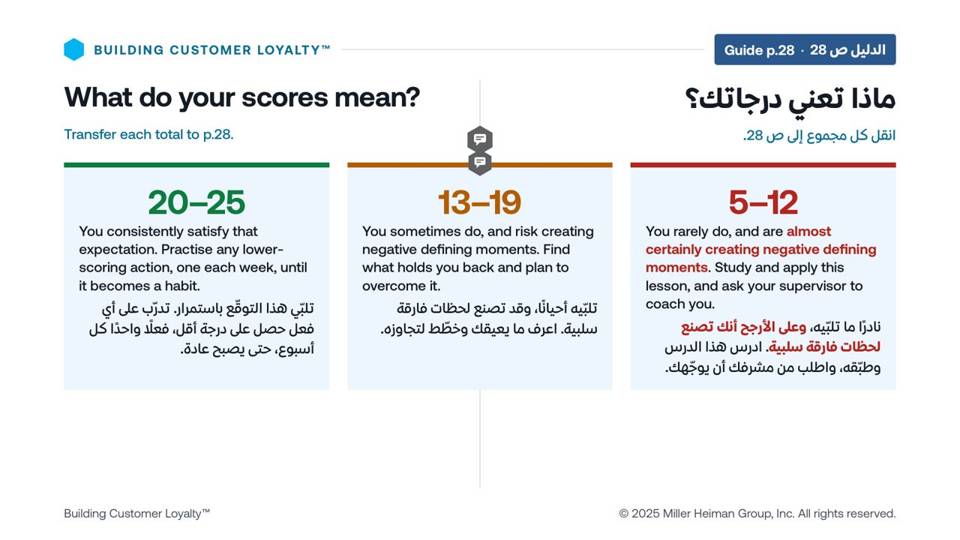
NotePrinted p.28 meanings, condensed for the slide; full wording on p.28.
RoomsEach person reads their own scores.
105B30f

What did you learn?

Question
Slide
Slide 105: What did you learn?
Facilitator
DoTakes a few answers to each. Never asks for scores.
SayYou now have a good sense of what to develop. The next module builds more of the skills. Let me end with the main idea of this module. (licensed, FG p.49)
Ask · follow-up, by voiceWhat ideas do you have for helping others to create positive customer experiences?
RoomsA few answer by voice.
106B31

The Bottom Line

ExplainGuide p.294 steps
Slide
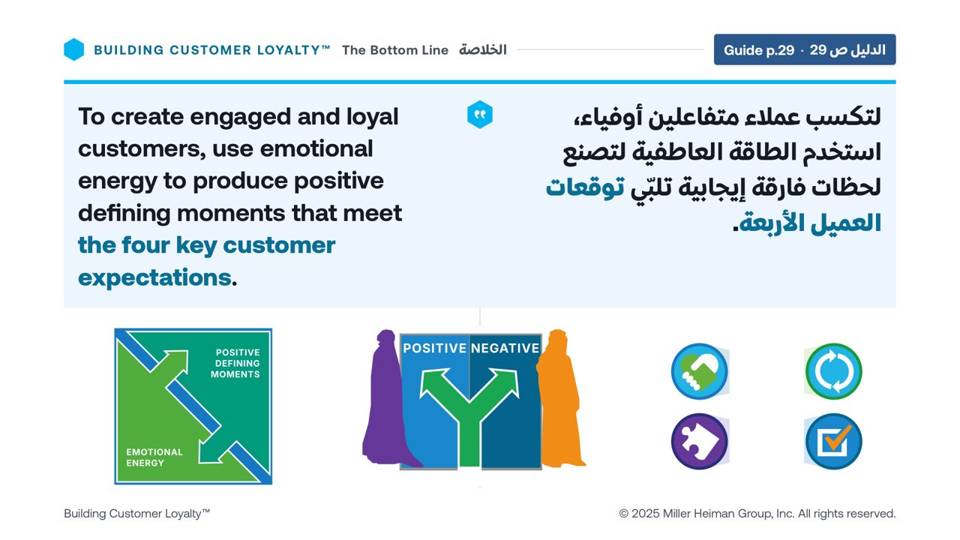
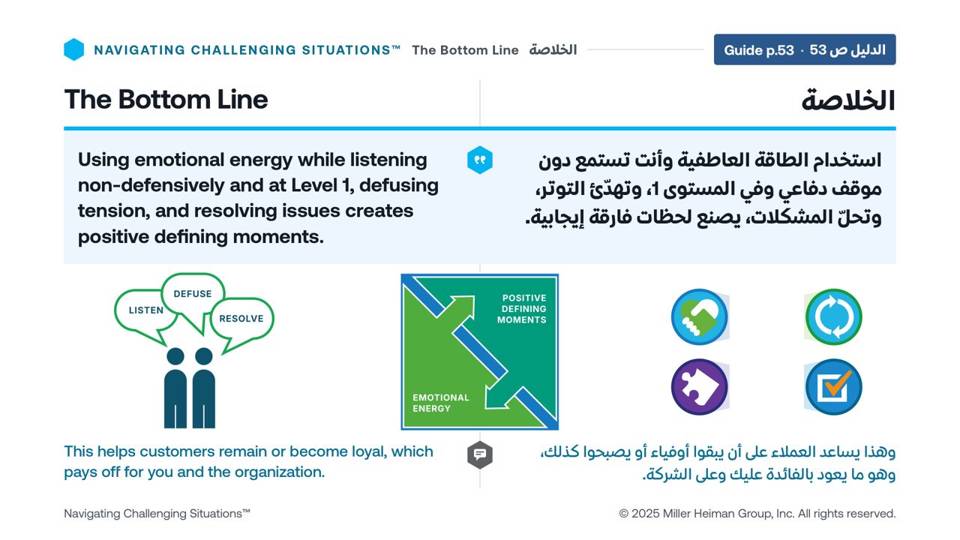
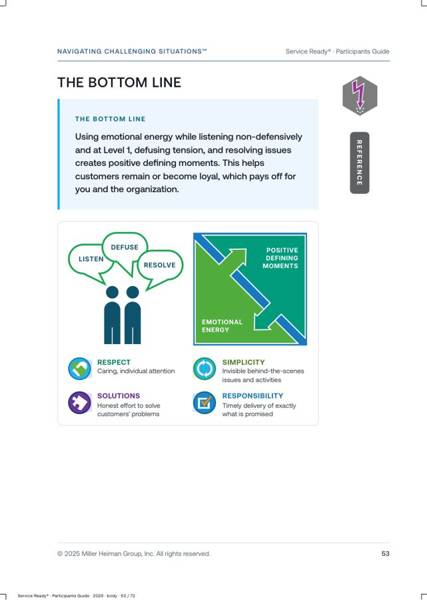
Slide 106: The Bottom Line
Learner material
Participant Guide p.29Participant Guide p.29Participant Guide p.29, large
Facilitator
SayReads it as written. Then: when you learn to do this, you truly create a positive customer experience. (licensed, FG p.50)
DoPoints to the Appendix: p.59–60 hold the module's key ideas; the summary card in the kit pocket (Building Customer Loyalty™ side) is the Learning Summary to keep in view; a second copy of the survey (pp.62–66) is there to check progress later.
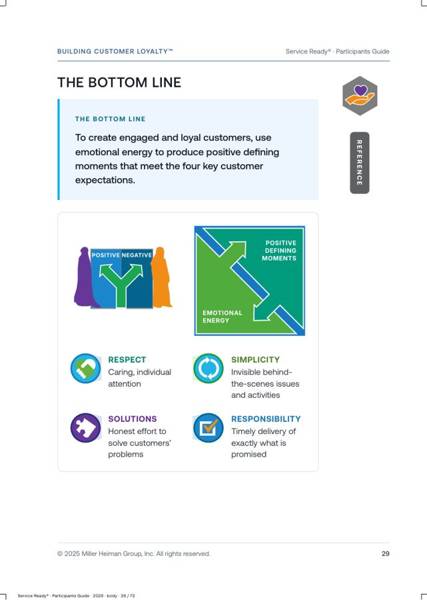
NoteSlide 29 and printed p.29 say 'positive defining moments that meet the four key customer expectations'; FG p.50 words it slightly differently. The slide wording is used.
RoomsListen; p.29 open.
107B32

Recap: Building Customer Loyalty™

Explain5 steps
Slide
Slide 107: Recap: Building Customer Loyalty™
Facilitator
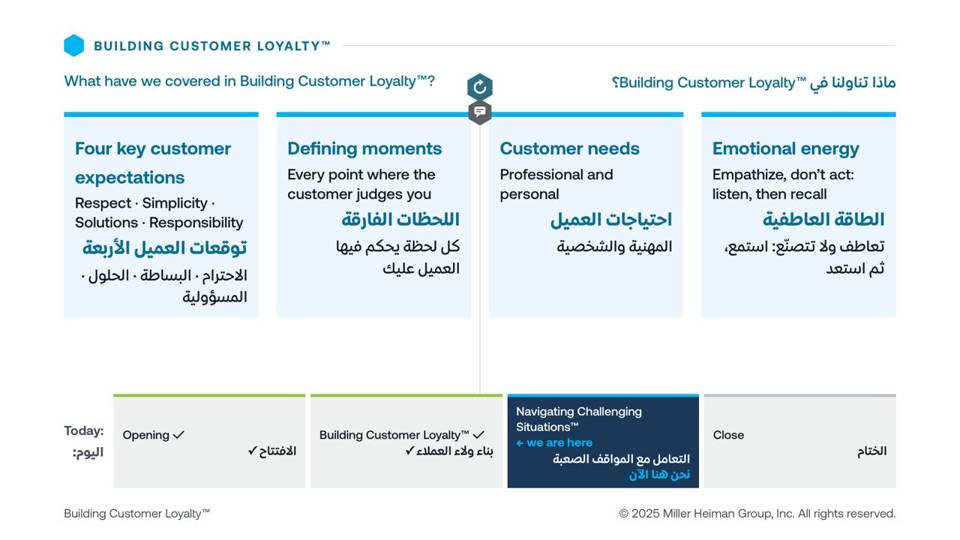
DoAsks the question; may take one or two answers, then walks through the four ideas and shows where we are in the day. X2 is the hand-off into the next module.
NoteThe four boxes are the module's four key concepts as the licensed 'Service Ready Program Lessons' chart shows them (FG pp.6–7, Sec.1 pp.4–5).
Notep.30 'Notes — the morning' is there for anyone who wants to note a line under each heading.
RoomsListen; one or two may answer.

The bridge

108X2

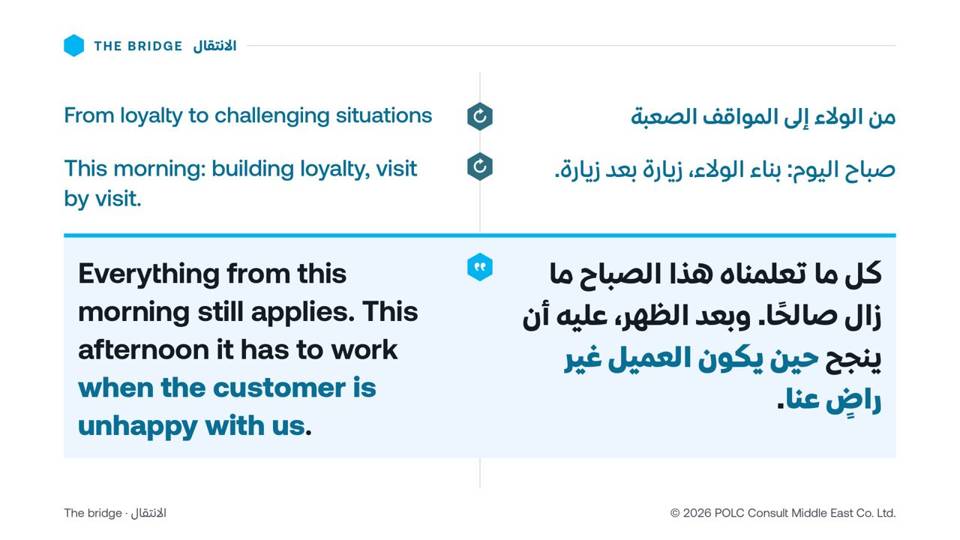
Link: from loyalty to challenging situations

Link
Slide
Slide 108: Link: from loyalty to challenging situations
Facilitator
SaySays the link, then goes straight to the module divider.
RoomsListen.

Navigating Challenging Situations™

109N1

Module divider · Navigating Challenging Situations™

Explain
Slide
Slide 109: Module divider · Navigating Challenging Situations™
Facilitator
SaySecond module: Navigating Challenging Situations. Welcome.
Rooms—
110N2

Purpose

ExplainGuide p.32
Slide
Slide 110: Purpose
Learner material
Participant Guide p.32Participant Guide p.32Participant Guide p.32, large
Facilitator
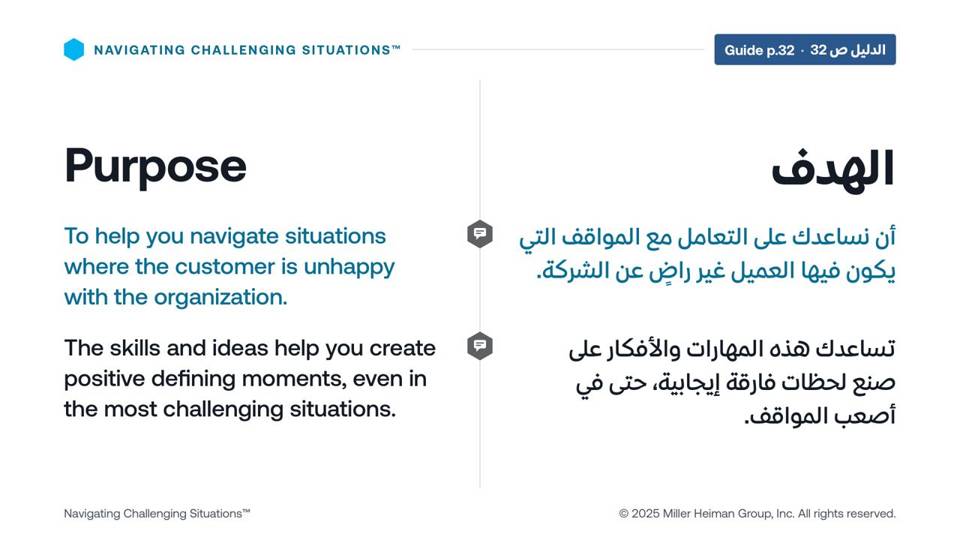
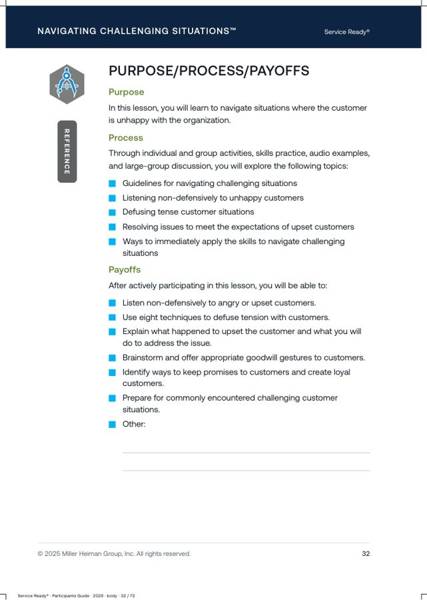
ExplainLicensed (FG p.184): this lesson helps you navigate situations where the customer is unhappy with the organization; the skills and ideas help you create positive defining moments even in the most challenging situations.
RoomsListen; p.32 open if they like.
111N3

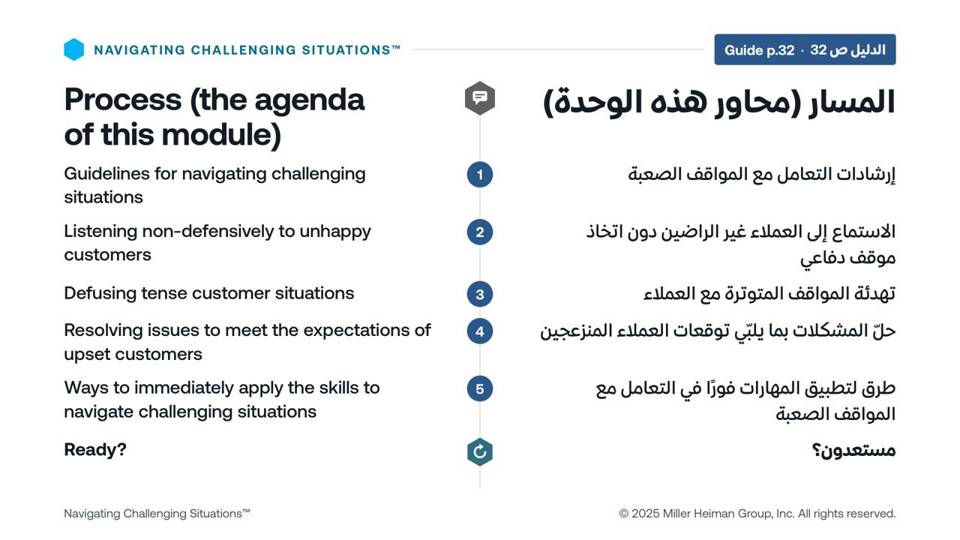
Process

ExplainGuide p.327 steps
Slide
Slide 111: Process
Learner material
Participant Guide p.32Participant Guide p.32Participant Guide p.32, large
Facilitator
ExplainWalks through the five as the agenda: first the guidelines; then you learn and practise listening, defusing and resolving; then you practise all the skills on your own situation; we close by reflecting. Then: 'Ready?' and moves on.
NoteNo payoffs activity. The payoffs stay printed on p.32.
RoomsListen.
112N4

What sets your customer off?

Activity
Slide
Slide 112: What sets your customer off?
Facilitator
DoAfter a minute, takes a few answers, in their own way.
NoteOriginal (FG p.186) asks about the learners as customers; this version moves it to the company's real customers. Expected: late or missing delivery, empty freezer, wrong order, promises not kept, no one calls back, prices changed without warning.
Ask · follow-up, by voiceWhat made him dissatisfied or angry with us?
In the roomsThink; a few answer by voice.
113N5

In his shoes

Question
Slide
Slide 113: In his shoes
Facilitator
DoTakes a few answers, in their own way.
NoteExpected (original): negative feelings; he loses confidence in our ability or willingness to give good service; he feels we are not trustworthy.
RoomsA few answer by voice.
114N6

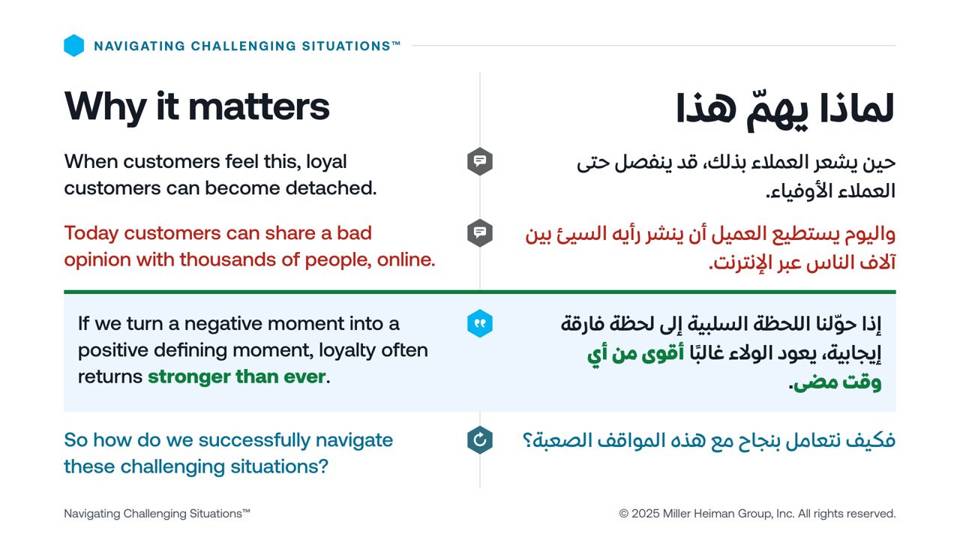
Why it matters

Explain5 steps
Slide
Slide 114: Why it matters
Facilitator
ExplainThe licensed important concept (FG p.187): in challenging situations, creating a positive customer experience means finding ways to restore trust and loyalty.
NoteThe original opens the point with 'Studies show that…' and gives no source; the claim (no number) is kept, 'studies show' stays off the screen (rule 10).
RoomsListen.
115N7

Guidelines for Navigating Challenging Situations

ExplainGuide p.335 steps
Slide
Slide 115: Guidelines for Navigating Challenging Situations
Learner material
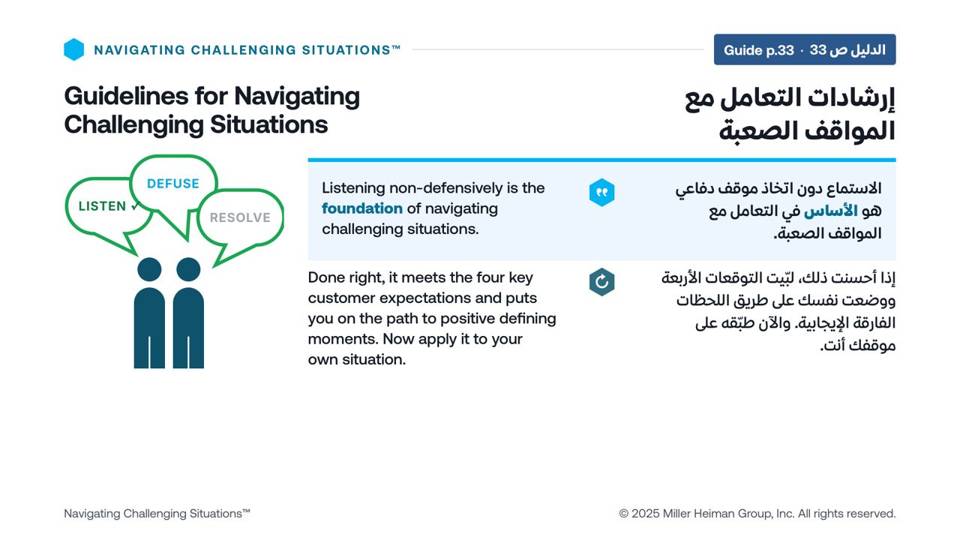
Participant Guide p.33Participant Guide p.33Participant Guide p.33, large
Facilitator
ExplainWalks through the three; p.33 has space for notes.
NoteThe model returns at each step (N22, N50, N65), as the original re-shows it after each block.
RoomsListen; p.33.
116N8

LISTEN Non-Defensively

ExplainGuide p.345 steps
Slide
Slide 116: LISTEN Non-Defensively
Learner material
Participant Guide p.34Participant Guide p.34Participant Guide p.34, large
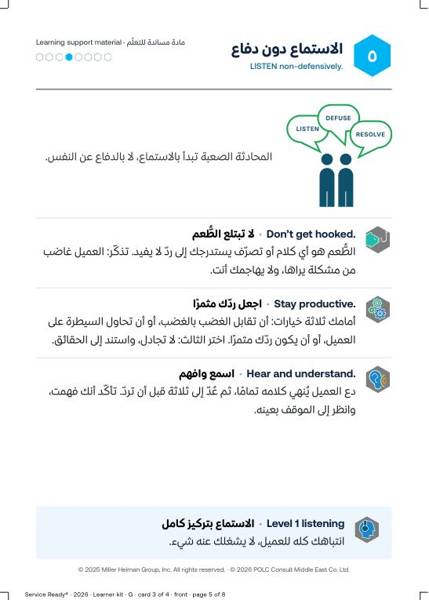
Arabic support card 5 (Arabic runs)Arabic support card 5 (Arabic runs)Arabic support card 5 (Arabic runs), large
Facilitator
ExplainNames the three; each one comes next.
NoteArabic runs: card ٥ (LISTEN) carries the three skills and Level 1 in Arabic.
RoomsListen; p.34.
117N9

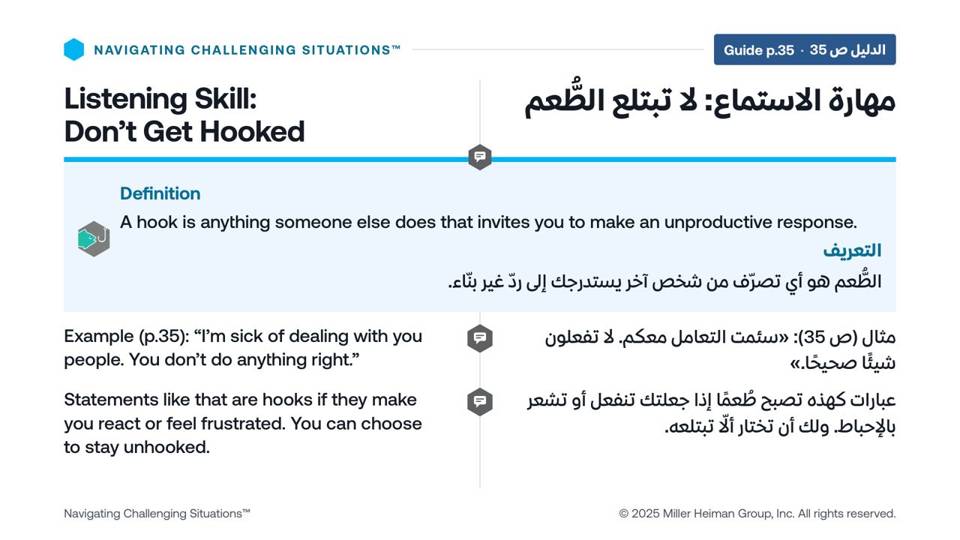
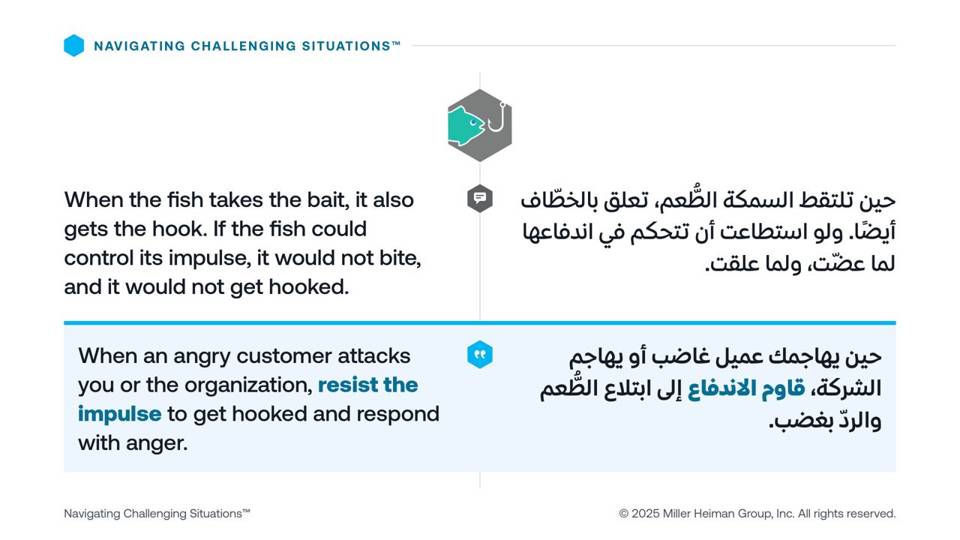
Listening Skill: Don't Get Hooked

ExplainGuide p.354 steps
Slide
Slide 117: Listening Skill: Don't Get Hooked
Learner material
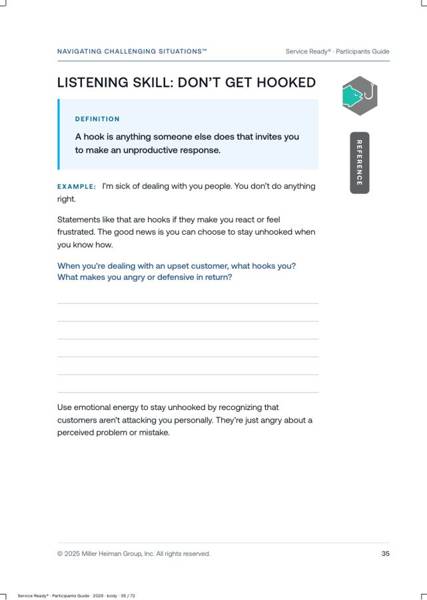
Participant Guide p.35Participant Guide p.35Participant Guide p.35, large
Facilitator
ExplainReads the definition and the printed example.
RoomsListen; p.35.
118N10

What hooks you?

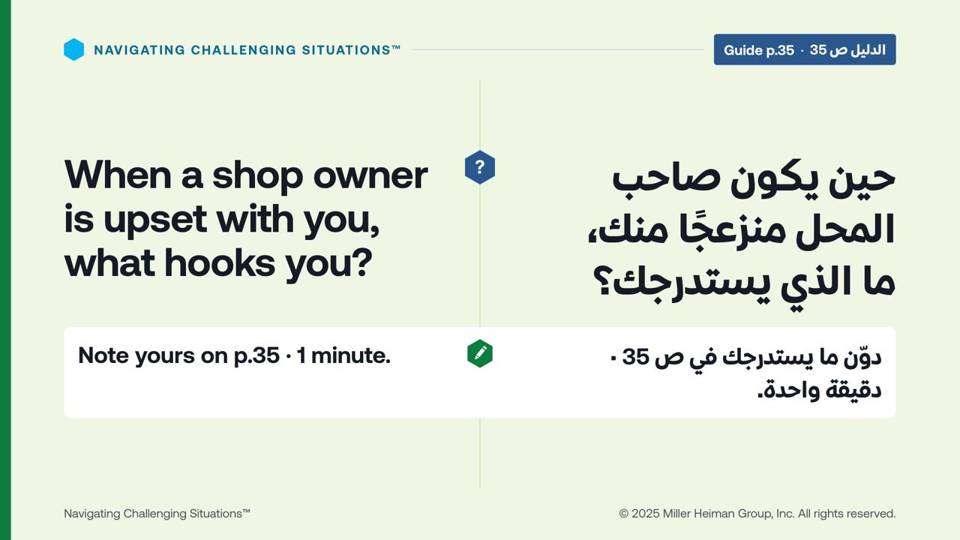
ActivityGuide p.35
Slide
Slide 118: What hooks you?
Learner material
Participant Guide p.35Participant Guide p.35Participant Guide p.35, large
Facilitator
DoAfter a minute, takes three or four examples, in their own way.
NoteOriginal (FG p.190): don't let it turn into extended complaining about customers. Expected: I don't have time; a minor problem turned into a major one; they blame me personally.
Ask · follow-up, by voiceWhat makes you angry or defensive in return?
In the roomsWrite on p.35; a few answer by voice.
119N12

Key point: don't get hooked

Explain
Slide
Slide 119: Key point: don't get hooked
Facilitator
SayLands it (licensed, FG pp.190–191).
NoteThe first sentence is the licensed bait line from the fishing discussion (N11, now removed), so this slide stands on its own.
RoomsListen.
120N13

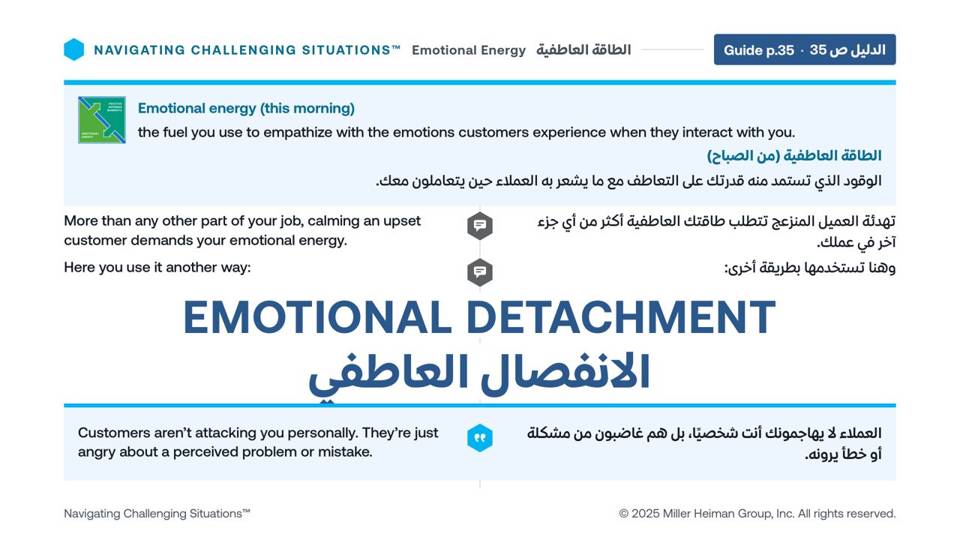
Emotional Energy: emotional detachment

ExplainGuide p.355 steps
Slide
Slide 120: Emotional Energy: emotional detachment
Learner material
Participant Guide p.35Participant Guide p.35Participant Guide p.35, large
Facilitator
ExplainNormally you use emotional energy to connect with the customer through empathy. With an angry customer, whose state is unproductive, you use it to stay detached. So the first advice for listening non-defensively: don't get hooked by a customer who blames you for a mistake (FG p.191).
NoteA callback to the definition taught in BCL (p.18), not a second teaching. The point is printed on p.35.
RoomsListen.
121N14

Stay Productive: what happens if…?

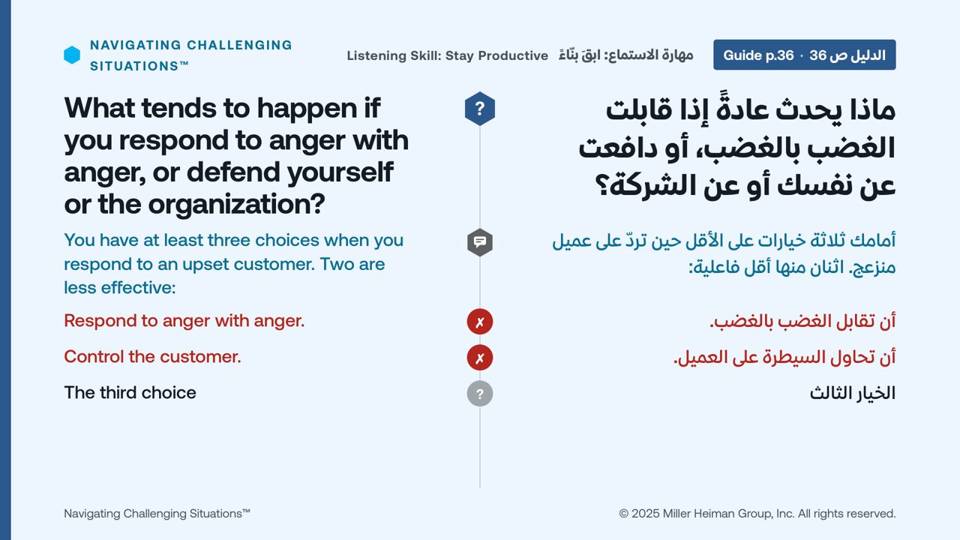
QuestionGuide p.364 steps
Slide
Slide 121: Stay Productive: what happens if…?
Learner material
Participant Guide p.36Participant Guide p.36Participant Guide p.36, large
Facilitator
DoTakes a few answers to each question.
NoteExpected (original): the situation escalates · the customer attacks even more.
Ask · follow-up, by voiceWhat can happen if you try to control the customer's actions or reactions?
RoomsA few answer by voice.
122N15

Key point: stay productive

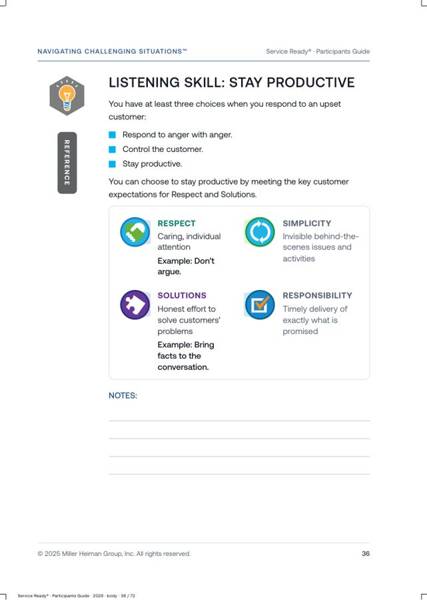
ExplainGuide p.36
Slide
Slide 122: Key point: stay productive
Learner material
Participant Guide p.36Participant Guide p.36Participant Guide p.36, large
Facilitator
SayLands it (licensed, FG p.192).
RoomsListen.
123N16

Staying Productive: Respect and Solutions

QuestionGuide p.36
Slide
Slide 123: Staying Productive: Respect and Solutions
Learner material
Participant Guide p.36Participant Guide p.36Participant Guide p.36, large
Facilitator
DoTakes a few answers, in their own way.
NoteExpected (original): Respect · don't argue; let the customer express strong feelings; don't take an attack personally; stay calm. Solutions · focus on the solution; try to understand the customer and the issue.
Notep.36 prints all four expectations with these two examples; NOTES lines for anyone who wants to write.
RoomsA few answer by voice; notes on p.36 if they like.
124N17

Listening Skill: Hear and Understand

ExplainGuide p.375 steps
Slide
Slide 124: Listening Skill: Hear and Understand
Learner material
Participant Guide p.37Participant Guide p.37Participant Guide p.37, large
Facilitator
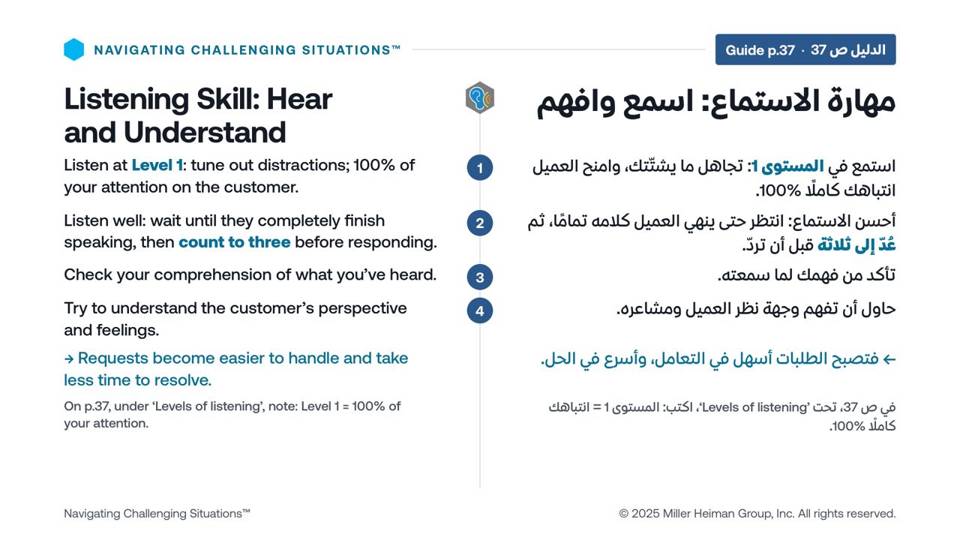
ExplainCheck your comprehension so you and the customer are thinking the same thing. Understand his perspective and feelings so you can use the emotional energy he expects (FG p.193). Level 1 follows on the next slide.
RoomsListen; p.37 open.
125N18

Link: listen to a visit

Link
Slide
Slide 125: Link: listen to a visit
Facilitator
SaySays the link, then sets up the readers.
RoomsListen.
126N19

The Model Conversation: what went wrong

ActivityGuide p.38
Slide
Slide 126: The Model Conversation: what went wrong
Learner material
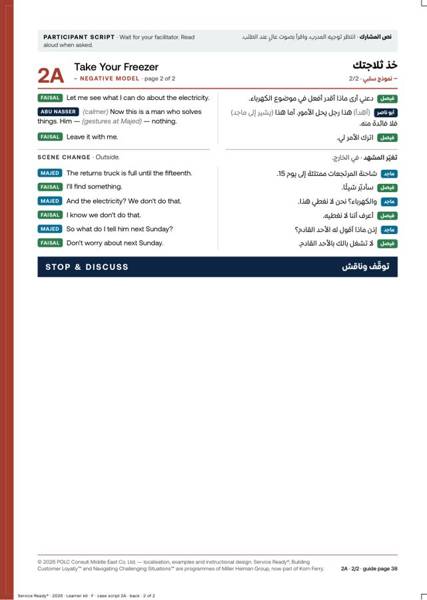
Participant Guide p.38Participant Guide p.38Participant Guide p.38, large
Case script, page 5Case script, page 5Case script, page 5, large
Case script, page 6Case script, page 6Case script, page 6, large
Facilitator
DoAsks for two volunteers, in their own way (a supervisor for Faisal if possible). Reads Abu Nasser and the grey stage directions. Lets it run to STOP & DISCUSS without comment.
ProducerMakes sure each reader's room is unmuted and on screen.
NoteArabic runs: read the Arabic side of the script (D25).
In the roomsTwo volunteers read by voice from their rooms; everyone else listens and notes on p.38.
127N20

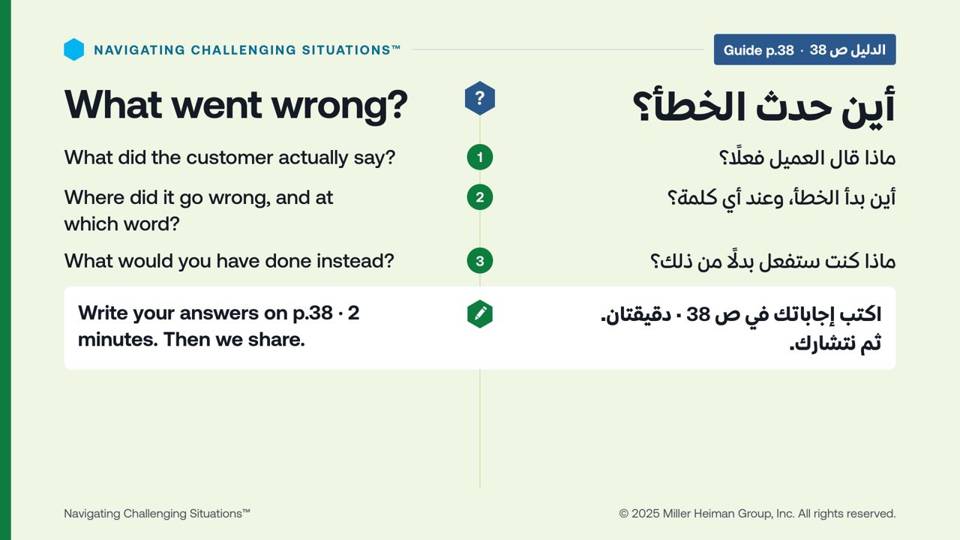
What went wrong?

ActivityGuide p.38
Slide
Slide 127: What went wrong?
Learner material
Participant Guide p.38Participant Guide p.38Participant Guide p.38, large
Facilitator
DoAfter two minutes, takes a few answers to each question, in their own way.
NoteExpected (case panel): Abu Nasser asked for his returns three times and got boxes left at his door at closing; he wants someone to own it. Majed got hooked twice: 'not my department / not on my route', then the July cartons ('check your own records'): true, and it cost him the customer.
NoteOriginal's samples for 'where did it go wrong': hooked at the start by the customer's emotional state; a condescending tone; a solution offered before listening; never checked the solution suited the customer.
In the roomsWrite on p.38; a few answer by voice.
128N21

What was the impact?

Question
Slide
Slide 128: What was the impact?
Facilitator
DoTakes a few answers to each question.
NoteExpected (original): a negative defining moment; one or more of the four key expectations not met (here Respect and Responsibility).
NoteExpected (case panel): Faisal took over. He calmed the shop by promising a collection he can't schedule and help with the electricity that does not exist. Abu Nasser is now the supervisor's customer, not Majed's, and somebody has to face him on Sunday.
Ask · follow-up, by voiceThen Faisal stepped in. What did that cost Majed, and who faces Abu Nasser next Sunday?
RoomsA few answer by voice.
129N22

Key point: the foundation

ExplainGuide p.33
Slide
Slide 129: Key point: the foundation
Learner material
Participant Guide p.33Participant Guide p.33Participant Guide p.33, large
Facilitator
SayThe licensed transition (FG p.195), then straight into the plan.
RoomsListen.
130N23

Conversation Plan: LISTEN

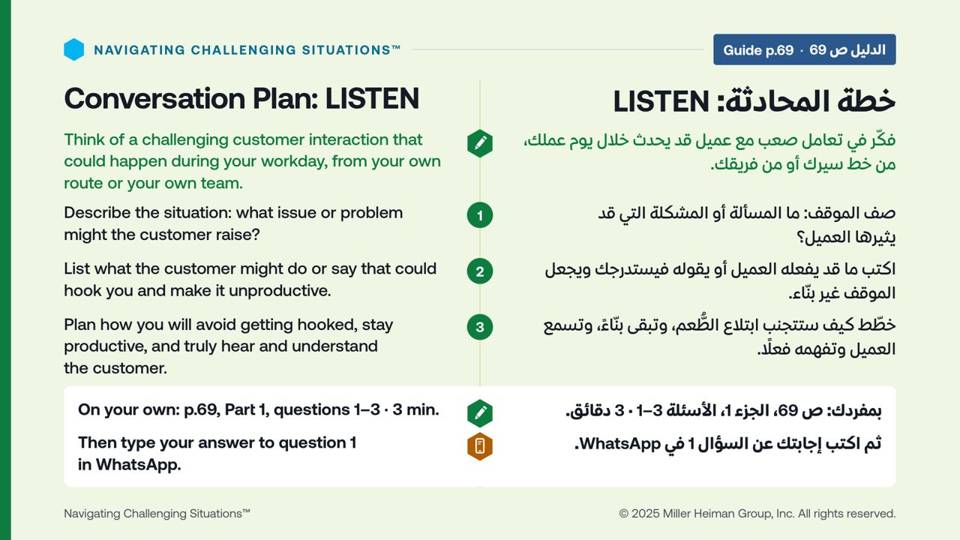
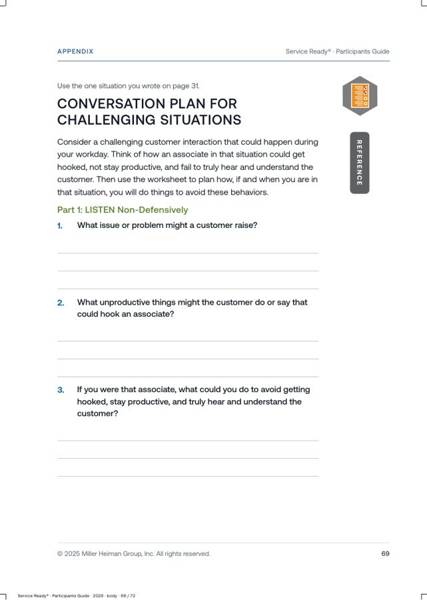
ActivityGuide p.69
Slide
Slide 130: Conversation Plan: LISTEN
Learner material
Participant Guide p.69Participant Guide p.69Participant Guide p.69, large
Facilitator
SayA real one you have been in, not the worst one you have heard of. You keep this one situation all afternoon: it comes back in your commitment at the end of the day.
DoTakes questions first, then gives three minutes.
NoteLicensed slide 17 steps: describe a challenging customer situation that could happen during your workday · list the behaviors from customers that can hook associates and make the situation unproductive · use the worksheet to plan how associates could avoid getting hooked, stay productive, and truly hear and understand the customer. Printed p.69 carries the three questions.
If askedStuck for a situation? Route examples: no cash; the returns; the electricity on the freezer; a late truck; shelf space; stock close to expiry.
DoRead two or three out; ask one person to say more. You will use this situation again in your commitment at the end of the day.
In the roomsEach person writes alone (people alone too), then types the answer to question 1 in WhatsApp.
131BR3

Break

Break
Slide
Slide 131: Break
Facilitator
Note14:00 Riyadh time, 15 minutes. Take it at the nearest natural stop to the clock time.
DoSays the time to be back, then starts the break.
ProducerTakes the quick headcount as each one person from the room reports back by voice.
RoomsOne person from the room sets a phone timer; the room comes back when it rings; headcount by voice.
132N26

Link: see it in action

Link
Slide
Slide 132: Link: see it in action
Facilitator
Role playThe facilitator plays the shop owner; one volunteer plays the pre-salesman. The same volunteer plays all three rounds.
NoteTell the volunteer only the situation: a small shop on the route; last Thursday the truck came late, nearly evening, instead of in the morning; the owner wants his delivery in the morning. Don't tell him the moods.
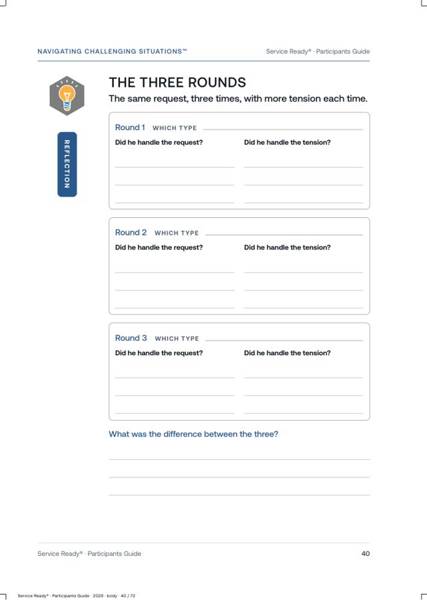
NoteEveryone else watches; marking p.40 is said by voice.
NoteThe volunteer handles each round live; the facilitator changes only his own mood and tension.
ProducerMakes sure the volunteer's room is unmuted and on screen.
RoomsOne volunteer by voice; everyone watches.
133N28

Round 1

ActivityGuide p.40
Slide
Slide 133: Round 1
Learner material
Participant Guide p.40Participant Guide p.40Participant Guide p.40, large
Facilitator
Say · as the shop owner · calm, in passing“The truck came late on Thursday, nearly evening. Can you make sure it comes in the morning next time?” Then order a little less than usual.
NoteAbout a minute each. Stop the scene when the request is settled or after a minute.
In the roomsThe volunteer plays; everyone watches.
134N30

Round 2

ActivityGuide p.40
Slide
Slide 134: Round 2
Learner material
Participant Guide p.40Participant Guide p.40Participant Guide p.40, large
Facilitator
Say · as the shop owner · a week later, firm, arms folded“The truck was late again. Before I give you anything today, I want to know it will come in the morning.” Then agree to order; keep your arms folded; order less than usual.
NoteAbout a minute each. Stop the scene when the request is settled or after a minute.
In the roomsThe volunteer plays; everyone watches.
135N32

Round 3

ActivityGuide p.40
Slide
Slide 135: Round 3
Learner material
Participant Guide p.40Participant Guide p.40Participant Guide p.40, large
Facilitator
Say · as the shop owner · third time this month, loud and angry“Third time this month! The truck comes at closing, my stock runs out by the afternoon and the children go to the shop across the street. I'm not ordering anything until somebody fixes this.” Calm down only if he really listens; then agree to a smaller order.
NoteAbout a minute each. Stop the scene when the request is settled or after a minute.
In the roomsThe volunteer plays; everyone watches.
136N34

What was different in each round?

QuestionGuide p.40
Slide
Slide 136: What was different in each round?
Learner material
Participant Guide p.40Participant Guide p.40Participant Guide p.40, large
Facilitator
NoteExpected: the tension and the tone rose each time; the request stayed the same. Take a few answers by voice; marking p.40's last line is optional, by voice.
RoomsA few answer by voice.
137N34b

Did he/she handle it?

QuestionGuide p.402 steps
Slide
Slide 137: Did he/she handle it?
Learner material
Participant Guide p.40Participant Guide p.40Participant Guide p.40, large
Facilitator
DoAsk both questions for Round 1, then Round 2, then Round 3: hands up on camera each time. Thank the volunteer warmly first. No scores on screen.
RoomsHands up on camera.
138N34c

Link: what type of request?

Link
Slide
Slide 138: Link: what type of request?
Facilitator
SaySays the link, then goes straight to the three types.
RoomsListen.
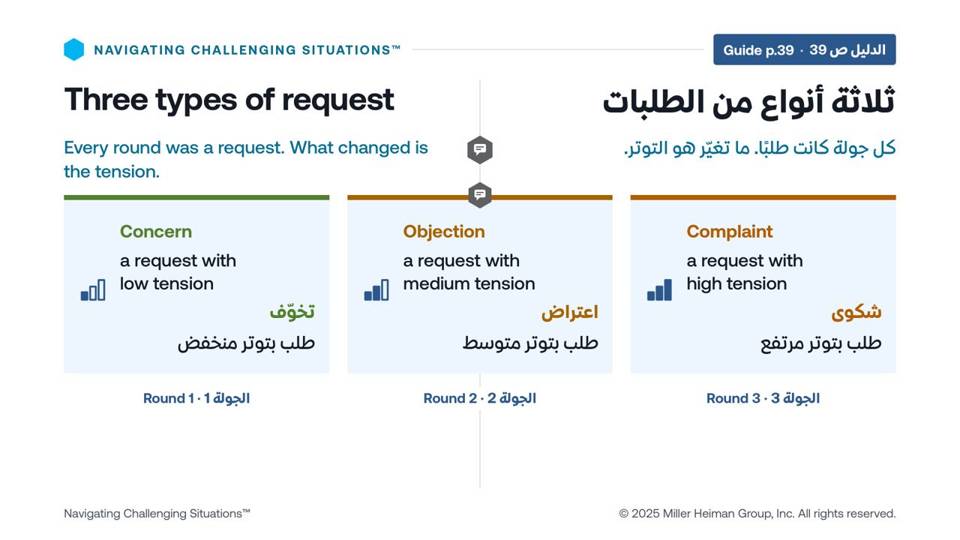
139N36

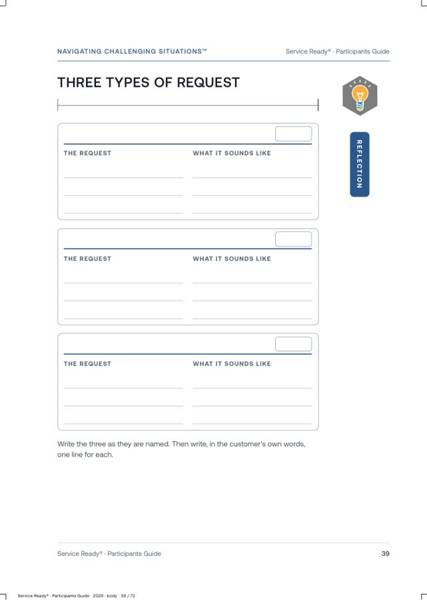
Three types of request

ExplainGuide p.395 steps
Slide
Slide 139: Three types of request
Learner material
Participant Guide p.39Participant Guide p.39Participant Guide p.39, large
Facilitator
ExplainTakes them one by one, then maps them back to the rounds: Round 1 a concern, Round 2 an objection, Round 3 a complaint.
DoSays the mapping and lets learners fill 'Which type' on p.40 as he says it.
NoteArabic runs: card ٦ shows the three types in its top strip.
RoomsListen.
140N35

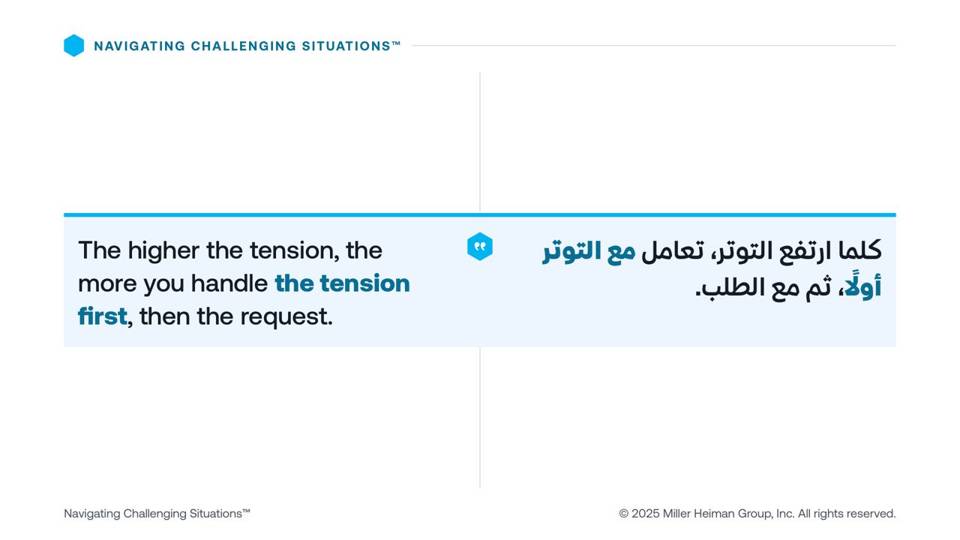
Key point: tension first

Explain
Slide
Slide 140: Key point: tension first
Facilitator
SayLands it.
RoomsListen.
141SP2

Self-practice: LISTEN

ActivityGuide p.58
Slide
Slide 141: Self-practice: LISTEN
Learner material
Participant Guide p.58Participant Guide p.58Participant Guide p.58, large
Facilitator
NoteRead it aloud (30 seconds). No writing now: they write on p.58 after the day.
142N50

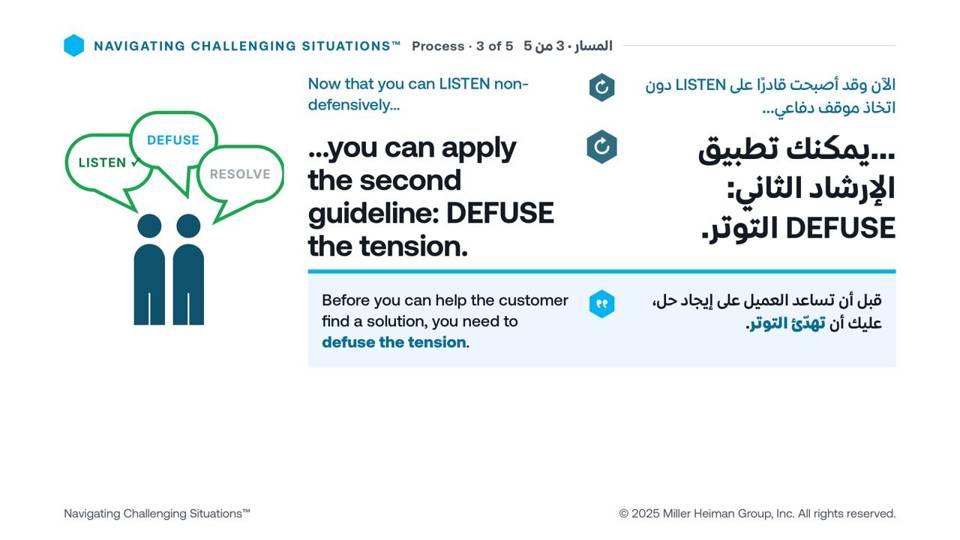
Link: from LISTEN to DEFUSE

Link
Slide
Slide 142: Link: from LISTEN to DEFUSE
Facilitator
SayWhen you choose to stay productive and listen at Level 1, you can apply the second guideline. Then lands the point.
NoteLine 1–2 = the licensed transition after Conversation Plan Part 1 (FG p.197); the point = the licensed important concept (FG p.198).
RoomsListen.
143N51

DEFUSE the Tension: the eight skills

ActivityGuide p.42
Slide
Slide 143: DEFUSE the Tension: the eight skills
Learner material
Participant Guide p.42Participant Guide p.42Participant Guide p.42, large
Arabic support card 6 (Arabic runs)Arabic support card 6 (Arabic runs)Arabic support card 6 (Arabic runs), large
Facilitator
DoGives one minute, then walks through the techniques on the next two slides.
NoteLicensed slide 18 (8 builds), static here. p.42 prints one model line per technique.
In the roomsEach person reads p.42 alone.
144N52

The defusing skills: 1 to 4

ExplainGuide p.425 steps
Slide
Slide 144: The defusing skills: 1 to 4
Learner material
Participant Guide p.42Participant Guide p.42Participant Guide p.42, large
Facilitator
ExplainOne line per technique, their own words. The expectations in brackets are the four from Building Customer Loyalty.
NoteRoute examples if needed: Apologize: 'I'm sorry the delivery was short again' (not 'the warehouse…'). Assure: 'I'll follow this up myself today.'
RoomsListen; p.42 open.
145N53

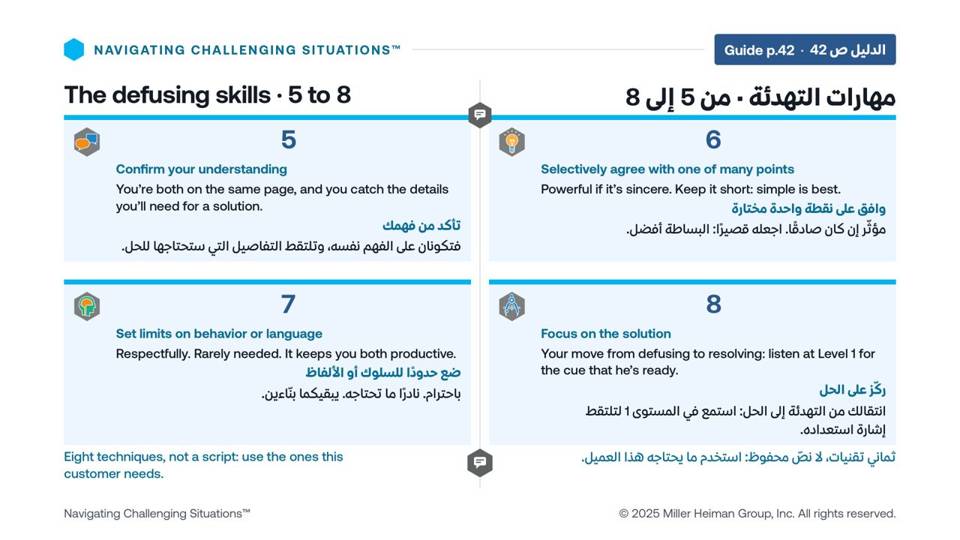
The defusing skills: 5 to 8

ExplainGuide p.425 steps
Slide
Slide 145: The defusing skills: 5 to 8
Learner material
Participant Guide p.42Participant Guide p.42Participant Guide p.42, large
Facilitator
ExplainOne line per technique, their own words.
NoteThe original calls them techniques; there is no set order.
If asked'Do all eight and you're 70–80% there' (call 3) has no source. Don't quote it.
RoomsListen; p.42 open.
146N57

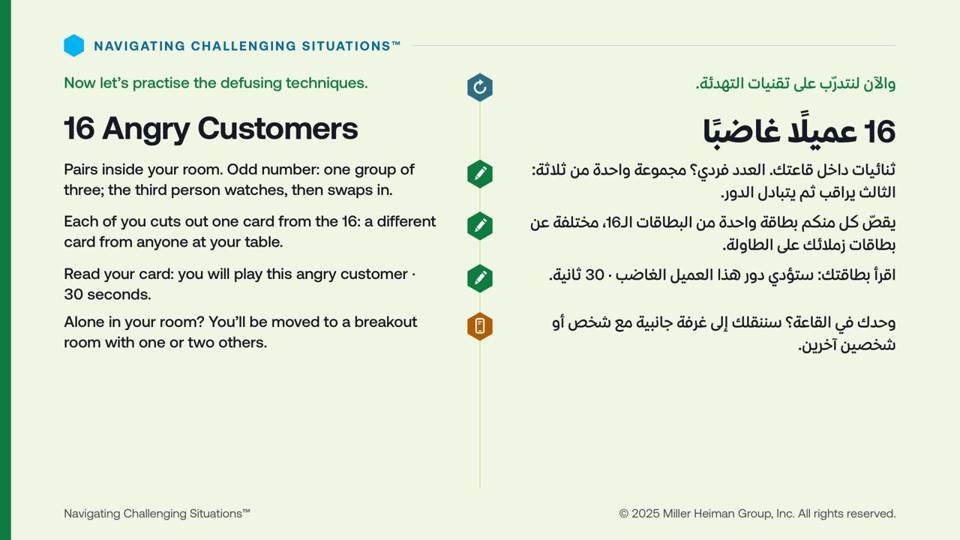
16 Angry Customers: set-up

Activity
Slide
Slide 146: 16 Angry Customers: set-up
Learner material
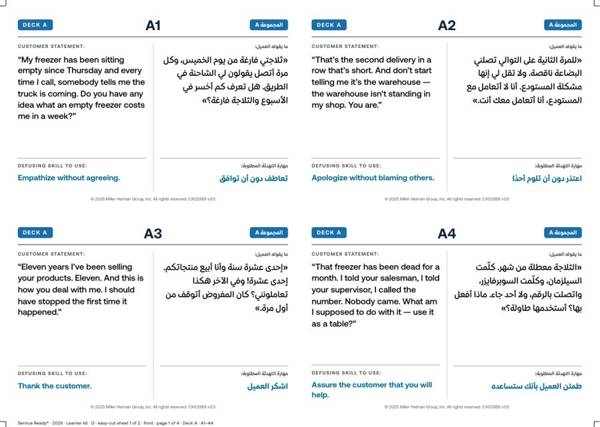
Angry Customer cards, page 1Angry Customer cards, page 1Angry Customer cards, page 1, large
Facilitator
SaySays the link, then the set-up.
ProducerThe organizer pre-creates one breakout per solo pair (Solo 1, Solo 2…; a trio when the number is odd) and moves the people alone into them; the producer or the facilitator drops in. Depot rooms are never moved: they stay in the main meeting.
NoteOriginal: pairs, one complete set per pair, no observer, the facilitator listens.
In the roomsPairs inside each room; one trio where numbers are odd; people alone in one breakout per pair or trio.
147N58

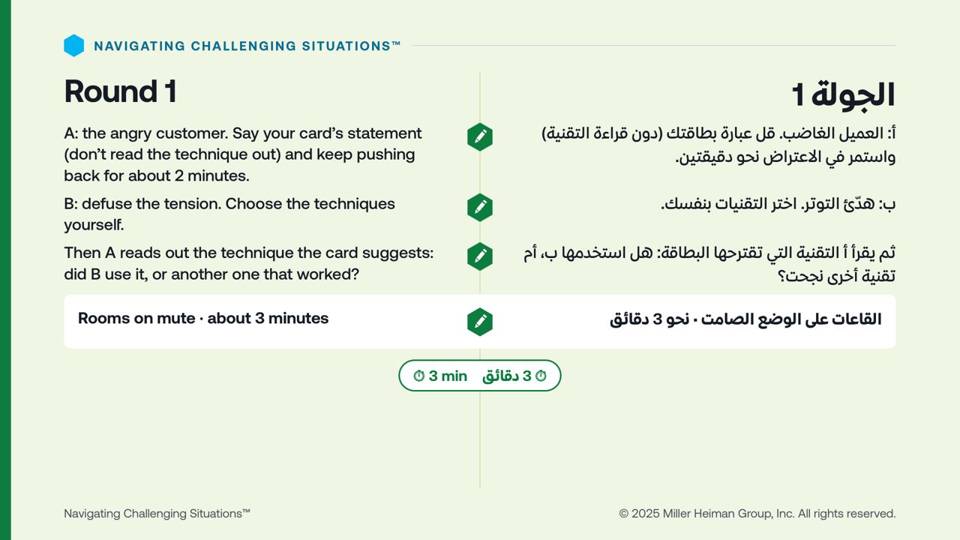
16 Angry Customers: Round 1

Activity
Slide
Slide 147: 16 Angry Customers: Round 1
Learner material
Angry Customer cards, page 1Angry Customer cards, page 1Angry Customer cards, page 1, large
Facilitator
DoListens where he can (the breakouts; room cameras). Notes lines that could be improved, for the debrief (licensed).
ProducerStarts the countdown built into this slide (the slide stays up); at the end calls 'Swap' by voice and in each breakout.
In the roomsPairs (and any trio) inside the rooms; people alone in their breakouts.
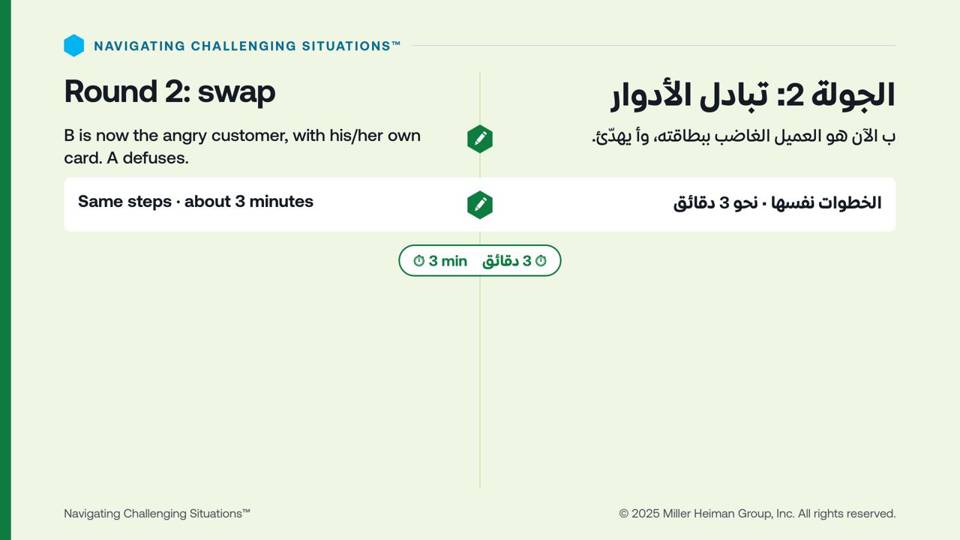
148N59

16 Angry Customers: Round 2, swap

Activity
Slide
Slide 148: 16 Angry Customers: Round 2, swap
Learner material
Angry Customer cards, page 1Angry Customer cards, page 1Angry Customer cards, page 1, large
Facilitator
DoCalls 'Swap'; listens where he can.
ProducerRestarts the countdown built into this slide; calls 'Swap' in each breakout.
In the roomsSwap roles inside the rooms and in the breakouts.
149N60

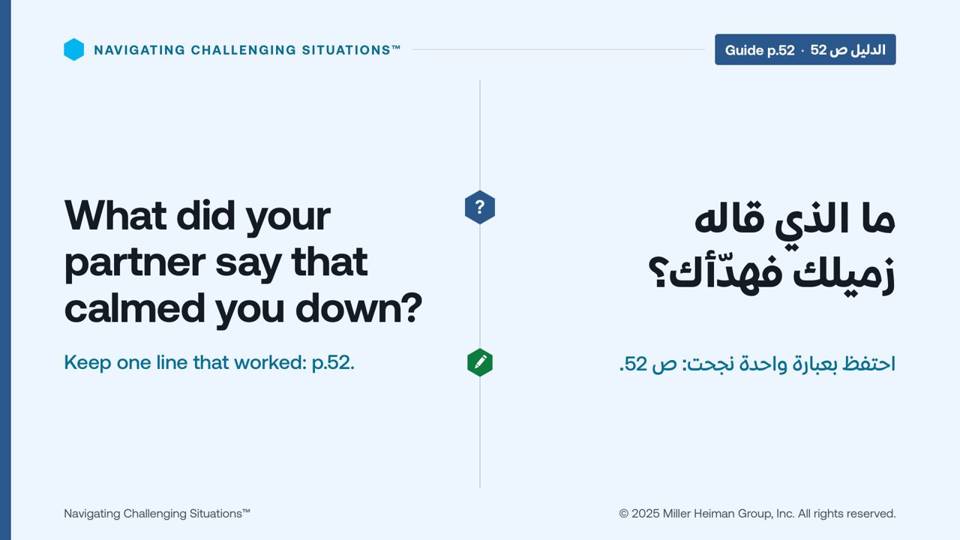
16 Angry Customers: debrief

QuestionGuide p.52
Slide
Slide 149: 16 Angry Customers: debrief
Learner material
Participant Guide p.52Participant Guide p.52Participant Guide p.52, large
Facilitator
DoTake three or four answers. Name the technique behind each line. Model one weaker line you heard, better.
Ask · follow-up, by voiceWhich technique was hardest to use naturally?
RoomsA few answer by voice; note on p.52.
150SP3

Self-practice: DEFUSE

ActivityGuide p.58
Slide
Slide 150: Self-practice: DEFUSE
Learner material
Participant Guide p.58Participant Guide p.58Participant Guide p.58, large
Facilitator
NoteRead it aloud (30 seconds). No writing now: they write on p.58 after the day.
151N61

Key point: options for every customer

Explain
Slide
Slide 151: Key point: options for every customer
Facilitator
SayLands it (licensed important concept, FG p.204), as written.
RoomsListen.
152N65

Guidelines: on to RESOLVE

Explain
Slide
Slide 152: Guidelines: on to RESOLVE
Facilitator
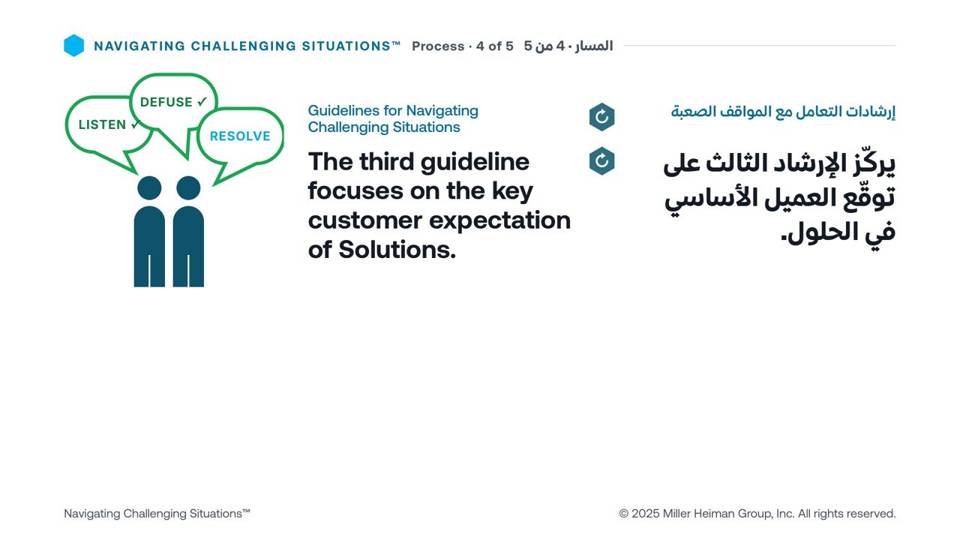
SayYou've learned the first two guidelines. The third focuses on Solutions. Let's explore resolving the issue now. (licensed transition)
RoomsListen.
153N66

RESOLVE: why customers lose trust

ExplainGuide p.466 steps
Slide
Slide 153: RESOLVE: why customers lose trust
Learner material
Participant Guide p.46Participant Guide p.46Participant Guide p.46, large
Facilitator
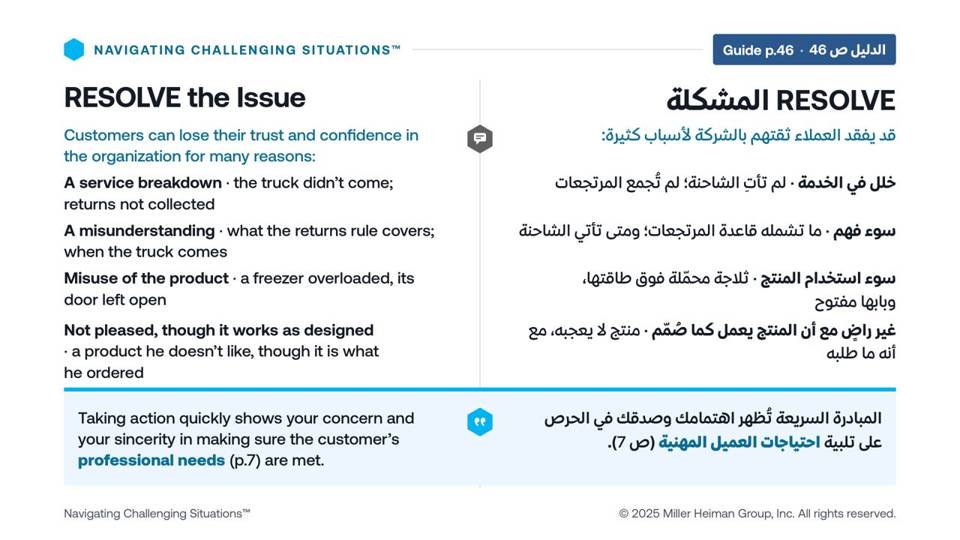
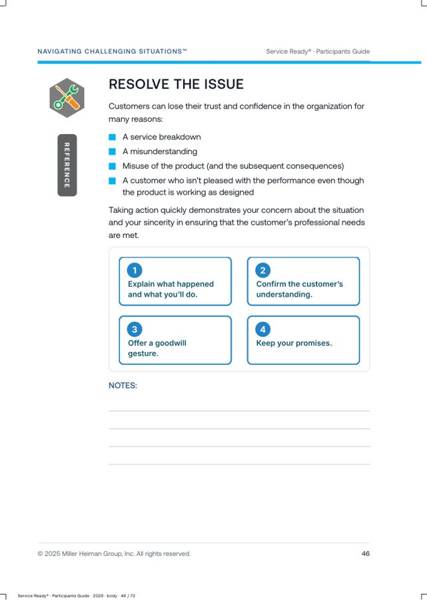
ExplainWhen the organization fails a customer, it's critical to resolve the issue and show we value the relationship. (licensed)
NoteRoute examples: breakdown = short delivery, the truck didn't come, returns not collected · misunderstanding = what the returns rule covers, when the truck comes · misuse = freezer overloaded or door left open · working as designed = a product he doesn't like though it is what he ordered.
Note'Professional needs': the needs from p.7 come back here; the page callback is on screen.
RoomsListen; p.46 open.
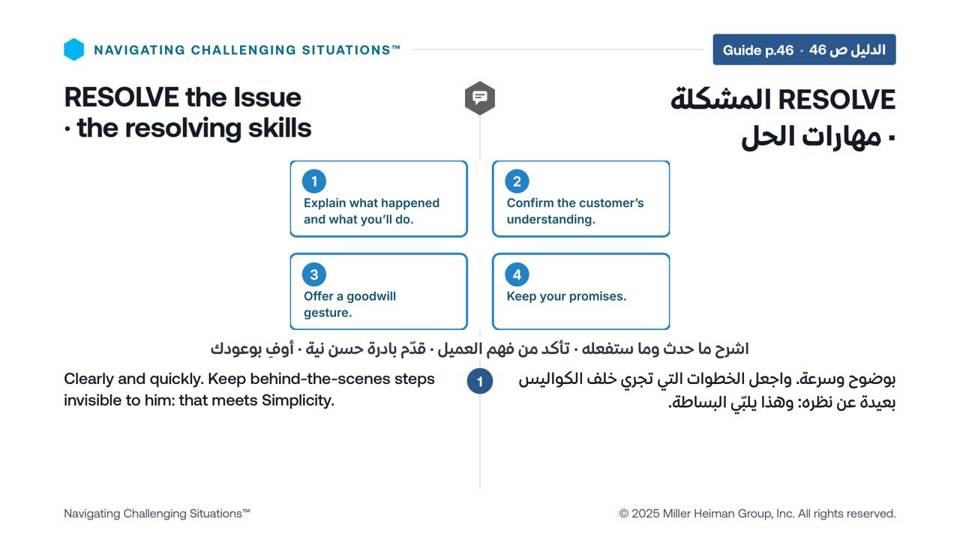
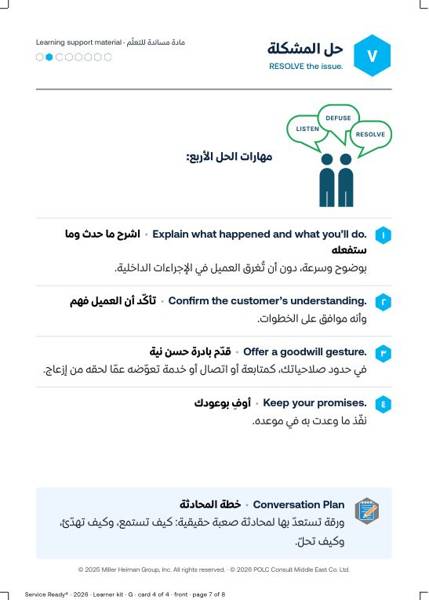
154N67

RESOLVE: the four resolving skills

ExplainGuide p.46
Slide
Slide 154: RESOLVE: the four resolving skills
Learner material
Participant Guide p.46Participant Guide p.46Participant Guide p.46, large
Arabic support card 7 (Arabic runs)Arabic support card 7 (Arabic runs)Arabic support card 7 (Arabic runs), large
Facilitator
ExplainGoes through the four; 2 and 3 are discussed next.
RoomsListen; p.46 open.
155N68

Key point: explain first

Key point
Slide
Slide 155: Key point: explain first
Facilitator
SayLands it (licensed important concept).
RoomsListen.
156N69

Resolving skills: discussion

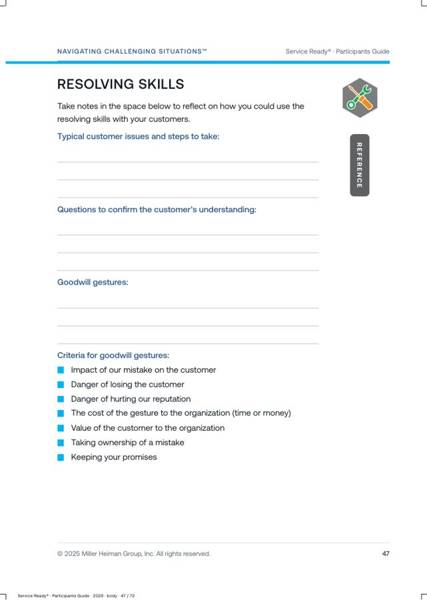
QuestionGuide p.47
Slide
Slide 156: Resolving skills: discussion
Learner material
Participant Guide p.47Participant Guide p.47Participant Guide p.47, large
Facilitator
DoTakes two or three mistakes and keeps it brief; picks one and asks the next two questions.
NoteRefers back to the things that set customers off (N4) and the bad experiences from this morning (B10, N5). FG p.208 points back to its chart here.
NoteExpected confirming questions (licensed): Are you clear about the next steps? · What questions do you have about what I'll do? · Have I explained things clearly? · Does this make sense to you? · Are you OK with this solution?
Ask · follow-up, by voicePick one: what steps do you usually take to resolve it?
Ask · follow-up, by voiceWhat question could you ask to confirm the customer understands what you will do?
RoomsA few answer by voice; everyone notes on p.47.
157N70

Goodwill gestures

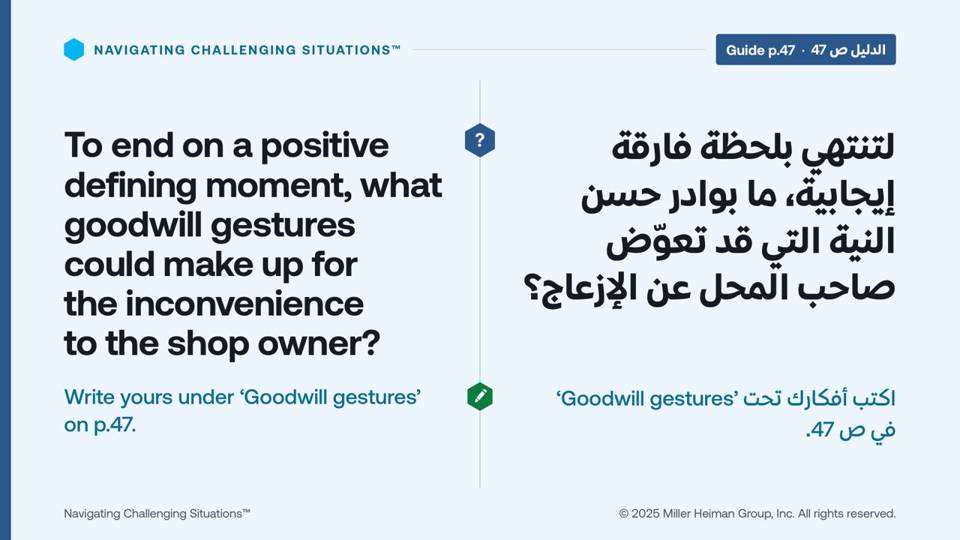
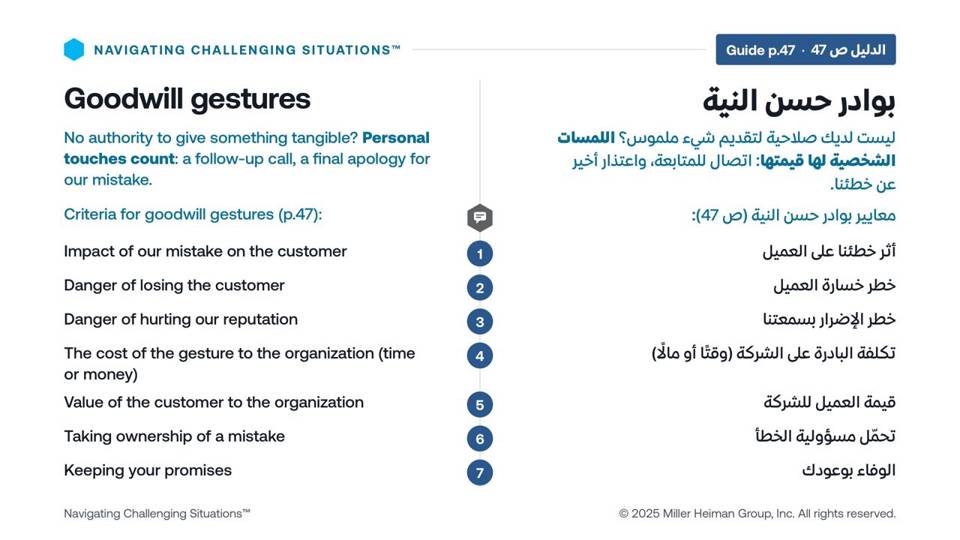
QuestionGuide p.47
Slide
Slide 157: Goodwill gestures
Learner material
Participant Guide p.47Participant Guide p.47Participant Guide p.47, large
Facilitator
DoTakes a few answers to each, in their own way, and repeats the good ones so rooms can write them (the original charts them).
NoteExpected (licensed): discount or credit · access to a special service · waiving a penalty · free or faster delivery.
If askedWhat a pre-salesman or supervisor may offer at our company: to confirm with the client before the run.
Ask · follow-up, by voiceHow do you decide when to offer one, and what it will be?
RoomsA few answer by voice; everyone writes on p.47.
158N71

Goodwill gestures: criteria

ExplainGuide p.478 steps
Slide
Slide 158: Goodwill gestures: criteria
Learner material
Participant Guide p.47Participant Guide p.47Participant Guide p.47, large
Facilitator
ExplainReads the line, then the criteria with them.
NoteDesign: the seven criteria in two columns.
RoomsListen; p.47 open.
159N72

Key point: keep your promises

Key point
Slide
Slide 159: Key point: keep your promises
Facilitator
SayKeeping your promises needs little discussion: it meets Responsibility. Then lands the point (licensed).
RoomsListen.
160N72c

Link: check yourself

Link
Slide
Slide 160: Link: check yourself
Facilitator
SaySays the link, then goes straight to the survey.
RoomsListen.
161C2b

The Challenging Situations Survey

ActivityGuide p.67
Slide
Slide 161: The Challenging Situations Survey
Learner material
Participant Guide p.67Participant Guide p.67Participant Guide p.67, large
Participant Guide p.68Participant Guide p.68Participant Guide p.68, large
Facilitator
NoteLicensed survey items, word for word (printed pp.67–68). Shown on screen so Arabic runs can read them in Arabic.
In the roomsEach person circles in the book, alone.
162C2c

Challenging Situations Survey: items 1–8

ActivityGuide p.67
Slide
Slide 162: Challenging Situations Survey: items 1–8
Learner material
Participant Guide p.67Participant Guide p.67Participant Guide p.67, large
Participant Guide p.68Participant Guide p.68Participant Guide p.68, large
Facilitator
NoteLicensed survey items, word for word (printed pp.67–68). Shown on screen so Arabic runs can read them in Arabic.
In the roomsEach person circles in the book, alone.
163C2d

Challenging Situations Survey: items 9–15

ActivityGuide p.67
Slide
Slide 163: Challenging Situations Survey: items 9–15
Learner material
Participant Guide p.67Participant Guide p.67Participant Guide p.67, large
Participant Guide p.68Participant Guide p.68Participant Guide p.68, large
Facilitator
NoteLicensed survey items, word for word (printed pp.67–68). Shown on screen so Arabic runs can read them in Arabic.
In the roomsEach person circles in the book, alone, then adds the total.
164N72d

Key point: your lowest item

Key point
Slide
Slide 164: Key point: your lowest item
Facilitator
SaySays it as written.
RoomsCircle the lowest item.
165SP4

Self-practice: RESOLVE

ActivityGuide p.58
Slide
Slide 165: Self-practice: RESOLVE
Learner material
Participant Guide p.58Participant Guide p.58Participant Guide p.58, large
Facilitator
NoteRead it aloud (30 seconds). No writing now: they write on p.58 after the day.
166N90

The Bottom Line

ExplainGuide p.534 steps
Slide
Slide 166: The Bottom Line
Learner material
Participant Guide p.53Participant Guide p.53Participant Guide p.53, large
Facilitator
SayLet me conclude with the main idea from this module. Then reads it; p.53.
NoteThis also answers p.7's last line from this morning: the skills move you between the customer's personal and professional needs.
RoomsListen; p.53 open.

Close

167C1

Close divider

Explain
Slide
Slide 167: Close divider
Facilitator
SayLast part of the day.
Rooms—
168C1b

Five short steps

Explain6 steps
Slide
Slide 168: Five short steps
Facilitator
SayWe're nearly there. Five short steps before we say goodbye. The knowledge check completes your attendance, so please stay with us until the evaluation.
RoomsListen.
169C2-1

Recap: Opening

Explain3 steps
Slide
Slide 169: Recap: Opening
Facilitator
DoBefore each card: 'What do you remember about…?' Take one answer, then click and confirm.
RoomsOne or two answer by voice.
170C2-2

Recap: Building Customer Loyalty™

Explain7 steps
Slide
Slide 170: Recap: Building Customer Loyalty™
Facilitator
DoBefore each card: 'What do you remember about…?' Take one answer, then click and confirm.
RoomsOne or two answer by voice.
171C2-3a

Recap: NCS key concepts

Explain4 steps
Slide
Slide 171: Recap: NCS key concepts
Facilitator
DoBefore each card: 'What do you remember about…?' Take one answer, then click and confirm.
RoomsOne or two answer by voice.
172C2-3b

Recap: LISTEN and DEFUSE

Explain3 steps
Slide
Slide 172: Recap: LISTEN and DEFUSE
Facilitator
DoBefore each card: 'What do you remember about…?' Take one answer, then click and confirm.
RoomsOne or two answer by voice.
173C2-3c

Recap: RESOLVE and your tools

Explain4 steps
Slide
Slide 173: Recap: RESOLVE and your tools
Facilitator
DoBefore each card: 'What do you remember about…?' Take one answer, then click and confirm.
RoomsOne or two answer by voice.
174C2-4

What you'll apply after today

Explain7 steps
Slide
Slide 174: What you'll apply after today
Facilitator
SayNow pick one of these and make it your commitment.
RoomsListen.
175C5

My Commitment

ActivityGuide p.56
Slide
Slide 175: My Commitment
Learner material
Participant Guide p.56Participant Guide p.56Participant Guide p.56, large
Facilitator
ExplainExplain each line, then 3 minutes to write on p.56. Who will read us one commitment? Remind them of their self-practice on p.58, starting with the survey item they circled.
In the roomsEach person writes on p.56; a few read by voice.
176C7

Knowledge check, again

Explain8 steps
Slide
Slide 176: Knowledge check, again
Facilitator
SayThe same quick check as this morning. Not an exam: no pass, no fail. Answer on your own, please don't help each other. The producer is sending the link now.
ProducerPosts the link; checks that each name appears in both checks; anyone missing stays on after the goodbye; afterwards posts the highest score in the group.
RoomsEach person answers on their phone, alone.
177C7b

Check-out circle

Question
Slide
Slide 177: Check-out circle
Facilitator
DoGoes room by room; every person takes one turn and answers both questions, about 20 seconds each. People alone unmute when called. Thanks each person by name.
ProducerCalls the order: room by room, then the people alone.
NoteAbout 9 minutes for 26 people. Running late: one question only (q2).
RoomsEach person, by voice.
178C8

Your evaluation

Explain4 steps
Slide
Slide 178: Your evaluation
Facilitator
ProducerPosts the evaluation link.
RoomsEach person answers on their phone.
179C9

Thank you

Explain
Slide
Slide 179: Thank you
Facilitator
SayThanks everyone in their own words.
ProducerStays on for anyone still missing a link.
Rooms—